


Survivors of Italy's devastating earthquake had little to celebrate as Easter Sunday dawned yesterday after many salvaged what they could from their abandoned homes.
On Saturday, rescue workers said no one remained in the missing column as hundreds of the newly homeless, clutching empty bags and suitcases, waited to be escorted to their ruined homes.
Many refugees from the devastated town of L'Aquila voiced fears of looting following several arrests since the quake on Monday that claimed at least 293 lives, as shown by the latest police toll.
Some 600 police officers were patrolling the walled city founded in the 13th century, the capital of the Abruzzo region with a population of some 70,000.
“I want to find our two cats and pick up some clothes,” said Riccardo Copersini as he waited in line. “Anything else would be extra.”
Also in the line was Vincenzo Rizi, an engineering professor at L’Aquila’s university.
“We all need to rebuild our lives,” he said simply.
Engineers meanwhile began assessing the damage to the estimated 10,000 buildings hit by Monday’s earthquake and the European Commission said construction experts will arrive in the region early next week.
“It's really a difficult situation. It will take a long time,” said Gennaro Tornatore, a fire service chief coordinating rescues. “We're trying to get the situation under control. We’ve got 125 firefighters working on it.”
Strong aftershocks continued to jolt the region, where some 40,000 people have lost their homes. Local administration chief Massimiliano Cordeschi said 18,000 people had registered for inspections of their homes so far.
Italy's space agency, comparing satellite radar images taken before and after the earthquake, said on Saturday that the earth in the region of L’Aquila had shifted by up to 15cm.
Italian Prime Minister Silvio Berlusconi was set to attend an Easter mass in L’Aquila yesterday and other masses were planned in the many tent camps set up in and around the city.
Easter Sunday, the most joyous day on the Christian calendar, celebrates the resurrection of Jesus Christ after his crucifixion.
At a mass funeral for the victims on Friday, Vatican Secretary of State Tarcisio Bertone told survivors that Easter Sunday would “once again be a rebirth from the rubble for a people who have already suffered so many times.”
But at one of the tent camps near L'Aquila, 70-year-old Anna Parisse said she was not looking forward to the holiday in the current situation.
“Unfortunately, we're going to have to celebrate Easter here. It's not going to be the same. I want to be at home with my family,” Parisse said.
She also voiced skepticism about Berlusconi's promises of aid, saying: “I don't trust him ... He just says whatever comes into his head.”
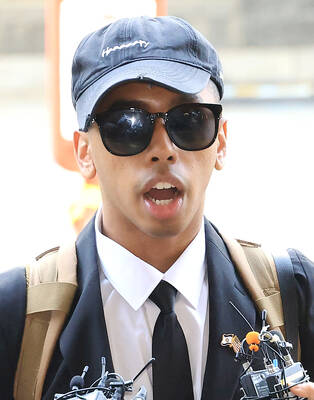
A US YouTuber who caused outrage for filming himself kissing a statue commemorating Korean wartime sex slaves has been sentenced to six months in prison, a court in Seoul said yesterday. Johnny Somali, 25, gained notoriety several years ago for recording himself doing a series of provocative stunts in South Korea and Japan, and streaming them on platforms such as YouTube and Twitch. South Korean authorities indicted Somali — whose real name is Ramsey Khalid Ismael — in 2024 on public order violations and obstruction of business, and banned him from leaving the country. “The court has sentenced him to six months in
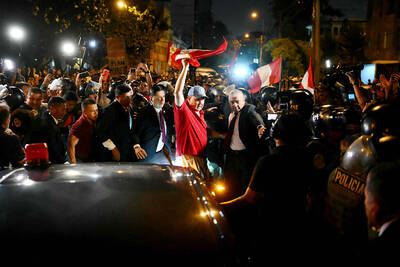
Former Lima mayor Rafael Lopez Aliaga, a Peruvian presidential hopeful, gathered hundreds of supporters in Lima on Tuesday and gave authorities 24 hours to annul the first round of the country’s election over allegations of fraud. Lopez Aliaga is locked in a tight three-way race with two other candidates for second place in Sunday’s vote. The election runner-up wins a ticket to June’s presidential run-off against front-runner Keiko Fujimori. “I am giving them 24 hours to declare this electoral fraud null and void,” said Lopez Aliaga, surrounded by a crowd of several hundred supporters. “If it is not declared null and void tomorrow,

PAPAL RETORT: Pope Leo told reporters that he has ‘no fear, neither of the Trump administration nor speaking out loudly about the message of the Gospel’ US President Donald Trump has feuded with Pope Leo XIV over the Iran conflict — setting off an unholy row that could have serious political implications for the Republican leader back in the US. Trump has drawn barbs even from some allies over the attacks on the US-born pontiff, who has criticized the Trump administration over its immigration crackdown, the intervention in Venezuela and the Iran war. The president risks alienating the religious right in November’s crucial US midterm elections. So far the unprecedented clash between the leader of the most powerful military on Earth and the head of the world’s 1.4 billion

A 16-year-old boy has been charged with murder and aggravated sexual abuse in Florida in the death of his 18-year-old stepsister on a Carnival Cruise ship, the US Department of Justice said on Monday. Timothy Hudson was initially charged in February and subsequently indicted on March 10, but the breadth of the case was not known until a seal was lifted on Friday last week, weeks after US District Judge Beth Bloom in Miami said that he would be prosecuted as an adult at the request of the government. Anna Kepner had been traveling on the Carnival Horizon ship in November last


 RSS
RSS