

A Hong Kong journalist was under fire in the Philippines yesterday for calling the Southeast Asian country a “nation of servants” in a column about disputed areas in the South China Sea.
In his Friday column for HK Magazine titled “The War At Home,” Chip Tsao denounced the Philippines’ claims to the Spratly Islands, which are also claimed in whole or in part by China, Vietnam, Taiwan, Brunei and Malaysia.
“As a nation of servants, you don’t flex your muscles at your master, from where you earn most of your bread and butter,” he said.
Tsao said he gave his Philippine maid a “harsh lecture” on the issue and “sternly warned her that if she wants her wages increased next year, she had better tell every one of her compatriots … that the entirety of the Spratly Islands belongs to China.”
The magazine said Tsao is a best-selling author and columnist. He is a former reporter for the BBC.
The Blas F Ople Policy Center, a Manila-based non-governmental organization providing assistance to migrant workers, called on the Philippine labor department to blacklist Tsao as an “undesirable foreign employer.”
Susan Ople, the center’s chairwoman, said Tsao should not use his Philippine maid as a “pawn” in the dispute over the Spratly Islands.
“The household is not the place to resolve multiple claims to the Spratly Islands, and Philippine domestic workers should not suffer because of it,” she said.
Ople added that Tsao’s maid “deserves a sane and more humane employer while he deserves to clean up his own filth.”
Congresswoman Risa Hontiveros Baraquel, a representative of a left-wing party, condemned the column and lamented that Tsao’s “disgusting, derogatory and vile remark can only come from dim-witted and mediocre writing.”
“The article reflects the attitude that promotes intolerance and abuse against Philippine domestic workers,” she said.
On the magazine’s Web site, Tsao has received numerous negative comments.
“There is a point where irony done in very poor taste becomes not humorous, but crass, bigoted and stupid,” one commenter said.

A Chinese artificial intelligence (AI) cybersecurity tool called ARTEX was used in a spate of recent hacks of Japanese companies, the subsidiary of a major Tokyo-based Internet company yesterday. Dozens of Japanese companies, from restaurant chains to a car hire operator, have disclosed unauthorized access or data breaches in the past weeks — potentially impacting millions of customers. The information security arm of GMO Internet Group said it had “confirmed ARTEX was used” having investigated the attacks in collaboration with external organizations. “It also became clear ... the attacks were almost exclusively targeting Japan,” GMO cybersecurity center director Daiki Fukumori

On his terrace overlooking the forest in eastern Pennsylvania, Ed Negra lays out four letters. All are from a developer promising a US$10,000 check to each household once its data center is running. “I call it a bribe,” the US retiree said. The scene is picture-perfect. Autumn leaves are turning russet, and there is a stunning mountain view in this corner of Pennsylvania, a key state in the US’ upcoming midterm elections. “We thought it was a beautiful place to retire,” said the septuagenarian, who used to manage a large building-supply store in neighboring New Jersey. He and his wife settled in a sprawling

A 16-year-old on Thursday shot his way through locked doors to get into an elementary school in Bend, Oregon, killing three children and a teacher. He was then shot by a person at the scene who followed him inside, authorities said. The suspect was found dead inside the school minutes after the shooting was first reported, Bend Police Chief Mike Krantz said. The three children killed were aged 5, 8 and 11. Another child, 7, and a teacher, 54, were injured and taken to the hospital in critical condition, he said. The first 911 call came just before 1pm from a person in
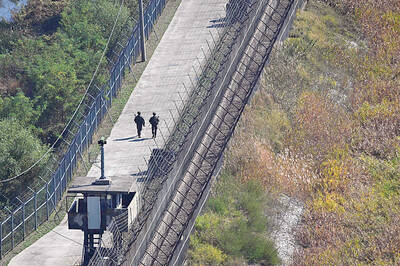
A STEP UP: The moving of small military positions forward should be taken seriously amid the North’s recent demonstrations of its firepower, an analyst said North Korea has moved new units into “firing positions,” the sister of leader Kim Jong-un said yesterday, days after Pyongyang warned it was considering deploying additional strike means to its border with South Korea. Tensions between Seoul and Pyongyang have soared since the South last month blamed an explosion inside the heavily fortified demilitarized zone (DMZ) separating the two countries on landmines laid by North Korea, an accusation it has rejected. “Our military leadership underlined the need to make those rogues aware that our new firepower units have taken their firing positions,” state media cited Kim Yo-jong as saying. Her statement came a


 RSS
RSS