


Environmental groups on Saturday condemned Canada’s decision to boost its annual quota for seal hunting, warning that with an expected European ban on any seal products the increase makes little sense.
On Friday, the Canadian government authorized the hike in seal killing to 280,000 on the Atlantic seaboard, amounting to around one-third of the number killed annually worldwide.
The figure is up 5,000 from a year earlier and up 10,000 from 2007. The new quota is still 55,000 less than in 2006.
“This quota flies in the face of the best available science and common sense,” said Rebecca Aldworth, director of the Canadian branch of the Humane Society.
“The last time Canada allowed this many seals to be killed, the harp seal population was reduced by as much as two-thirds within a decade,” she said in a statement.
European animal rights group Equanimal says more than 40 percent of the seals killed last year were still alive when they were skinned.
Equanimal has said it wants to pressure the European Parliament on the issue, as it is due to decide next month whether to impose a complete ban on seal products in the 27-member bloc.
The new quota for the “dangerous, dead-end industry” that is the seal hunt is “completely indefensible,” said Sheryl Fink, senior researcher at the International Fund for Animal Welfare.
“It’s not supported by markets, it’s not supported by the DFO’s [Department of Fisheries and Oceans] own management plan and it’s certainly not going to be supported by the majority of Canadians,” she said.
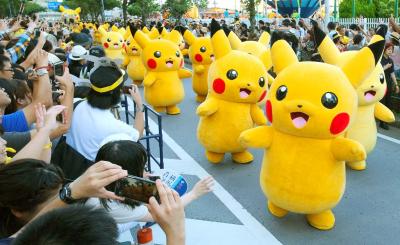
China’s military news agency yesterday warned that Japanese militarism is infiltrating society through series such as Pokemon and Detective Conan, after recent controversies involving events at sensitive sites. In recent days, anime conventions throughout China have reportedly banned participants from dressing as characters from Pokemon or Detective Conan and prohibited sales of related products. China Military Online yesterday posted an article titled “Their schemes — beware the infiltration of Japanese militarism in culture and sports.” The article referenced recent controversies around the popular anime series Pokemon, Detective Conan and My Hero Academia, saying that “the evil influence of Japanese militarism lives on in

DIPLOMATIC THAW: The Canadian prime minister’s China visit and improved Beijing-Ottawa ties raised lawyer Zhang Dongshuo’s hopes for a positive outcome in the retrial China has overturned the death sentence of Canadian Robert Schellenberg, a Canadian official said on Friday, in a possible sign of a diplomatic thaw as Canadian Prime Minister Mark Carney seeks to boost trade ties with Beijing. Schellenberg’s lawyer, Zhang Dongshuo (張東碩), yesterday confirmed China’s Supreme People’s Court struck down the sentence. Schellenberg was detained on drug charges in 2014 before China-Canada ties nosedived following the 2018 arrest in Vancouver of Huawei chief financial officer Meng Wanzhou (孟晚舟). That arrest infuriated Beijing, which detained two Canadians — Michael Spavor and Michael Kovrig — on espionage charges that Ottawa condemned as retaliatory. In January

A sign hanging from a rusty ice-green shipping container installed by Thai forces on what they say is the border with Cambodia reads: “Cambodian citizens are strictly prohibited from entering this area.” On opposite sides of the makeshift barricade, fronted by coils of barbed wire, Cambodians lamented their lost homes and livelihoods as Thailand’s military showed off its gains. Thai forces took control of several patches of disputed land along the border during fighting last year, which could amount to several square kilometers in total. Cambodian Kim Ren said her house in Chouk Chey used to stand on what is now the Thai

NEW RULES: There would be fewer school days, four-day workweeks, and a reduction in transportation services as the country battles a crisis exacerbated by US pressure The Cuban government on Friday announced emergency measures to address a crippling energy crisis worsened by US sanctions, including the adoption of a four-day work week for state-owned companies and fuel sale restrictions. Cuban Deputy Prime Minister Oscar Perez-Oliva Fraga blamed Washington for the crisis, telling Cuban television the government would “implement a series of decisions, first and foremost to guarantee the vitality of our country and essential services, without giving up on development.” “Fuel will be used to protect essential services for the population and indispensable economic activities,” he said. Among the new measures are the reduction of the working week in


 RSS
RSS