


The fossilized remains of two pregnant fish indicate that sex as we know it — fertilization of eggs inside a female — took place as much as 30 million years earlier than previously thought, researchers said on Thursday.
Scientists from Australia and Britain studying 380 million-year-old fossils of the armored placoderm fish, or Incisoscutum richiei, said they were initially confused when they realized that the two fish were carrying embryos. They originally thought the fish laid their eggs before fertilization.
“Once we found embryos in this group, we knew they had internal fertilization. But how the hell are they doing it?” said John Long, the head of sciences at the Museum Victoria in Melbourne who wrote a paper on the discovery that appeared in Thursday’s issue of the journal Nature.
The answer came when the scientists re-examined the pelvis of the male placoderm, armed with the new information about fertilization.
After looking at specimens at the Natural History Museum in London and the Museum Victoria, they realized the pelvis had a fin not seen on the female fish and surmised it was likely used to grip its mate during fertilization, much as sharks do.
“These fish have an extra large bone that attaches to the pelvic bone,” he said. “It had been overlooked and hadn’t been identified. So in a nutshell, we have reinterpreted the structure of the pelvic bone in these placoderms to show they had a method for copulation.”
Zerina Johanson, a paleontologist at the Natural History Museum who also took part in the study along with the University of Western Australia’s Kate Trinajstic, said findings of internal fertilization showed that “sex started a lot sooner than we thought.”
“We expected these early fish would show a more primitive type of reproduction, where sperm and eggs combine in the water and embryos develop outside fish,” Johanson said in a statement.
Per Ahlberg, a professor of evolutionary organismal biology at Uppsala University in Sweden who did not take part in the study, said the discovery “may prove to have far-reaching implications for our understanding of early vertebrate evolution.”
“Every once in a while, a discovery comes along that puts our biological understanding of some extinct group of organism on much firmer footing,” Ahlberg wrote in Nature. “Long and colleagues present such a discovery.”
Long first became enamored with the reproductive skills of this ancient fish last year, when his team identified the first placoderm containing embryos at the Gogo dig site in Western Australia.
The 380 million year old fossils were hailed as one of the most important discoveries in Australia and the fossil represents the world’s oldest known vertebrate mother. The site, which Long has worked since 1986, is believed to have once been the home of an ancient tropical reef that would have rivaled the Great Barrier Reef.

Through the noise of rushing papers and whirring belts at a print factory in Kyoto, two creators watch their photo essay come to life in broadsheet form — part of an effort to win new audiences in the age of artificial intelligence (AI). Despite the decline of the publishing industry, self-publication and handmade “zine” magazines are growing in popularity in Japan, reflecting the nation’s enduring love of paper in the digital era. While speaking to Agence France-Presse at the plant, his hands black with ink, one of the creators, Kazuma Obara, said: “I think [paper] is a medium that engages all five
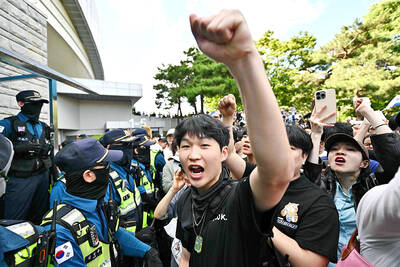
‘ABSURD MISTAKE’: The election commission said that there had been a failure to anticipate turnout after 14 polling stations ran short of ballot papers South Korean riot police yesterday cleared protesters from a Seoul polling station after a 35-hour blockade sparked by a shortage of ballot papers during local elections earlier this week. Wednesday’s election was the first nationwide vote since South Korean President Lee Jae-myung took office following the ouster of Yoon Suk-yeol over his short-lived martial law declaration. Lee’s ruling Democratic Party swept most races, but failed to flip the crucial Seoul mayoral seat. The South Korean National Election Commission apologized, blaming a failure to anticipate turnout after 14 polling stations in Seoul ran short of ballot papers. Some polling stations stayed open until 10pm to

Australian researchers have trained lab-grown brain cells on a silicon computer chip to play the 1990s shooter game Doom and said they are just scratching the surface of what the neurons could be capable of doing. It is the science-fiction work of biotech boffins at Cortical Labs, who researched and developed the technology that harnesses the workings of the brain’s networking system. Each so-called “biological computer” contains about 200,000 living human brain cells, grown from stem cells that were harvested from blood donations. Having mastered the simple computer game Pong, where a paddle is moved up and down to send a ball

France experienced its hottest spring on record, the French weather service said on Tuesday, after an exceptional early heat wave that also broke highs for the season in England and Wales. Meteo-France said the average nationwide temperature over March to May was 13.8°C — about 1.7°C above the norm, and surpassing records set in 2011 and 2020. “The warmest spring since records began in 1900,” it said in a bulletin. All three months were warmer than average, but the onset of an “unprecedented heatwave” late last month pushed the mercury to highs typically seen at the height of the summer. “Our country had never


 RSS
RSS