


A seasoned campaigner for high political office, US Secretary of State Hillary Clinton worked the crowds in Asia on her maiden tour in office, making good on a promise to reach out to the world.
And though she is a tough competitor who narrowly lost the race for the US presidency last year, Clinton proved a hit with many when she showed her softer side.
Appearing at a university campus in Tokyo, she charmed and inspired her audience with self-deprecating jokes about her roller-coaster public life and lofty talk about the planet’s future.
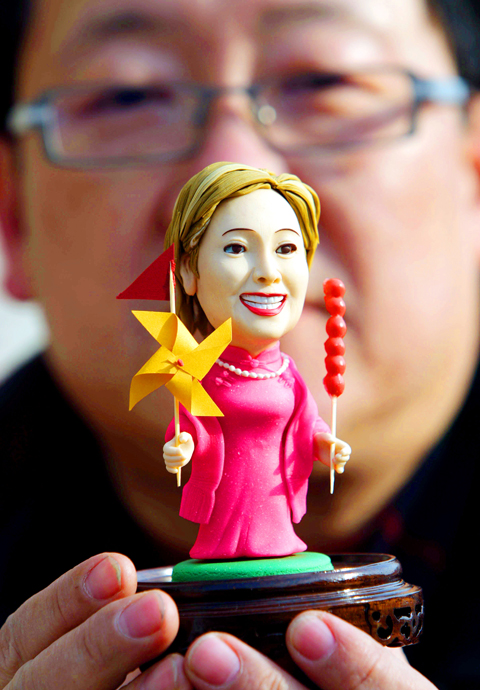
PHOTO: AFP
In Jakarta, she poked fun at her music tastes on a popular TV show and mixed with smiling and cheering crowds in a slum benefiting from US aid projects.
Clinton moved an audience of 2,000 at Ewha University in Seoul, the largest women’s college in the world, becoming deeply personal at one point when she spoke of her love for her husband.
In Beijing, she spoke humbly about past US environmental mistakes when she visited a clean-energy plant to highlight the need for international cooperation in fighting climate change.
Less hard-edged than she often appeared to be during the presidential campaign, the 61-year-old has basked in the glow of warm contact with private citizens and public officials alike.
Upon meeting Clinton, one of China’s top officials, Dai Bingguo (戴秉國), said: “And you look younger and more beautiful than you look on TV.”
She reddened, before replying: “Well, we will get along very well.”
Clinton has signaled she plans to meet as many people as she can, both inside and outside government, in her role as the top US diplomat.
She has said the new administration of US President Barack Obama is looking to balance military might with the “soft” power of diplomacy and development — a combination the Obama administration has called “smart power.”
Her approach so far has stood in contrast to that of her predecessor, Condoleezza Rice, an academic whose public persona on overseas trips was more reserved.
She says she wants to repair the damage to the image of the US abroad after eight years under former US president George W. Bush, although she does not mention the former president by name.
“I really believe that it’s that kind of outreach that we have to do everywhere ... there’s a real hunger for the United States to be present again,” Clinton told reporters traveling on her Asian tour.
“People still really want to like America and they want to know what we’re doing,” she said.
In Indonesia, she connected with a population fascinated by Obama, who spent four years of his childhood in Jakarta.
On popular television show Dahsyat, Clinton caused a stir among the young guests when she started off with: “I was just speaking to President Obama.”
Members of the audience, their eyes lighting up and voices rising with excitement at the comment, later wanted to know her tastes in music.
When she replied that she likes “old standbys” by the Beatles and the Rolling Stones, the audience applauded and cheered.
“I don’t feel so old,” she gushed.
She also complimented her audience by pointing out how Indonesia had changed over the years to become a place where “democracy, Islam and modernity” thrive.
It was a clear indication of how the new administration wants to promote Indonesia as a model for other Muslim countries with which Obama seeks a “new way forward” based on mutual interests and respect.
Clinton also spoke about the “struggle” against terrorism, discarding the “war on terror” language used by the Bush administration.
In Tokyo, she used a visit to a Shinto shrine to promote the Obama administration’s push for more “balance and harmony” in US foreign policy.
She also drew praise by promoting women’s rights on the tour.
During a meeting with Chinese women’s activists, one said: “I personally think you are a wonderful representative of the best women on this earth.”

‘CROSSING THE LINE’: China’s embassy in Seoul criticized US Forces Korea Commander General Xavier Brunson, asking if his ‘hostile’ remarks were authorized by Washington South Korea and the US are in talks over recent public remarks by the commander of US Forces Korea, Seoul’s presidential office said yesterday, after the comments drew sharp criticism from China. In a recent podcast interview, US Forces Korea Commander General Xavier Brunson described South Korea as “the dagger in the heart of Asia” from China’s east coast, prompting the Chinese embassy in Seoul to say that he had “truly crossed the line.” The interview came amid growing speculation that Washington might seek to expand the role of US Forces Korea in countering the growing regional influence of China, a key

Through the noise of rushing papers and whirring belts at a print factory in Kyoto, two creators watch their photo essay come to life in broadsheet form — part of an effort to win new audiences in the age of artificial intelligence (AI). Despite the decline of the publishing industry, self-publication and handmade “zine” magazines are growing in popularity in Japan, reflecting the nation’s enduring love of paper in the digital era. While speaking to Agence France-Presse at the plant, his hands black with ink, one of the creators, Kazuma Obara, said: “I think [paper] is a medium that engages all five

Australian researchers have trained lab-grown brain cells on a silicon computer chip to play the 1990s shooter game Doom and said they are just scratching the surface of what the neurons could be capable of doing. It is the science-fiction work of biotech boffins at Cortical Labs, who researched and developed the technology that harnesses the workings of the brain’s networking system. Each so-called “biological computer” contains about 200,000 living human brain cells, grown from stem cells that were harvested from blood donations. Having mastered the simple computer game Pong, where a paddle is moved up and down to send a ball

France experienced its hottest spring on record, the French weather service said on Tuesday, after an exceptional early heat wave that also broke highs for the season in England and Wales. Meteo-France said the average nationwide temperature over March to May was 13.8°C — about 1.7°C above the norm, and surpassing records set in 2011 and 2020. “The warmest spring since records began in 1900,” it said in a bulletin. All three months were warmer than average, but the onset of an “unprecedented heatwave” late last month pushed the mercury to highs typically seen at the height of the summer. “Our country had never


 RSS
RSS