


Soldiers, police, prisoners and displaced people began early voting yesterday ahead of Saturday’s provincial election in Iraq, which will determine the political landscape across the country as US forces withdraw.
Iraqis held in detention were also expected to take part in the early voting.
US and Iraqi authorities hoped the election would open the political process to more groups and further erode support for extremist networks.
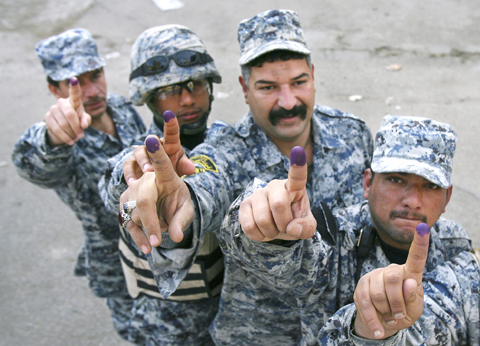
PHOTO: AP
In the Shiiite south, Iraqi Prime Minister Nouri al-Maliki is hoping to win support in provinces long dominated by large rival parties. In other parts of the country, Sunni Arabs, many of whom boycotted the last provincial poll, are seeking a bigger share of provincial power.
The early round of special voting was called to ensure that soldiers and police can all be on duty for a massive security operation during the main election on Saturday, when vehicles will be banned from the streets.
“This is our challenge to every terrorist and to everyone opposed,” soldier Abed Khalaf said at a polling station in the northern city of Kirkuk, where the main poll has been delayed indefinitely but troops from other parts of Iraq can vote.
“We came here today and we are not afraid, because an honest person should not hide his head from these groups,” he said.
The commander in the area, Lieutenant Colonel Khalil Kamal al-Zobaie, said his men were happy to be voting: “This day is like a wedding for all the army.”
In other parts of Iraq there were some signs of confusion.
At the Maqal Prison in the city of Basra, fights broke out between guards and reporters brought inside to film the voting. Several photographers were beaten by guards who accused them of taking pictures that showed prisoners’ faces.
Tens of thousands of displaced people were also registered for early voting, although they make up only a fraction of up to 4 million Iraqis believed to have fled abroad or to other parts of Iraq during years of fighting.
Holding a successful election is an important test of the ability of Iraqi troops to keep the peace as 140,000 US troops begin to leave. US President Barack Obama wants to speed up the pace of withdrawal after his predecessor George W. Bush promised to pull out the troops by the end of 2011.
Iraqis have embraced the voting enthusiastically. Some 14,400 candidates, including nearly 4,000 women, have registered to fight 440 provincial council seats. Campaign posters are plastered all over the concrete blast walls that have sprung up throughout the country since the US-led invasion in 2003.
The election campaign so far has not seen a surge in violence feared by US and Iraqi commanders. At least two candidates were assassinated, but overall attacks have remained at among the lowest levels since the war began.

SPEAKING OUT: After Siranudh Scott’s allegations surfaced, celebrities and public figures took to social media to share their own experiences of sexual misconduct and abuse A high-profile alleged sexual abuse case within a wealthy Thai beer brewing family has prompted a wave of painful accounts from survivors of unconnected abuse in the conservative nation. Siranudh Scott, a member of the billionaire Thai family that founded the ubiquitous Singha beer brand, posted an emotional video this month accusing his elder brother Sunit of repeatedly abusing him when he was a teenager. Sunit, who is in his 30s, later denied the allegations in a video posted online, but Singha parent Boonrawd dismissed him from his executive role with the company on Tuesday last week. “I felt I needed to speak

‘CROSSING THE LINE’: China’s embassy in Seoul criticized US Forces Korea Commander General Xavier Brunson, asking if his ‘hostile’ remarks were authorized by Washington South Korea and the US are in talks over recent public remarks by the commander of US Forces Korea, Seoul’s presidential office said yesterday, after the comments drew sharp criticism from China. In a recent podcast interview, US Forces Korea Commander General Xavier Brunson described South Korea as “the dagger in the heart of Asia” from China’s east coast, prompting the Chinese embassy in Seoul to say that he had “truly crossed the line.” The interview came amid growing speculation that Washington might seek to expand the role of US Forces Korea in countering the growing regional influence of China, a key

SEEKING ORDER: Rodrigo Paz said that ‘anyone who wants to destroy the nation will have to deal with this president and the full force of the constitution’ Bolivian President Rodrigo Paz on Wednesday said that the nation was at a “breaking point” after nearly a month of protests that have caused shortages of food, fuel and medicine. Paz, who took office six months ago amid the worst economic crisis there in four decades, is battling a groundswell of fury over his policies. The political capital, La Paz, has been besieged by low-income workers and members of the indigenous majority calling for his resignation. “The country needs order and is reaching breaking point,” the 58-year-old said at a public event in La Paz, renewing his appeal for dialogue. On Tuesday, the Bolivian

Forecasters in Europe yesterday warned of exceptional heat as record temperatures driven by a “heat dome” push temperatures well above seasonal norms across the continent. The surge follows a record-breaking Monday, with France logging its hottest day in the month of May on record, its weather agency said, and the UK also posting unprecedented highs. A so-called “heat dome” of warm air from northern Africa trapped under a high-pressure system over western Europe is behind the high temperatures not usually seen until high summer. Restrictions on outdoor work were imposed in parts of Italy, beaches in southwest France filled earlier than usual and


 RSS
RSS