


Roman Catholic leaders have pounced on a “confession” by one of the inventors of the birth control pill who has said the contraceptive he helped create was responsible for a “demographic catastrophe.”
In an article published by the Vatican this week, the head of the world’s Roman Catholic doctors broadened the attack on the pill, claiming it had also brought “devastating ecological effects” by releasing into the environment “tonnes of hormones” that had impaired male fertility.
The assault began with a personal commentary in the Austrian newspaper Der Standard by 85-year-old Carl Djerassi. The Austrian chemist was one of three whose formulation of the synthetic progestogen Norethisterone marked a key step toward the earliest oral contraceptive pill.
Djerassi outlined the “horror scenario” that occurred because of the population imbalance, for which his invention was partly to blame. He said that in most of Europe there was now “no connection at all between sexuality and reproduction.” He said: “This divide in Catholic Austria, a country which has on average 1.4 children per family, is now complete.”
He described families who had decided against reproduction as “wanting to enjoy their schnitzels while leaving the rest of the world to get on with it.”
The fall in the birth rate, he said, was an “epidemic” far worse — but given less attention — than obesity. Young Austrians, he said, were committing national suicide if they failed to procreate. And if it were not possible to reverse the population decline they would have to understand the necessity of an “intelligent immigration policy.”
The head of Austria’s Catholics, Cardinal Christoph Schonborn, told an interviewer that the Vatican had forecast 40 years ago that the pill would lead to a dramatic fall in the birth rate in the west.
“Somebody above suspicion like Carl Djerassi ... is saying that each family has to produce three children to maintain population levels, but we’re far away from that,” he said.
Schonborn told Austrian TV that when he first read Pope Paul VI’s 1968 encyclical condemning artificial contraception he viewed it negatively as a “cold shower.” But he said he had altered his views as, over time, it had proved “prophetic.”
Writing for the Vatican daily, L’Osservatore Romano, the president of the World Federation of Catholic Medical Associations, Jose Maria Simon, said research from his association also showed the pill “worked in many cases with a genuinely ... abortive effect.”
Angelo Bonelli, of the Italian Green party, said it was the first he had heard of a link between the pill and environmental pollution. The worst of poisons were to be found in the water supply.
“It strikes me as idiosyncratic to be worried about this,” he said.
A leading gynecologist and member of the New York Academy of Science, professor Gian Benedetto Melis, called Simon’s claims “science fiction,” saying that the pill blocked ovulation only.

SPEAKING OUT: After Siranudh Scott’s allegations surfaced, celebrities and public figures took to social media to share their own experiences of sexual misconduct and abuse A high-profile alleged sexual abuse case within a wealthy Thai beer brewing family has prompted a wave of painful accounts from survivors of unconnected abuse in the conservative nation. Siranudh Scott, a member of the billionaire Thai family that founded the ubiquitous Singha beer brand, posted an emotional video this month accusing his elder brother Sunit of repeatedly abusing him when he was a teenager. Sunit, who is in his 30s, later denied the allegations in a video posted online, but Singha parent Boonrawd dismissed him from his executive role with the company on Tuesday last week. “I felt I needed to speak

SEEKING ORDER: Rodrigo Paz said that ‘anyone who wants to destroy the nation will have to deal with this president and the full force of the constitution’ Bolivian President Rodrigo Paz on Wednesday said that the nation was at a “breaking point” after nearly a month of protests that have caused shortages of food, fuel and medicine. Paz, who took office six months ago amid the worst economic crisis there in four decades, is battling a groundswell of fury over his policies. The political capital, La Paz, has been besieged by low-income workers and members of the indigenous majority calling for his resignation. “The country needs order and is reaching breaking point,” the 58-year-old said at a public event in La Paz, renewing his appeal for dialogue. On Tuesday, the Bolivian
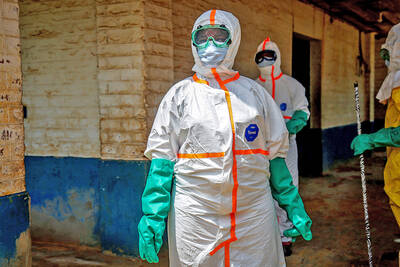
COMMUNITY CONFLICT: Concerns about disease spread from corpses has run up against friends and families’ desire to bury their dead as infection spreads in the area Angry residents of a town at the epicenter of the Ebola outbreak in the Democratic Republic of the Congo (DR Congo) attacked and burned a tent that was part of a health center where people are being treated for the virus, the staff there said Saturday. It was the second such attack in the region in a week. No one was hurt in the attack, according to reports but as patients ran out to escape the fire, 18 people with suspected Ebola infections fled the facility and are unaccounted for, a hospital director said. Angry residents arrived at the clinic in the
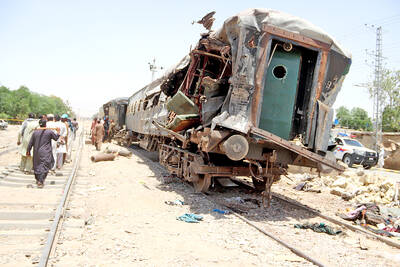
INSURGENT ACTION: A local independence movement in Balochistan, alleged by Pakistan’s government to be backed by India, claimed responsibility for the strike A suicide bomber detonated an vehicle-borne IED near a railway as a passenger train passed through the southwestern Pakistani city of Quetta yesterday, killing at least 23 people and wounding over 70, officials said. The explosion caused two of the train cars to overturn and catch fire, according to footage shared online. The attack happened in an area where security forces are usually stationed, badly damaging several nearby buildings and smashing more than a dozen vehicles parked along the road, according to witnesses and images circulating on social media. Doctors at local hospitals said they had received the wounded, with 20 in critical


 RSS
RSS