


Two politicians accused of brutal attitudes toward women have been made Cabinet ministers in Pakistan, causing outrage among human rights activists.
Mir Hazar Khan Bijarani, charged with presiding over a jirga that gave away five young girls as compensation, and Israrullah Zehri, who recently made international headlines after defending the burying alive of women in “honor killing” cases, have been made ministers.
Last year the Supreme Court ordered the arrest of Oxford-educated Bijarani over the allegations, though he remained at liberty. He has now been made minister for education. Street protests and angry newspaper editorials met the induction of Bijarani and Zehri, who were brought in as part of a major expansion of the Cabinet last week.
“It is a very clear message from the government that they don’t care about these things,” said Samar Minallah, a human rights campaigner who had brought the court case against Bijarani. “I think they deliberately chose these two people to be ministers to send that message.”
The practice of settling disputes by awarding girls taken from the family of those convicted by a meeting of village elders in a jirga to an aggrieved party is illegal but it continues in rural areas. Bijarani, a landowner from Sindh Province, is accused of heading such a jirga in 2006, in which five girls, aged between two and five, were given as compensation to the family of a murdered man.
He denies the allegations.
“Is this the politics of appeasement?” said Tahira Abdullah, a member of rights group the Women’s Action Forum. “It almost looks like rewarding these men for their deeds against women.”
Zehri, a member of the upper house of parliament, has been made minister for postal services.
Earlier this year, in response to news that three teenage girls had been buried alive for trying to choose their own husbands, he told parliament it was “tribal tradition.”

SPEAKING OUT: After Siranudh Scott’s allegations surfaced, celebrities and public figures took to social media to share their own experiences of sexual misconduct and abuse A high-profile alleged sexual abuse case within a wealthy Thai beer brewing family has prompted a wave of painful accounts from survivors of unconnected abuse in the conservative nation. Siranudh Scott, a member of the billionaire Thai family that founded the ubiquitous Singha beer brand, posted an emotional video this month accusing his elder brother Sunit of repeatedly abusing him when he was a teenager. Sunit, who is in his 30s, later denied the allegations in a video posted online, but Singha parent Boonrawd dismissed him from his executive role with the company on Tuesday last week. “I felt I needed to speak

SEEKING ORDER: Rodrigo Paz said that ‘anyone who wants to destroy the nation will have to deal with this president and the full force of the constitution’ Bolivian President Rodrigo Paz on Wednesday said that the nation was at a “breaking point” after nearly a month of protests that have caused shortages of food, fuel and medicine. Paz, who took office six months ago amid the worst economic crisis there in four decades, is battling a groundswell of fury over his policies. The political capital, La Paz, has been besieged by low-income workers and members of the indigenous majority calling for his resignation. “The country needs order and is reaching breaking point,” the 58-year-old said at a public event in La Paz, renewing his appeal for dialogue. On Tuesday, the Bolivian
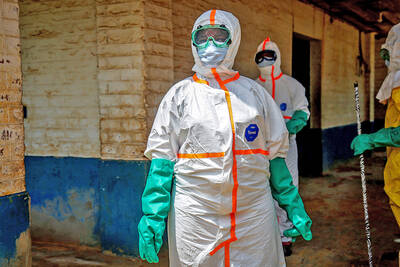
COMMUNITY CONFLICT: Concerns about disease spread from corpses has run up against friends and families’ desire to bury their dead as infection spreads in the area Angry residents of a town at the epicenter of the Ebola outbreak in the Democratic Republic of the Congo (DR Congo) attacked and burned a tent that was part of a health center where people are being treated for the virus, the staff there said Saturday. It was the second such attack in the region in a week. No one was hurt in the attack, according to reports but as patients ran out to escape the fire, 18 people with suspected Ebola infections fled the facility and are unaccounted for, a hospital director said. Angry residents arrived at the clinic in the

Forecasters in Europe yesterday warned of exceptional heat as record temperatures driven by a “heat dome” push temperatures well above seasonal norms across the continent. The surge follows a record-breaking Monday, with France logging its hottest day in the month of May on record, its weather agency said, and the UK also posting unprecedented highs. A so-called “heat dome” of warm air from northern Africa trapped under a high-pressure system over western Europe is behind the high temperatures not usually seen until high summer. Restrictions on outdoor work were imposed in parts of Italy, beaches in southwest France filled earlier than usual and


 RSS
RSS