


A fight within the US Democratic Party over control of the powerful Energy and Commerce Committee in the House of Representatives could influence the outcome of president-elect Barack Obama’s efforts to tackle global warming.
Obama has said he wants to act quickly on climate change, but crucial bipartisan support could be tested if liberal California Representative Henry Waxman succeeds at unseating chairman John Dingell of Michigan, the panel’s top Democrat for 28 years and a major ally of automakers and electric utilities.
The winner will be at the helm of a panel that will spearhead a bill to cap greenhouse gases and establish a multibillion-dollar market in carbon dioxide, with companies buying and selling rights to pollute.
Last month Dingell and Rick Boucher, also a Democrat, offered a draft global warming bill based on dozens of hearings and white papers for reducing greenhouse gases by 80 percent by 2050, a reduction in line with what Obama has proposed.
Environmentalists and some liberal Democrats, however, see Dingell as an obstacle to stricter fuel economy standards for cars and trucks and cleaner fuels also advocated by Obama.
They see in Waxman a chance to push through a more ambitious environmental agenda now that Democrats have expanded their majorities in Congress and will take over the White House.
Dingell’s supporters say his global warming draft legislation has a better chance of winning support from some Republicans and conservative Democrats, many of them on his 57-member committee, because it slowly reduces emissions to buy time for necessary technology to develop.
Liberals and environmentalists complain that Dingell’s bill could pre-empt states such as California, which have set up their own carbon trading systems, and forbid the Environmental Protection Agency and state agencies from setting fuel economy standards different from those adopted by the US Transportation Department.
“The prospects for success will be much better under Chairman Dingell on this issue and many others,” said Boucher, who chairs the energy panel’s air quality subcommittee.
Democrat Mike Doyle, who was working the phones to drum up support for Dingell, said claims by Waxman supporters that Dingell would not move climate legislation quickly were “not based in reality.”
“This climate change bill is not a slam-dunk,” Doyle said. “It is not like we have overwhelming votes in the House and Senate.”
House Speaker Nancy Pelosi and Majority Leader Steny Hoyer have thus far avoided taking sides. Obama’s camp also is staying out of it.
Waxman signed on to legislation this year with Markey that would ban any new coal-fired power plants built without technology to capture carbon dioxide. Dingell favors a more tempered approach, and has signaled his support for a bill advanced by Boucher that would establish a US$1 billion annual fund generated by fees on electricity generation to develop carbon capture technology.
In a letter to members of the Committee, Dingell, without referring to Waxman, cited Pelosi: “The country must be governed from the middle.”
Waxman has chaired the House Oversight and Government Reform Committee that has spent the past two years taking the administration of US President George W. Bush to task over global warming and muzzling government scientists while also investigating the White House’s political operation, steroids in sports and, most recently, abuses behind the financial collapse.
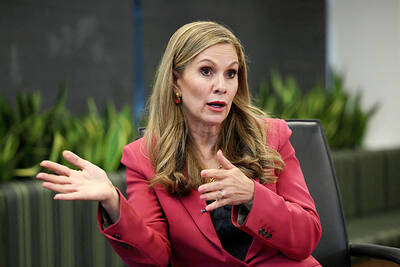
Australians were downloading virtual private networks (VPNs) in droves, while one of the world’s largest porn distributors said it was blocking users from its platforms as the country yesterday rolled out sweeping online age restriction. Australia in December became the first country to impose a nationwide ban on teenagers using social media. A separate law now requires artificial intelligence (AI)-powered chatbot services to keep certain content — including pornography, extreme violence and self-harm and eating disorder material — from minors or face fines of up to A$49.5 million (US$34.6 million). The country also joined Britain, France and dozens of US states requiring
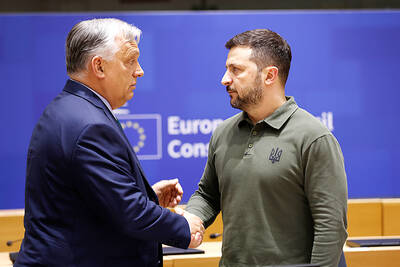
Hungarian authorities temporarily detained seven Ukrainian citizens and seized two armored cars carrying tens of millions of euros in cash across Hungary on suspicion of money laundering, officials said on Friday. The Ukrainians were released on Friday, following their detention on Thursday, but Hungarian officials held onto the cash, prompting Ukraine to accuse Hungary’s Russia-friendly government of illegally seizing the money. “We will not tolerate this state banditism,” Ukrainian Minister of Foreign Affairs Andrii Sybiha said. The seven detained Ukrainians were employees of the Ukrainian state-owned Oschadbank, who were traveling in the two armored cars that were carrying the money between Austria and
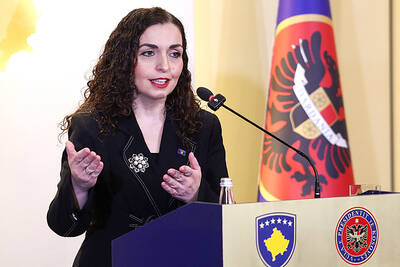
Kosovar President Vjosa Osmani on Friday after dissolving the Kosovar parliament said a snap election should be held as soon as possible to avoid another prolonged political crisis in the Balkan country at a time of global turmoil. Osmani said it is important for Kosovo to wrap up the upcoming election process and form functional institutions for political stability as the war rages in the Middle East. “Precisely because the geopolitical situation is that complex, it is important to finish this electoral process which is coming up,” she said. “It is very hard now to imagine what will happen next.” Kosovo, which declared

ACTIONABLE ADVICE: The majority of chatbots tested provided guidance on weapons, tactics and target selections, with Perplexity and Meta AI deemed to be the least safe From school shootings to synagogue bombings, leading artificial intelligence (AI) chatbots helped researchers plot violent attacks, according to a study published on Wednesday that highlighted the technology’s potential for real-world harm. Researchers from the nonprofit watchdog Center for Countering Digital Hate and CNN posed as 13-year-old boys in the US and Ireland to test 10 chatbots, including ChatGPT, Google Gemini, Perplexity, Deepseek and Meta AI. Eight of the chatbots assisted the make-believe attackers in more than half the responses, providing advice on “locations to target” and “weapons to use” in an attack, the study said. The chatbots had become a “powerful accelerant for


 RSS
RSS