


A little-known Islamic group claimed responsibility in a text message to a news channel on Friday for serial blasts in India’s northeast that claimed 76 lives the day before, police said.
The group, identifying itself as the “Islamic Security Force-Indian Mujahedeen,” warned such attacks would continue in Assam state, police said.
“The Islamic Security Force-Indian Mujahedeen takes the responsibility for yesterday’s blasts,” the text message to the Newslive television network in Assam said.
“We warn all of Assam and India about situations like this in the future and we thank all our holy members and partners,” it said.
A police spokesman said the group is believed to have come into existence in 2000 in western Assam, where tribal Bodo militants are campaigning against Muslim settlers from nearby Bangladesh.
The group has not been active recently in Assam, where more than a dozen militant groups are campaigning for demands ranging from independence to greater autonomy.
The police’s suspicion had centered on the rebel United Liberation Front of Asom (ULFA), which has been fighting for an independent homeland since 1979, but the ULFA had denied its involvement.
Police say they are questioning about a dozen people over the attacks.
Twelve blasts — all within the space of an hour — hit the insurgency-hit state on Thursday, six of them ripping through crowded areas in the main city of Guwahati.
Some of the bombs had been strapped to bicycles and packed with incendiary material to trigger fires.
Assam Home Commissioner Subhas Das said 15 people had died of their injuries overnight, taking the death toll to 76, of whom 43 were killed in Guwahati.
Three other districts in western Assam were also targeted. The total number of injured stood at more than 300.
The blasts, including one in front of the Guwahati city court, reduced nearby vehicles to heaps of twisted metal.
UN Secretary General Ban Ki-moon, in New Delhi on an official visit, condemned what he called an “act of terrorism targeting civilians,” while Indian Prime Minister Manmohan Singh vowed to bring the bombers to justice.
“Such barbaric acts targeting innocent men, women and children only highlight the desperation and cowardice of those responsible,” Singh said, adding he would visit Assam yesterday.
The attacks came six weeks after New Delhi was hit by a series of bombs in crowded markets that left more than 20 dead. Those blasts were claimed by a group calling itself the Indian Mujahedeen.
The emergence in recent years of an indigenous Islamist militancy has posed a new challenge to the Indian government, which has routinely blamed neighboring rival Pakistan for organizing attacks on its soil.
In the aftermath of Thursday’s bombings, police slapped a curfew on Guwahati as residents — blaming lax security — attacked fire engines that were trying to battle a series of fires.
By Friday morning, the curfew had been lifted and there were fresh clashes as around 200 angry protesters confronted police in the city center.
In the past two decades, more than 10,000 people have lost their lives to insurgency-linked violence in tea- and oil-rich Assam.
In January of last year, police blamed the ULFA for a wave of attacks in which 62 people were killed, many of them Hindi-speaking migrant workers.
Attacks have continued since peace talks between the ULFA and New Delhi collapsed in 2006.
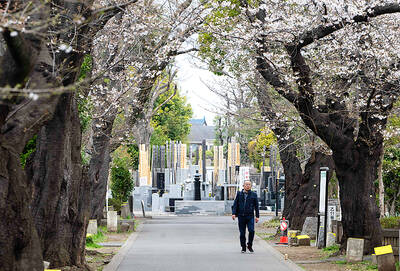
ROCKY RELATIONS: The figures on residents come as Chinese tourist numbers drop following Beijing’s warnings to avoid traveling to Japan The number of Chinese residents in Japan has continued to rise, even as ties between the two countries have become increasingly fractious, data released on Friday showed. As of the end of December last year, the number of Chinese residents had increased by 6.5 percent from the previous year to 930,428. Chinese people accounted for 22.6 percent of all foreign residents in Japan, making them by far the largest group, Japanese Ministry of Justice data showed. Beijing has criticized Tokyo in increasingly strident terms since Japanese Prime Minister Sanae Takaichi last year suggested that a military conflict around Taiwan could

A retired US colonel behind a privately financed rocket launch site in the Dominican Republic sees the project as a response to China’s dominance of the space race in Latin America. Florida-based Launch on Demand is slated to begin building a US$600 million facility in a remote region near the border with Haiti late this year. The project is designed to meet surging demand for the heavy-lift rockets needed to put clusters of satellites into orbit. It is also an answer to China’s growing presence in the region, said CEO Burton Catledge, a former commander of the US Air Force’s 45th Operations

Germany is considering Australia’s Ghost Bat robot fighter as it looks to select a combat drone to modernize its air force, German Minister of Defense Boris Pistorius said yesterday. Germany has said it wants to field hundreds of uncrewed fighter jets by 2029, and would make a decision soon as it considers a range of German, European and US projects developing so-called “collaborative combat aircraft.” Australia has said it will integrate the Ghost Bat, jointly developed by Boeing Australia and the Royal Australian Air Force, into its military after a successful weapons test last year. After inspecting the Ghost Bat in Queensland yesterday,
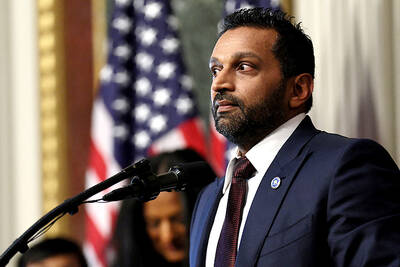
A pro-Iran hacking group claimed to breach FBI Director Kash Patel’s personal e-mail inbox and posted some of the contents online. The e-mails provided by the hacking group include travel details, correspondence with leasing agents in Washington and global entry, and loyalty account numbers. The e-mail address the hackers claim to have compromised has been previously tied to Patel’s personal details, and the leaked e-mails contain photos of Patel and others, in addition to correspondence with family members and colleagues. “The FBI is aware of malicious actors targeting Director Patel’s personal email information,” the agency said in a statement on


 RSS
RSS