


The first major opinion poll taken after Canada’s election debates showed on Sunday that the ruling Conservatives were headed for a strengthened mandate but would still fall short of a majority of seats in parliament.
The Ekos survey put the Conservatives, led by Canadian Prime Minister Stephen Harper, at 35 percent and the Liberals back at 25 percent. The New Democratic Party (NDP), to the left of the Liberals, stood at 19 percent.
Debates in French and English on Wednesday and Thursday respectively “appear to have failed to shake up the election race, despite what some regarded as effective performances by opposition party leaders,” Ekos said late on Sunday.
Ekos’ automated telephone survey was conducted on Friday through Sunday.
Another poll, a Nanos survey taken partly before the more widely watched English debate, had the Conservatives ahead by just 34 percent to 30 percent for the Liberals. The poll spanned Thursday through Saturday.
The Liberals seized upon the fact that the leftist NDP, which had been doing so well that it had a shot at taking second place in next Tuesday’s election, was 11 points behind in the Nanos survey at 19 percent.
“Can someone tell me how in these numbers the NDP finishes second?” Liberal spokesman Jae Epworth asked in an e-mail.
The Liberals and the NDP are closer in other polls, and the Liberals further behind the Conservatives, who took power from the Liberals with a minority of seats in parliament in the January 2006 election.
A Harris-Decima survey released on Sunday by Canadian Press that covered Wednesday through Saturday put the Conservatives also at 34 percent but the Liberals down at 24 percent and the NDP at 20 percent.
In the 2006 election, the Conservatives got 36 percent of the popular vote, the Liberals 30 percent and the NDP 17.5 percent.
When pParliament was dissolved on Sept. 7, the Conservatives had 127 of the 308 seats, well short of the 155 needed for a majority.
Harper has campaigned on the need for a steady hand in uncertain times, with no new taxes and no major new spending.
Liberal opposition leader Stephane Dion has pledged to keep the budget balanced without raising the overall tax load.
The Liberal Party is proposing a tax on carbon to finance cuts in corporate and personal income taxes.
The move will be “revenue-neutral, and some government investments could be made gradually to ensure the budget doesn’t slip into deficit, Dion said in an interview on Saturday.
“We don’t think Canadians need to pay more taxes,” Dion said by phone from Prince Edward Island. “It’s not our intention at all to increase our tax burden.”
Dion said Harper has squandered the surplus since taking office in 2006.
The NDP want to cancel a corporate tax cut and spend more on housing and education.
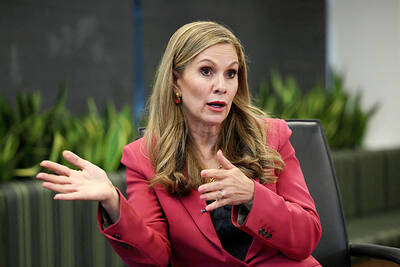
Australians were downloading virtual private networks (VPNs) in droves, while one of the world’s largest porn distributors said it was blocking users from its platforms as the country yesterday rolled out sweeping online age restriction. Australia in December became the first country to impose a nationwide ban on teenagers using social media. A separate law now requires artificial intelligence (AI)-powered chatbot services to keep certain content — including pornography, extreme violence and self-harm and eating disorder material — from minors or face fines of up to A$49.5 million (US$34.6 million). The country also joined Britain, France and dozens of US states requiring
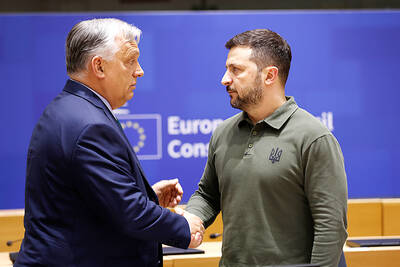
Hungarian authorities temporarily detained seven Ukrainian citizens and seized two armored cars carrying tens of millions of euros in cash across Hungary on suspicion of money laundering, officials said on Friday. The Ukrainians were released on Friday, following their detention on Thursday, but Hungarian officials held onto the cash, prompting Ukraine to accuse Hungary’s Russia-friendly government of illegally seizing the money. “We will not tolerate this state banditism,” Ukrainian Minister of Foreign Affairs Andrii Sybiha said. The seven detained Ukrainians were employees of the Ukrainian state-owned Oschadbank, who were traveling in the two armored cars that were carrying the money between Austria and
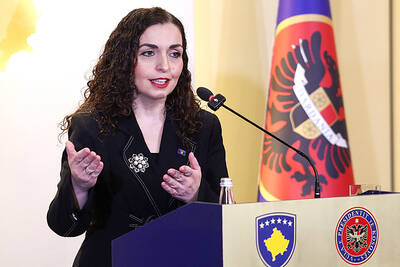
Kosovar President Vjosa Osmani on Friday after dissolving the Kosovar parliament said a snap election should be held as soon as possible to avoid another prolonged political crisis in the Balkan country at a time of global turmoil. Osmani said it is important for Kosovo to wrap up the upcoming election process and form functional institutions for political stability as the war rages in the Middle East. “Precisely because the geopolitical situation is that complex, it is important to finish this electoral process which is coming up,” she said. “It is very hard now to imagine what will happen next.” Kosovo, which declared

MORE BANS: Australia last year required sites to remove accounts held by under-16s, with a few countries pushing for similar action at an EU level and India considering its own ban Indonesia on Friday said it would ban social media access for children under 16, citing threats from online pornography, cyberbullying, online fraud and Internet addiction. “Accounts belonging to children under 16 on high-risk platforms will start to be deactivated, beginning with YouTube, TikTok, Facebook, Instagram, Threads, X, Bigo Live and Roblox,” Indonesian Minister of Communications and Digital Meutya Hafid said. “The government is stepping in so that parents no longer have to fight alone against the giants of the algorithm. Implementation will begin on March 28, 2026,” she said. The social media ban would be introduced in stages “until all platforms fulfill their


 RSS
RSS