


The son of a wealthy Indian arms dealer was sentenced on Friday to five years in prison after being found guilty of hitting and killing six people, including three police officers, with his car more than nine years ago, his attorney said.
Sanjeev Nanda, 30, who pleaded innocent, was convicted on manslaughter charges in what is known as the “BMW case.”
The high-profile case has been seen as a test of whether India’s judicial system, which has a long history of favoring the well-connected, is willing to hold the wealthy accountable.
Judge Vinod Kumar sentenced three other defendants to prison terms ranging from six months to one year on charges of destroying evidence.
“This is a harsh penalty,” said Nanda’s attorney, Prem Kumar, adding that he would appeal the verdict in New Delhi’s High Court.
However, Ved Marwah, a former police commissioner and a prominent commentator on criminal affairs, said Nanda should consider himself lucky that he didn’t get the maximum punishment of 10 years in prison.
“After the accident, these young people didn’t have the human consideration of taking the injured to hospital. They left them to die there and they very deliberately tried to get rid of all the evidence,” Marwah said.
Nanda is the son of private arms dealer Suresh Nanda and a grandson of former Indian naval chief S.M. Nanda. At the time of the crash, Nanda was home for the holidays from the University of Pennsylvania’s Wharton School of Business.
Prosecutors said Nanda and two of his friends were returning from a party at 4:30am on Jan. 10, 1999, when their BMW, speeding at roughly 135kph, crashed into seven people standing along an empty street. A witness reportedly saw the men stop, examine the damage to their car, then speed off. Three policemen and three laborers died.
Nanda and the two friends, Siddharta Gupta and Manik Kapoor, were classmates at an elite New Delhi private school.
Prosecutors said Gupta and two of Nanda’s employees washed blood from the car, and the three were convicted of destroying evidence.
Kapoor, who was also charged with destroying evidence, was acquitted.

Hungarian authorities temporarily detained seven Ukrainian citizens and seized two armored cars carrying tens of millions of euros in cash across Hungary on suspicion of money laundering, officials said on Friday. The Ukrainians were released on Friday, following their detention on Thursday, but Hungarian officials held onto the cash, prompting Ukraine to accuse Hungary’s Russia-friendly government of illegally seizing the money. “We will not tolerate this state banditism,” Ukrainian Minister of Foreign Affairs Andrii Sybiha said. The seven detained Ukrainians were employees of the Ukrainian state-owned Oschadbank, who were traveling in the two armored cars that were carrying the money between Austria and
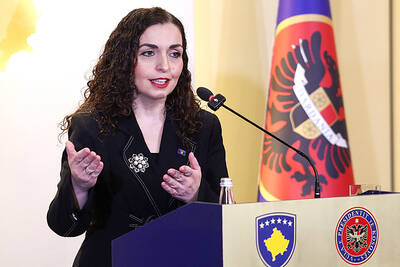
Kosovar President Vjosa Osmani on Friday after dissolving the Kosovar parliament said a snap election should be held as soon as possible to avoid another prolonged political crisis in the Balkan country at a time of global turmoil. Osmani said it is important for Kosovo to wrap up the upcoming election process and form functional institutions for political stability as the war rages in the Middle East. “Precisely because the geopolitical situation is that complex, it is important to finish this electoral process which is coming up,” she said. “It is very hard now to imagine what will happen next.” Kosovo, which declared

MORE BANS: Australia last year required sites to remove accounts held by under-16s, with a few countries pushing for similar action at an EU level and India considering its own ban Indonesia on Friday said it would ban social media access for children under 16, citing threats from online pornography, cyberbullying, online fraud and Internet addiction. “Accounts belonging to children under 16 on high-risk platforms will start to be deactivated, beginning with YouTube, TikTok, Facebook, Instagram, Threads, X, Bigo Live and Roblox,” Indonesian Minister of Communications and Digital Meutya Hafid said. “The government is stepping in so that parents no longer have to fight alone against the giants of the algorithm. Implementation will begin on March 28, 2026,” she said. The social media ban would be introduced in stages “until all platforms fulfill their
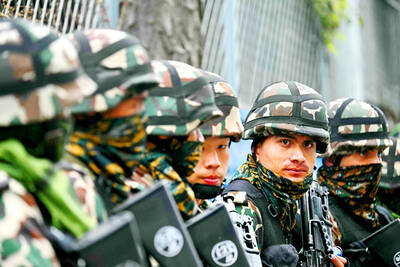
Counting was under way in Nepal yesterday, after a high-stakes parliamentary election to reshape the country’s leadership following protests last year that toppled the government. Key figures vying for power include former Nepalese prime minister K. P. Sharma Oli, rapper-turned-mayor Balendra Shah, who is bidding for the youth vote, and newly elected Nepali Congress party leader Gagan Thapa. In Kathmandu’s tea shops and city squares, people were glued to their phones, checking results as early trends flashed up — suggesting Shah’s centrist Rastriya Swatantra Party (RSP) was ahead. Nepalese Election Commission spokesman Prakash Nyupane said the counting was ongoing “in a peaceful manner”


 RSS
RSS