


When US Secretary of State Condoleezza Rice spends a few hours in Libya and shakes hands with Libyan leader Muammar Qaddafi, she will close a nearly three-decade era of bitter animosity between the US and the North African nation that has sometimes gotten personal.
It’s not every day that a US president calls a foreign leader a “mad dog.”
As the first secretary of state to visit the country in more than a half-century, Rice’s visit yesterday will represent a foreign policy success for the Bush administration.
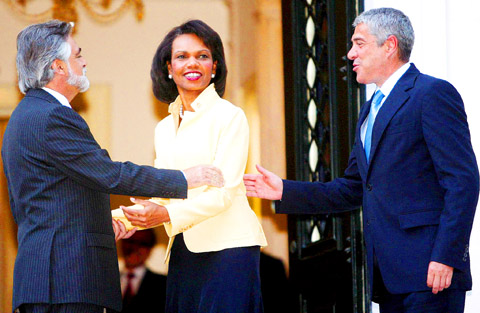
PHOTO: EPA
“It is a historic moment and it is one that has come after a lot of difficulty, the suffering of many people that will never be forgotten or assuaged, a lot of Americans in particular. It is also the case that this comes out of a historic decision that Libya made to give up weapons of mass destruction and renounce terrorism. I am very much looking forward to it,” Rice said yesterday at a news conference in Lisbon.
“Libya,” she said, “is a place that is changing and I want to discuss how that change is taking place.”
Yet relations between the two countries still will face strains on a number of fronts, ranging from human rights to the final resolution of legal claims from 1980s terror bombings.
Despite Qaddafi’s 2003 decision to abandon weapons of mass destruction, renounce terrorism and compensate victims of the 1986 La Belle disco bombing in Berlin and the 1988 Pan Am 103 bombing over Lockerbie, Scotland, not all questions have been settled.
Even as Rice prepared for her landmark face-to-face meeting with Qaddafi, whom the late president Ronald Reagan once called the “mad dog of the Middle East,” a fund set up last month to compensate US and Libyan victims of those bombings remained empty.
A leading reformer, Fathi al-Jhami, whose case has been championed by the Bush administration, remained in detention, where he has been near continuously since 2002. Rights groups say hundreds of other political prisoners are still being held.
Among the biggest question marks is the often unpredictable behavior of Qaddafi, who has cultivated images as both an Arab potentate and African monarch since taking power in a 1969 coup. By all accounts it will be a meeting to remember.
In an interview with al-Jazeera TV last year, Qaddafi spoke of Rice in most unusual terms, calling her “Leezza” and suggesting that she actually runs the Arab world with which he has had severe differences in the past.
“I support my darling black African woman,” he said. “I admire and am very proud of the way she leans back and gives orders to the Arab leaders ... Leezza, Leezza, Leezza ... I love her very much. I admire her, and I’m proud of her, because she’s a black woman of African origin.”
Rice will be the first secretary of state to visit Libya since John Foster Dulles in 1953 and the highest-ranking US official to visit since then vice president Richard Nixon in 1957.
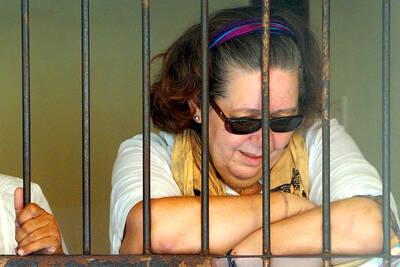
Indonesia was to sign an agreement to repatriate two British nationals, including a grandmother languishing on death row for drug-related crimes, an Indonesian government source said yesterday. “The practical arrangement will be signed today. The transfer will be done immediately after the technical side of the transfer is agreed,” the source said, identifying Lindsay Sandiford and 35-year-old Shahab Shahabadi as the people being transferred. Sandiford, a grandmother, was sentenced to death on the island of Bali in 2013 after she was convicted of trafficking drugs. Customs officers found cocaine worth an estimated US$2.14 million hidden in a false bottom in Sandiford’s suitcase when
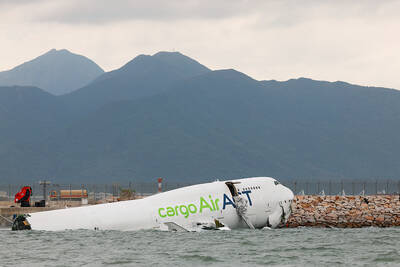
CAUSE UNKNOWN: Weather and runway conditions were suitable for flight operations at the time of the accident, and no distress signal was sent, authorities said A cargo aircraft skidded off the runway into the sea at Hong Kong International Airport early yesterday, killing two ground crew in a patrol car, in one of the worst accidents in the airport’s 27-year history. The incident occurred at about 3:50am, when the plane is suspected to have lost control upon landing, veering off the runway and crashing through a fence, the Airport Authority Hong Kong said. The jet hit a security patrol car on the perimeter road outside the runway zone, which then fell into the water, it said in a statement. The four crew members on the plane, which
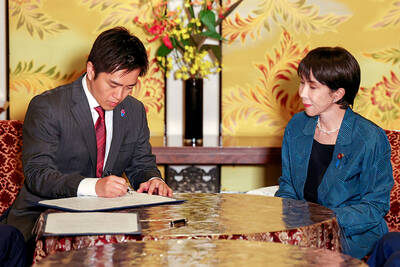
Japan’s ruling Liberal Democratic Party (LDP) and its junior partner yesterday signed a coalition deal, paving the way for Sanae Takaichi to become the nation’s first female prime minister. The 11th-hour agreement with the Japan Innovation Party (JIP) came just a day before the lower house was due to vote on Takaichi’s appointment as the fifth prime minister in as many years. If she wins, she will take office the same day. “I’m very much looking forward to working with you on efforts to make Japan’s economy stronger, and to reshape Japan as a country that can be responsible for future generations,”

SEVEN-MINUTE HEIST: The masked thieves stole nine pieces of 19th-century jewelry, including a crown, which they dropped and damaged as they made their escape The hunt was on yesterday for the band of thieves who stole eight priceless royal pieces of jewelry from the Louvre Museum in the heart of Paris in broad daylight. Officials said a team of 60 investigators was working on the theory that the raid was planned and executed by an organized crime group. The heist reignited a row over a lack of security in France’s museums, with French Minister of Justice yesterday admitting to security flaws in protecting the Louvre. “What is certain is that we have failed, since people were able to park a furniture hoist in the middle of


 RSS
RSS