


After reviewing a disputed airstrike on a village in Afghanistan, US officials have concluded that the civilian death toll was far lower than claimed by the Afghan government and the UN, two US defense officials said on Thursday.
The officials, who spoke on condition of anonymity because results of the review have not been announced publicly, said Afghan officials have been presented the findings, which say 25 militants were killed, plus five civilians. Afghan officials have said that between 76 and 90 civilians were killed.
Also, the US government is pressing for a joint US-Afghan investigation in hopes of reaching a common conclusion about an incident that stirred outrage in Afghanistan and frustration among US officials.
It was not clear on Thursday either whether the Afghan government accepted the findings of the US review or whether a joint probe would go forward. Details of how the US review was conducted were not immediately available.
In the days after the attack in western Afghanistan, the government of Afghan President Hamid Karzai sharply rebuked the US, saying the incident showed the need for tighter regulation of US military operations.
Afghanistan’s Council of Ministers ordered the ministries of defense and foreign affairs to open negotiations with the US and NATO over the use of airstrikes, house searches and the detentions of Afghan civilians. It also urged a “status of forces” agreement to regulate the troops’ presence.
Early this week a UN human rights team said it had found “convincing evidence” to support claims that about 90 civilians were killed, including 60 children.
The US military in Afghanistan said the operation was led by Afghan National Army commandos, with support from US Special Operations forces. It said that along with the fatalities, five militants were detained. Troops also seized ammunition, grenades, rifles and bomb-making materials.
At the Pentagon on Thursday, Admiral Mike Mullen, chairman of the Joint Chiefs of Staff, said he was not aware of the result of the US review of the disputed airstrike.
“We work exceptionally hard to minimize any collateral damage,” Mullen said, referring to unintended casualties. “Zero collateral damage is the goal. We know that when collateral damage occurs, that it really does set us back, so we worked exceptionally hard to make sure it doesn’t happen.”
The US military makes frequent use of air power in both Iraq and Afghanistan but has drawn more highly publicized accusations of civilian deaths in Afghanistan. Asked about this, Mullen said he has made clear to commanders the importance of avoiding civilian casualties.
“I’ve got great commanders out there, and it’s their — they make these decisions, and I am hard-pressed to second-guess what they’re doing with respect to that,” Mullen told a news conference.
The Joint Chiefs chairman announced that he met in secret on Tuesday with his Pakistani counterpart, General Ashfaq Kayani, to discuss efforts to slow the infiltration of militants from Pakistan into Afghanistan.
The meeting aboard the USS Abraham Lincoln, a US Navy aircraft carrier in the Indian Ocean, was also attended by General David Petraeus, the top US commander in Iraq, who will soon leave to become the senior commander in the Middle East. Also there were Admiral Eric Olson, head of the Special Operations Command, and Lieutenant General Martin Dempsey, acting commander of US forces in the Middle East.
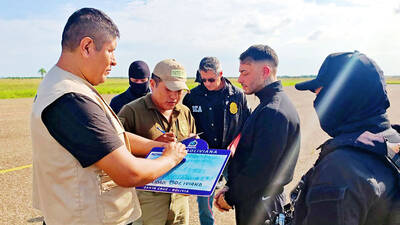
KINGPIN: Marset allegedly laundered the proceeds of his drug enterprise by purchasing and sponsoring professional soccer teams and even put himself in the starting lineups Notorious Latin American narco trafficker Sebastian Marset, who eluded police for years, was handed over to US authorities after his arrest on Friday in Bolivia. Marset, a Uruguayan national who was on the US most-wanted list, was passed to agents of the US Drug Enforcement Administration at Santa Cruz airport in Bolivia, then put on a US airplane, Bolivian state television showed. “The arrest and deportation were carried out pursuant to a court order issued by the US justice system,” Bolivian Minister of Government Marco Antonio Oviedo told reporters. The alleged kingpin was arrested in an upscale neighborhood of Santa
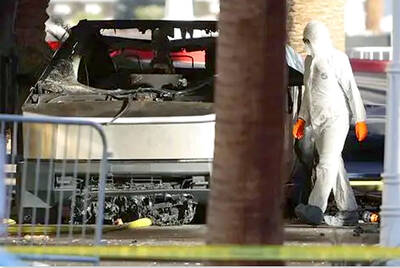
ACTIONABLE ADVICE: The majority of chatbots tested provided guidance on weapons, tactics and target selections, with Perplexity and Meta AI deemed to be the least safe From school shootings to synagogue bombings, leading artificial intelligence (AI) chatbots helped researchers plot violent attacks, according to a study published on Wednesday that highlighted the technology’s potential for real-world harm. Researchers from the nonprofit watchdog Center for Countering Digital Hate and CNN posed as 13-year-old boys in the US and Ireland to test 10 chatbots, including ChatGPT, Google Gemini, Perplexity, Deepseek and Meta AI. Eight of the chatbots assisted the make-believe attackers in more than half the responses, providing advice on “locations to target” and “weapons to use” in an attack, the study said. The chatbots had become a “powerful accelerant for
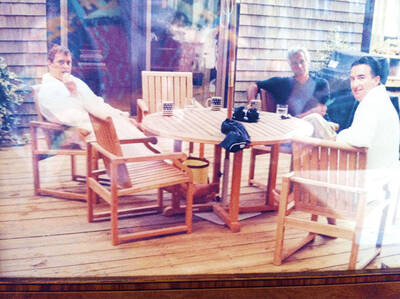
SCANDAL: Other images discovered earlier show Andrew bent over a female and lying across the laps of a number of women, while Mandelson is pictured in his underpants A photograph of former British prince Andrew and veteran politician Peter Mandelson sitting in bathrobes alongside late sex offender Jeffrey Epstein was unearthed on Friday in previously published documents. The image is believed to be the first known photograph of the two men with Epstein. They are currently engulfed in scandal in the UK over their ties to their mutual friend. The undated photograph, first reported by ITV News, shows King Charles III’s disgraced brother and former British ambassador to the US sitting barefoot outside on a wooden deck. They appear to have mugs with a US flag on them
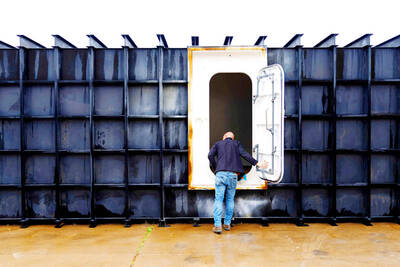
Since the war in the Middle East began nearly two weeks ago, the telephone at Ron Hubbard’s bomb shelter company in Texas has not stopped ringing. Foreign and US clients are rushing to buy his bunkers, seeking refuge in case of air raids, nuclear fallout or apocalypse. With the US and Israel pounding Iran, and Tehran retaliating with strikes across the region, Hubbard has seen demand for his product soar, mostly from Gulf nation customers in Bahrain, Qatar, Kuwait and the United Arab Emirates. “You can imagine how many people are thinking: ‘I wish I had a bomb shelter,’” Hubbard, 63, said in


 RSS
RSS