


South Korean police said yesterday that nine people have been arrested for trying to smuggle tons of chemicals for heroin production to Afghanistan’s Taliban insurgents.
Police said one Afghan, two Pakistanis, two Indians and four Koreans were detained for trying to use South Korea as a shipping point for several tonnes of acetic anhydride destined for southern Afghanistan.
The chemical is heated with morphine, an opium derivative, to make heroin.
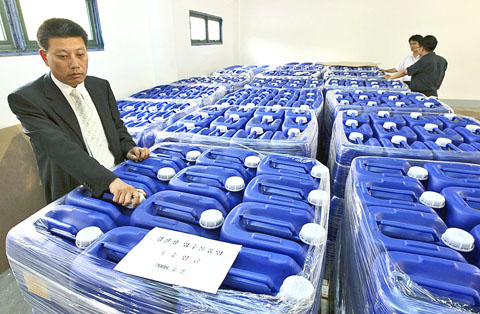
PHOTO: AP
In cooperation with the international police organization Interpol, South Korean police were also hunting three foreigners who had fled abroad, investigator Oh Ki-duk said.
Police confiscated 12 tonnes of acetic anhydride in a chemical engineering factory in the Seoul suburb of Ansan and arrested two people including a 47-year-old suspected Taliban member, he said.
“The key Afghan suspect admitted he did it at the instigation of the Taliban,” Oh said. “But he claimed he is not a member of the Taliban.”
He said the suspect had tried to smuggle the chemical, disguised as motor oil, into Afghanistan through Iran.
Oh said the Afghan came to South Korea on a forged passport and recruited Pakistani and Indian workers in the country. “Despite his denial, we have circumstantial evidence that he is a Taliban member,” he said.
In a separate operation led by Pakistanis, police said about 50 tonnes of the chemical had already been shipped to Afghanistan between April last year and March this year. It was labeled as disinfectant.
One Pakistani suspect was arrested in a Seoul suburb, and another who had acquired South Korean citizenship was detained in the United Arab Emirates, he said.
“Legal steps are being taken to repatriate the suspect arrested in the United Arab Emirates,” Oh said.
The operations were funded by the hawala money transfer network widely used in the Middle East, police said.
The 62 tons of acetic anhydride cost about 360 million won (US$344,800) but could be used to produce nearly 30 tonnes of heroin, Yonhap news agency quoted investigator Kim Ki-yong as saying.
“The suspects had money transferred from accounts suspected to be linked to hawala, and they acknowledged they had received orders from the Taliban,” Kim said.
The acetic anhydride was imported from Japan through several Korean dealers.
The investigation started in March after Interpol discovered 14 tonnes of the chemical that had been shipped from Korea in the southern Pakistani port of Karachi.
The UN Office on Drugs and Crime says Afghanistan produced 8,200 tonnes of opium base last year, 92 percent of the worldwide total.
The report also noted that 80 percent of the output came from five southern provinces where Taliban insurgents profit from drug-trafficking.
Last year 23 South Korean missionaries were captured and held hostage in Afghanistan by members of the Taliban.
Two of them were murdered before the South Korean government reached an undisclosed deal to free the remainder.
South Korea is a relatively drug-free nation, with just 7,709 people arrested in 2006 for drug offenses. But officials say it is becoming a more popular international transit point for cocaine and “ice.”

When a hiker fell from a 55m waterfall in wild New Zealand bush, rescuers were forced to evacuate the badly hurt woman without her dog, which could not be found. After strangers raised thousands of dollars for a search, border collie Molly was flown to safety by a helicopter pilot who was determined to reunite the pet and the owner. A week earlier, an emergency rescue helicopter found the woman with bruises and lacerations after a fall at a rocky spot at the waterfall on the South Island’s West Coast. She was airlifted on March 24, but they were forced to

CONFIDENCE BOOSTER: ’After parkour ... you dare to do a lot of things that you think only young people can do,’ a 67-year-old parkour enthusiast said In a corner of suburban Singapore, Betty Boon vaults a guardrail, crawls underneath a slide, executes forward shoulder rolls and scales a steep slope, finishing the course to applause. “Good job,” the 69-year-old’s coach cheers. This is “geriatric parkour,” where about 20 retirees learned to tackle a series of relatively demanding exercises, building their agility and enjoying a sense of camaraderie. Boon, an upbeat grandmother, said learning parkour has aided her confidence and independence as she ages. “When you’re weak, you will be dependent on someone,” she said after sweating it out with her parkour classmates in suburban Toa Payoh,
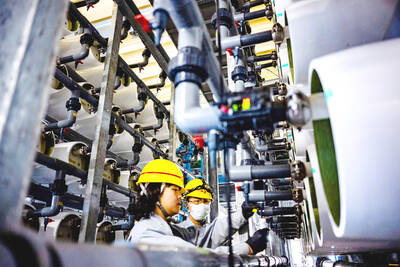
HIGH HOPES: The power source is expected to have a future, as it is not dependent on the weather or light, and could be useful for places with large desalination facilities A Japanese water plant is harnessing the natural process of osmosis to generate renewable energy that could one day become a common power source. The possibility of generating power from osmosis — when water molecules pass from a less salty solution to a more salty one — has long been known. However, actually generating energy from that has proved more complicated, in part due the difficulty of designing the membrane through which the molecules pass. Engineers in Fukuoka, Japan, and their private partners think they might have cracked it, and have opened what is only the world’s second osmotic power plant. It generates

Chinese dissident artist Gao Zhen (高兟), famous for making provocative satirical sculptures of former Chinese leader Mao Zedong (毛澤東), was tried on Monday over accusations of “defaming national heroes and martyrs,” his wife and a rights group said. Gao, 69, who was detained in 2024 during a visit from the US, faces a maximum three-year prison sentence, said his wife, Zhao Yaliang (趙雅良), and Shane Yi, a researcher at the Chinese Human Rights Defenders group which operates outside the nation. The closed-door, one-day trial took place at Sanhe City People’s Court in Hebei Province neighboring the capital, Beijing, and ended without a


 RSS
RSS