


Japan might boast universal health cover and some of the world's best medical technology, but an acute shortage of doctors is leaving some hospitals unable to treat even car crash victims.
Grueling working conditions are discouraging people from entering the medical profession in a country where the population is rapidly ageing, foreign doctors are barred and a swelling public debt caps doctors' salaries.
The strains are even being felt at the Hyogo Brain and Heart Center in the western city of Himeji, one of Japan's best-known neurology and cardiology hospitals.
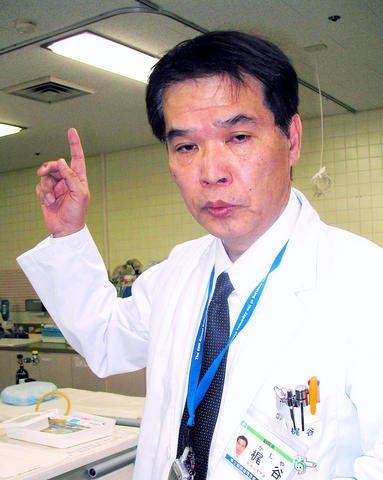
PHOTO: AFP
"We toil like workhorses," said Teishi Kajiya, the hospital's vice director and a cardiologist, taking some time for an interview before heading to the operation room.
"It's become the norm for doctors to work 36 hours straight, which is emotionally and physically exhausting. We never know when one of us might collapse," he said, looking weary despite his tidy coat.
"If this routine continues, doctors' abilities during surgery will drop and could increase the likelihood of medical errors," he said.
He said his hospital has turned down at least 100 patients in each of the past two years, adding that he was unaware of what happened to those who were rejected.
"The reality is that we've been forced to reduce emergency treatment to a portion of our patients since there are too few doctors. It simply can't be helped," Kajiya said.
The hospital, which has a total of 60 medical staff including doctors and resident students, is able to ensure only a bare minimum of three doctors on duty at all times for emergency patients, he said.
The situation is more dire for other hospitals. A recent poll by the Mainichi Shimbun showed that nearly 60 percent of non-emergency hospitals had only one doctor on duty after hours.
By medical standards, at least three doctors are required to attend to a single emergency patient at any one time.
The human toll is already being seen across Japan.
Osaka, Japan's second city, last year reported 3,800 cases in which ambulances had to call multiple hospitals to ensure treatment.
In one case, an 89-year-old women stricken with vomiting and diarrhea, died of a heart attack after her local fire department spent two hours contacting 30 medical facilities -- all of which refused to accept her, citing insufficient beds, shortage of on-duty doctors or because she had not sought previous medical treatment.
Doctors say they are also suffering as they come under intense emotional and physical stress, prompting some to leave the medical profession or resulting in death because of overwork or even suicide.
"Now students prefer professions like ophtalmology since all the wages are the same," said Seizan Tanabe, chief officer for emergency medical care at the health ministry.
The risk of being hauled to court by patients for malpractice is another reason why doctors are seeking to go into less taxing fields than surgery, officials said.
"Students now think more about themselves," said Yasuhiro Yamamoto, chairman of the department of emergency and critical care medicine at Nippon Medical School.
"For a senior doctor like myself, the priority isn't money but the patient's recovery. For me, it is a holy job. Now it's a money job," he said.

Crowds in Bangladesh are flocking to snap photographs with an unlikely social media star — an albino buffalo with flowing blond hair nicknamed “Donald Trump” that is due to be sacrificed within days. Owner Zia Uddin Mridha, 38, said his brother named the 700kg bull over its flowing helmet of hair resembling the signature look of the US president. “My younger brother picked this name because of the buffalo’s extraordinary hair,” he said at his farm in Narayanganj, just outside the capital, Dhaka. Mridha said that a constant stream of curious visitors — social media fans, onlookers and children — have come throughout

The Bolivian government on Friday struck a deal with protesting miners, but was still grappling with blockades and demonstrations by other workers across La Paz. Other groups are still blocking access roads into the city, which is also the seat of the government. Police on Thursday prevented the miners from entering the main square by using tear gas, while the demonstrators hurled stones and explosives with slingshots. Protests against the policies of Bolivian President Rodrigo Paz have convulsed the Andean nation since early this month, and roadblocks were choking routes into La Paz throughout Friday, the national road authority said. Miners demanded that Paz
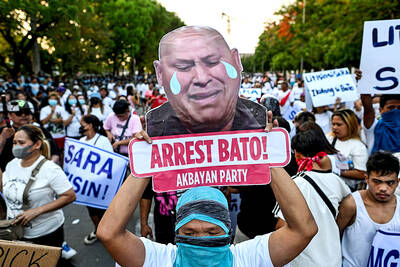
The Philippines said it has asked the country’s Supreme Court to allow it to arrest former Philippine president Rodrigo Duterte’s chief drug war enforcer to stand trial in an international tribunal. The International Criminal Court (ICC) last week unsealed an arrest warrant against Philippine Senator Ronald dela Rosa, accusing him along with Duterte and other “coperpetrators” of the “crime against humanity of murder.” Dela Rosa briefly sought refuge in the Philippine Senate last week while asking the Philippine Supreme Court to stop an ongoing attempt by government agents to arrest him. “By his own conduct, he has placed himself outside the protection of

The researchers in Ireland looked at their computer screen, marveling at a medieval book tracked down in a Roman library. They flipped through its digitized pages and found their sought-after treasure: the oldest surviving English poem. “We were extremely surprised. We were speechless. We couldn’t believe our eyes when we first saw that,” said Elisabetta Magnanti, a visiting research fellow at Trinity College Dublin’s school of English. The poem was also within the main body of Latin text, she said, calling it “extraordinary.” Composed in Old English by a Northumbrian agricultural worker in the 7th century, Caedmon’s Hymn appears within some copies of


 RSS
RSS