

Afghan poppy farmers are some of the richest in the country, so poverty is not a big factor driving drug production in Afghanistan, which last year produced 93 percent of the world's opium, a UN report said.
Despite millions of dollars spent to eradicate the crop and encourage farmers to turn to others, opium production has risen sharply since US-led and Afghan forces toppled the hardline Islamist Taliban government in 2001.
But some of the poorest Afghan farmers do not grow the poppies from which opium is produced, while those on some of the richest farmland are the biggest producers of the drug, which is processed to make heroin and exported to the West.
"Poverty does not appear to have been the main driving factor in the expansion of opium cultivation in recent years," said a report by the UN Office on Drugs and Crime (UNODC) received by wire agencies yesterday.
"There is no evidence that opium poppy cultivation is the choice of the poorest of the poor farmers," it said.
While it is difficult to measure income in Afghanistan the UNODC study looked at farmers' key assets.
The southern province of Helmand, which produces around 70 percent of Afghanistan's drug crop, has the country's highest level of car and motorcycle ownership and the second highest ownership of trucks, combine harvesters and tractors.
"It appears that the wealthier provinces were actually more likely to cultivate opium than the poorer ones," the report said.
The biggest factor in whether farmers grow opium is the level of Taliban insurgency.
Afghan and mostly British forces are engaged in almost daily battles trying to wrest control of the string of towns and villages along Helmand's fertile strip from Taliban insurgents.
Forty-four percent of Helmand households said their economic situation had improved in the last year, compared to 27 percent nationwide, the UNODC said.
Meanwhile, a suicide bomber blew up an explosives-filled car near international troops in eastern Afghanistan yesterday, killing an Afghan child, a provincial governor said.
The bombing just outside the city of Khost was the second suicide attack in Afghanistan since Thursday when a blast in Kabul killed six civilians and wounded four international soldiers.
First reports said the blast damaged a vehicle of the NATO-led International Security Assistance Force (ISAF), said Arsalla Jamal, governor of Khost.
Jamal said that there were no injuries among the ISAF troops.
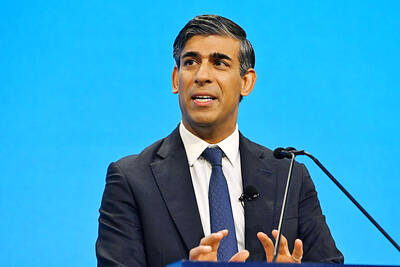
Former British prime minister Rishi Sunak on Wednesday urged so-called middle powers to become a “poisonous shrimp” to carve out strategic economic leverage in a more turbulent global environment. Sunak drew from a metaphor by former Singaporean prime minister Lee Kuan Yew (李光耀): A big fish will eat a smaller fish, and the smaller fish will eat the shrimp. Lee made the point a year after the Asian nation’s independence in 1966 that the city-state needed to build up its defense mechanisms — like a shrimp that stings — so it would be left alone by predators. “He was thinking about what Singapore’s

POLL POSITION: Democrats criticized the timing of the raid, saying that the US justice department historically avoids public investigations within 60 days of an election Federal agents on Monday searched the home of Democratic US Representative Ilhan Omar, a startling escalation in a criminal investigation that brings renewed focus to the frequent target of White House derision in the final weeks of her re-election bid. The search of the Minnesota congresswoman’s home so close to next month’s midterm contests that would determine control of the US House and the Senate was swiftly condemned by top Democrats in Congress, who raised questions about the timing given longstanding US Department of Justice (DOJ) protocol to avoid overt investigative steps involving political candidates in the direct run-up to an
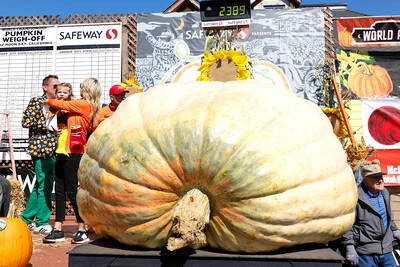
A Rhode Island pumpkin grower appears to have broken the world record for the heaviest pumpkin, with his giant squash topping the record by nearly 136kg. Ron Wallace of Greene, Rhode Island, weighed his pumpkin on Saturday at a contest in New England and is waiting for the Guinness World Records to confirm he smashed the record, set about a week earlier by a grower in England. Wallace said he has been in contact with Guinness officials who say his record is on track to be verified. “It’s truly massive, it was a pleasure to grow,” Wallace said on Monday. Guinness World Records lists

BUILDUP: The report comes as Japanese Prime Minister Sanae Takaichi boosts defense spending in the face of China’s military expansion and the North Korean threat French defence contractor Thales will establish a maintenance and operational support base in Japan in what is seen as the first such move by a foreign firm in the country, a report said yesterday. Thales chairman and CEO Patrice Caine told the Nikkei business daily that the base “will mark a milestone toward Thales’ long-term engagement in Japan.” It is believed to be the first time a foreign defense company has established a dedicated base in Japan for the maintenance and operation of Japanese defense equipment, the Nikkei said. It added that Thales might also expand its Japan-based business to


 RSS
RSS