


North Korea lashed out yesterday at South Korea and the US for planning annual joint military exercises next month, saying the maneuvers are preparations for an invasion of the communist country.
The six-day exercises -- dubbed Key Resolve and Foal Eagle -- are scheduled to begin on March 2 with 27,000 US troops, along with the aircraft carrier USS Nimitz and an undisclosed number of South Korean soldiers.
"Nothing can cover up the invasive nature" of the exercise, the North's state-run Korean Central TV Station reported yesterday, according to Yonhap news agency of South Korea.
The joint military exercises are "nothing but saber rattling to invade the North," the North's official Korean Central News Agency said in a separate report.
The annual exercises -- previously called RSOI and Foal Eagle -- involve a computer-simulated war game with field drills aimed at improving US and South Korean forces' defense capabilities.
South Korea and the US have characterized them as purely defensive but the North has long claimed the US is bent on invading the country, condemning the annual military drill as a "rehearsal'' for an attack.
The latest denunciation came just a day after the North accused the US of attempting to permanently station its troops in South Korea.
About 28,500 US troops are stationed in South Korea as a deterrent against a North Korean invasion, a legacy of the 1950 to 1953 Korean War. The conflict ended in a ceasefire, not a peace treaty, leaving the two Koreas technically still at war.

Crowds in Bangladesh are flocking to snap photographs with an unlikely social media star — an albino buffalo with flowing blond hair nicknamed “Donald Trump” that is due to be sacrificed within days. Owner Zia Uddin Mridha, 38, said his brother named the 700kg bull over its flowing helmet of hair resembling the signature look of the US president. “My younger brother picked this name because of the buffalo’s extraordinary hair,” he said at his farm in Narayanganj, just outside the capital, Dhaka. Mridha said that a constant stream of curious visitors — social media fans, onlookers and children — have come throughout

It began as a satirical online project. Now millions of young people in India are flocking to it as an outlet for their frustration. A parody political party called the Cockroach Janta Party, with the insect as its symbol, has exploded across India’s social media by turning absurdist humor into protest. Memes and short videos mocking corruption, joblessness and political dysfunction have flooded social media sites, where millions of users are embracing the cockroach — known for its ability to survive harsh conditions — as a tongue-in-cheek symbol of endurance. The online movement’s rise has been unusually rapid. The Cockroach Janta Party (CJP)
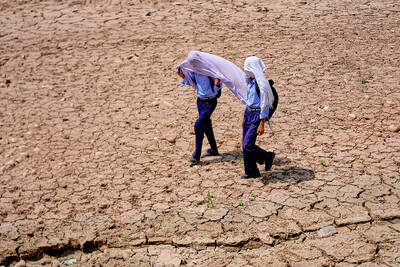
HOTTER: While Indians are accustomed to summer heat, climate change has caused northwestern India to warm faster than other parts of the country, an academic said Roads and markets have emptied during afternoons and some farmers have switched to nighttime work to avoid scorching temperatures as a heat wave grips large parts of India. The India Meteorological Department forecast maximum temperatures for yesterday of about 45°C in the capital, New Delhi, where authorities have opened temporary “cooling zones” to help people cope. The weather department warned that conditions would likely persist across several northern regions in the coming days, with temperatures staying well above seasonal averages. Authorities urged people to stay indoors during the hottest hours and take precautions against heat-related illnesses. India declares a heat wave whenever maximum temperatures

A Hong Kong astronaut is to join a Chinese space mission for the first time as part of a three-person crew launching today, as Beijing edges closer to its goal of landing people on the moon. The Tiangong space station — crewed by teams of three astronauts that are typically rotated every six months — is the crown jewel of China’s space program, boosted by billions in state investment in a bid to catch up with the US and Russia. The Shenzhou-23 mission is to blast off at 11:08pm from the Jiuquan Satellite Launch Center in northwestern China, carrying three astronauts to


 RSS
RSS