


Thousands of Australians turned out yesterday for a macabre viewing of the remains of a colonial graveyard for convicts, soldiers and free settlers beneath Sydney's city hall.
Officials said they had expected about 150 people to accept an open public invitation to visit the ancient cemetery during renovation work on the stately sandstone structure on Sydney's main thoroughfare, George Street.
Instead, more than 2,000 people, many of them office workers on their lunch break, were estimated to have joined a line that stretched around the building in the heart of the bustling modern city.
"I think it's true to say we've got more than we anticipated," City of Sydney media officer Josh MacKenzie said.
Inside the building, the crowds watched archaeologists at work in a shallow pit under the Peace Hall as they try to find any last shards of bone in the moist clay of the 53 graves of adults and children unearthed last year.
Archeologist Tony Lowe said the graves in the Old Sydney Burial Ground were cleared in the 1880s when the last of the Town Hall was built, but the excavation aimed to find any overlooked remains.
"All the graves have been exhumed so we are finding remnants. All the head stones are removed," Lowe said. "The coffins have completely decayed, just leaving gaps or black dust. Also the bones are in poor condition mostly because they've been disturbed or damaged."
He said anything that was found would be fragmentary but all human remains would be sent to an anatomy museum at Sydney University and possibly later reinterred at Sydney's Rookwood cemetery.
City historian Shirley Fitzgerald said that thousands of those buried at the Old Sydney Burial Ground, and later exhumed and reburied when the Town Hall was constructed, had already been identified using records from an adjoining church.
The cemetery, which was full within 30 years of Sydney's settlement by the British in 1788, was the final home for all levels of colonial society.
"But the reason we keep finding bodies is because of the convicts. A lot of the convicts were just put in the ground which means they [their bodies] moved around all over the place," she said.
Officially exhumed in 1869, additional coffins, skulls, headstones, vaults and other remains were still being found well into the 20th century as the Town Hall and its surroundings underwent maintenance work.
Fitzgerald said while the site was originally chosen as a graveyard because it was considered "way, way out of town" at 1,500m from early settlements, it was then built over because it was "good real estate."
"We imagine ... that people treated the dead with respect. We didn't. We trampled all over them. It was a good bit of real estate. This was the commercial heartland of Sydney," she said.
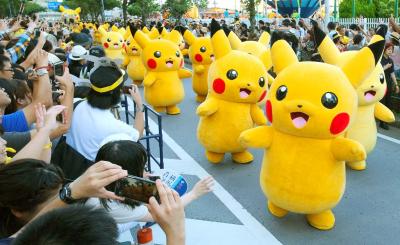
China’s military news agency yesterday warned that Japanese militarism is infiltrating society through series such as Pokemon and Detective Conan, after recent controversies involving events at sensitive sites. In recent days, anime conventions throughout China have reportedly banned participants from dressing as characters from Pokemon or Detective Conan and prohibited sales of related products. China Military Online yesterday posted an article titled “Their schemes — beware the infiltration of Japanese militarism in culture and sports.” The article referenced recent controversies around the popular anime series Pokemon, Detective Conan and My Hero Academia, saying that “the evil influence of Japanese militarism lives on in
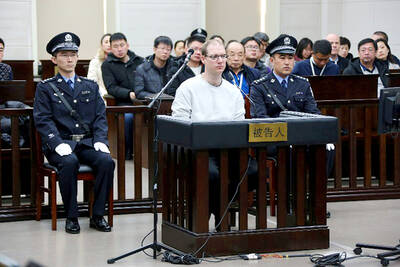
DIPLOMATIC THAW: The Canadian prime minister’s China visit and improved Beijing-Ottawa ties raised lawyer Zhang Dongshuo’s hopes for a positive outcome in the retrial China has overturned the death sentence of Canadian Robert Schellenberg, a Canadian official said on Friday, in a possible sign of a diplomatic thaw as Canadian Prime Minister Mark Carney seeks to boost trade ties with Beijing. Schellenberg’s lawyer, Zhang Dongshuo (張東碩), yesterday confirmed China’s Supreme People’s Court struck down the sentence. Schellenberg was detained on drug charges in 2014 before China-Canada ties nosedived following the 2018 arrest in Vancouver of Huawei chief financial officer Meng Wanzhou (孟晚舟). That arrest infuriated Beijing, which detained two Canadians — Michael Spavor and Michael Kovrig — on espionage charges that Ottawa condemned as retaliatory. In January

A sign hanging from a rusty ice-green shipping container installed by Thai forces on what they say is the border with Cambodia reads: “Cambodian citizens are strictly prohibited from entering this area.” On opposite sides of the makeshift barricade, fronted by coils of barbed wire, Cambodians lamented their lost homes and livelihoods as Thailand’s military showed off its gains. Thai forces took control of several patches of disputed land along the border during fighting last year, which could amount to several square kilometers in total. Cambodian Kim Ren said her house in Chouk Chey used to stand on what is now the Thai
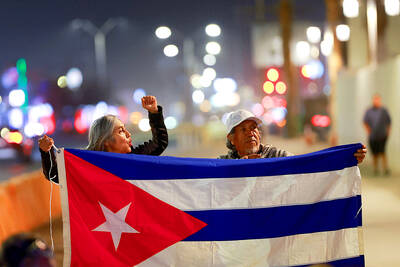
NEW RULES: There would be fewer school days, four-day workweeks, and a reduction in transportation services as the country battles a crisis exacerbated by US pressure The Cuban government on Friday announced emergency measures to address a crippling energy crisis worsened by US sanctions, including the adoption of a four-day work week for state-owned companies and fuel sale restrictions. Cuban Deputy Prime Minister Oscar Perez-Oliva Fraga blamed Washington for the crisis, telling Cuban television the government would “implement a series of decisions, first and foremost to guarantee the vitality of our country and essential services, without giving up on development.” “Fuel will be used to protect essential services for the population and indispensable economic activities,” he said. Among the new measures are the reduction of the working week in


 RSS
RSS