


Surging floodwaters forced scores of people to evacuate their homes in northeastern Australia yesterday, officials said, as farmers described heavy rains as a mixed blessing after years of drought.
Worst hit by the rising waters was the central Queensland town of Emerald, where people left their homes for higher ground as the swollen Nogoa River threatened to inundate parts of the town.
"There's been about 120 people who have voluntarily relocated at the moment -- that happened last night and this morning," a State Emergency Services spokeswoman said. "But it's likely that a further 250 dwellings will be voluntarily evacuated this afternoon."
Emergency workers also carried out helicopter evacuations near Emerald after workers at the Ensham coalmine, about 40km east of the town, were cut off by the rising waters.
Elsewhere, floodwaters were threatening the southwestern town of Charleville, but officials were confident they would be contained.
Queensland state premier Anna Bligh said while the focus was on the major population centers of Emerald and Charleville, there were also "many, many, many properties that have been isolated" by the rising waters.
Large parts of Australia have been hit by heavy rains in recent weeks -- including the drought affected eastern states of Queensland in the north and Victoria in the south -- raising hopes that an end to the worst dry spell in living memory could be in sight.
But Queensland farmers said the latest deluge was a mixed blessing because it came at the cost of millions of dollars in lost crops and stock.
Brett De Hayr, head of the agricultural group AgForce, said the losses from the flooding could top A$1 billion (US$876 million).
"Long-term, it is undeniably going to be extremely positive, but it's just in the nature of these things that individuals are going to have some fairly significant losses to wear for a while," he said.
Tony Rayner, an official with Queensland's Department of Primary Industries, said the benefits of the floods would eventually offset the losses.
"Generally speaking, most producers have been in long-term drought situations -- some properties have been experiencing five to seven years of below average rainfall -- so this is a good start to drought recovery," he said.
But he said follow-up rains were needed next month and in March to break the drought in Queensland.
"It's early days yet but some producers are quite optimistic that this is returning to a more traditional wet season," he said.
Wendy Craik, who heads the commission which steers the country's biggest agricultural zone, the Murray-Darling Basin, said it was not known how much water from the floods would benefit farmers further south but some would flow into the system.
Craik said recent rains in Victoria state, much of which falls within the Murray-Darling Basin, which holds 75 percent of the country's irrigated farmland, had also boosted water supplies.
"There was widespread rain last week through the Murray-Darling Basin -- with the exception of South Australia -- and in terms of dry land farmers, it's looking a lot better," she said.
"In terms of irrigators who rely on the Murray [River] ... we still have a long way to go to restore our storages. So we're not out of the woods yet," she said.
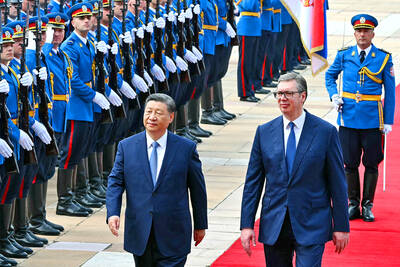
MONEY MATTERS: Xi was to highlight projects such as a new high-speed railway between Belgrade and Budapest, as Serbia is entirely open to Chinese trade and investment Serbian President Aleksandar Vucic yesterday said that “Taiwan is China” as he made a speech welcoming Chinese President Xi Jinping (習近平) to Belgrade, state broadcaster Radio Television of Serbia (RTS) said. “We have a clear and simple position regarding Chinese territorial integrity,” he told a crowd outside the government offices while Xi applauded him. “Yes, Taiwan is China.” Xi landed in Belgrade on Tuesday night on the second leg of his European tour, and was greeted by Vucic and most government ministers. Xi had just completed a two-day trip to France, where he held talks with French President Emmanuel Macron as the

With the midday sun blazing, an experimental orange and white F-16 fighter jet launched with a familiar roar that is a hallmark of US airpower, but the aerial combat that followed was unlike any other: This F-16 was controlled by artificial intelligence (AI), not a human pilot, and riding in the front seat was US Secretary of the Air Force Frank Kendall. AI marks one of the biggest advances in military aviation since the introduction of stealth in the early 1990s, and the US Air Force has aggressively leaned in. Even though the technology is not fully developed, the service is planning
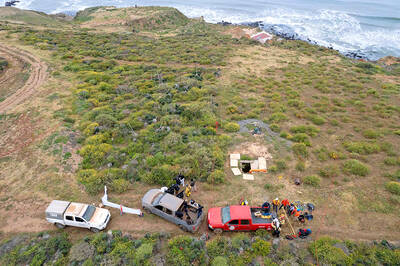
INTERNATIONAL PROBE: Australian and US authorities were helping coordinate the investigation of the case, which follows the 2015 murder of Australian surfers in Mexico Three bodies were found in Mexico’s Baja California state, the FBI said on Friday, days after two Australians and an American went missing during a surfing trip in an area hit by cartel violence. Authorities used a pulley system to hoist what appeared to be lifeless bodies covered in mud from a shaft on a cliff high above the Pacific. “We confirm there were three individuals found deceased in Santo Tomas, Baja California,” a statement from the FBI’s office in San Diego, California, said without providing the identities of the victims. Australian brothers Jake and Callum Robinson and their American friend Jack Carter
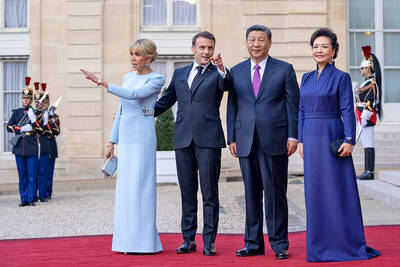
CUSTOMS DUTIES: France’s cognac industry was closely watching the talks, fearing that an anti-dumping investigation opened by China is retaliation for trade tensions French President Emmanuel Macron yesterday hosted Chinese President Xi Jinping (習近平) at one of his beloved childhood haunts in the Pyrenees, seeking to press a message to Beijing not to support Russia’s war against Ukraine and to accept fairer trade. The first day of Xi’s state visit to France, his first to Europe since 2019, saw respectful, but sometimes robust exchanges between the two men during a succession of talks on Monday. Macron, joined initially by EU Commission President Ursula von der Leyen, urged Xi not to allow the export of any technology that could be used by Russia in its invasion


 RSS
RSS