


Two Belgian women tourists were among four people killed, and four more Belgians were wounded, when suspected al-Qaeda gunmen opened fire on them in Yemen on Friday, a local official said.
The official, who declined to be named, blamed the local branch of the terror network for the attack, in which the tourists' Yemeni guide and driver were also killed.
The attackers were said to have opened fire on a bus carrying 15 Belgian tourists in the eastern province of Hadramut's Do'an Valley, before they fled the scene in a car.
In Brussels, Belgian Foreign Minister Karel De Gucht said the tourists should have known Yemen was a dangerous place to visit.
"Someone who leaves for Yemen knows that it is a dangerous destination," he said. "When you travel with a group specializing in adventure holidays, you also know that there is a risk."
One of the Belgian victims was named as 65-year-old Claudine Van Caillie from Bruges. Patrick Coucke, also 65, who was shot in the stomach, was expected to be flown out of Yemen late on Friday.
De Gucht did not confirm any al-Qaeda link with the attack, adding that the Hadramut area was out of the government's control and also had "tribal problems."
`DESERT MANHATTAN'
The group was traveling to the city of Shibam, which lies around 450km east of the capital, Sanaa.
The 16th century city is a UNESCO World Heritage site and has been dubbed the "Manhattan of the Desert" for its distinctive, tower-like structures.
Hadramut Governor Taha Hajir said in a statement posted on the defense ministry's Web site that security teams had set up roadblocks and helicopters had been deployed to locate those responsible for the "criminal incident."
The casualties were transported to a local hospital and arrangements were made to move them on to Sanaa, Hajir added.
Last July, seven Spanish tourists and two local drivers were killed when a suicide bomber rammed his explosives-laden car into their convoy at an ancient temple in Yemen.
That bombing was the worst attack against Westerners in the Arabian peninsula country since al-Qaeda extremists struck the USS Cole off the southern port of Aden in 2000, killing 17 US sailors.
HISTORY OF ATTACKS
Al-Qaeda has been blamed for a series of attacks in Yemen, the ancestral homeland of its leader, Osama bin Laden. Some predated the Sept. 11, 2001, attacks.
Yemen announced last month that it had foiled an al-Qaeda suicide attack in the country and captured two members of a terrorist cell in Sanaa.
The Yemeni branch of al-Qaeda recently announced in an Internet statement that it would carry out operations to free imprisoned members of its group.
The killing of tourists in Yemen is rare, but foreigners are frequently seized by powerful tribes for use as bargaining chips in disputes with the central government. More than 200 have been abducted during the past 15 years.
All have been freed unharmed except for three Britons and an Australian seized by Islamist militants in December 1998. They were killed when security forces stormed the kidnappers' hideout.

The team behind the long-awaited Vera Rubin Observatory in Chile yesterday published their first images, revealing breathtaking views of star-forming regions as well as distant galaxies. More than two decades in the making, the giant US-funded telescope sits perched at the summit of Cerro Pachon in central Chile, where dark skies and dry air provide ideal conditions for observing the cosmos. One of the debut images is a composite of 678 exposures taken over just seven hours, capturing the Trifid Nebula and the Lagoon Nebula — both several thousand light-years from Earth — glowing in vivid pinks against orange-red backdrops. The new image
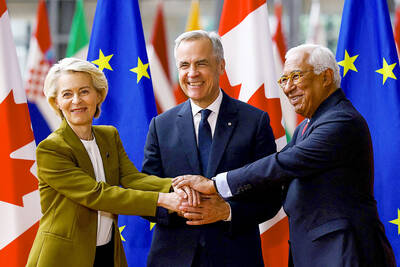
Canada and the EU on Monday signed a defense and security pact as the transatlantic partners seek to better confront Russia, with worries over Washington’s reliability under US President Donald Trump. The deal was announced after a summit in Brussels between Canadian Prime Minister Mark Carney and European Commission President Ursula von der Leyen and European Council President Antonio Costa. “While NATO remains the cornerstone of our collective defense, this partnership will allow us to strengthen our preparedness ... to invest more and to invest smarter,” Costa told a news conference. “It opens new opportunities for companies on both sides of the
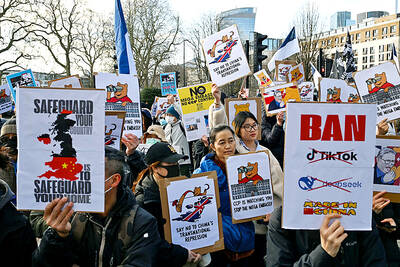
ESPIONAGE: The British government’s decision on the proposed embassy hinges on the security of underground data cables, a former diplomat has said A US intervention over China’s proposed new embassy in London has thrown a potential resolution “up in the air,” campaigners have said, amid concerns over the site’s proximity to a sensitive hub of critical communication cables. The furor over a new “super-embassy” on the edge of London’s financial district was reignited last week when the White House said it was “deeply concerned” over potential Chinese access to “the sensitive communications of one of our closest allies.” The Dutch parliament has also raised concerns about Beijing’s ideal location of Royal Mint Court, on the edge of the City of London, which has so
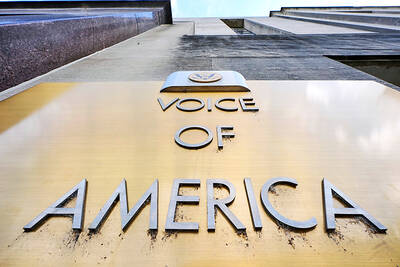
OVERHAUL: The move would likely mark the end to Voice of America, which was founded in 1942 to counter Nazi propaganda and operated in nearly 50 languages The parent agency of Voice of America (VOA) on Friday said it had issued termination notices to more than 639 more staff, completing an 85 percent decrease in personnel since March and effectively spelling the end of a broadcasting network founded to counter Nazi propaganda. US Agency for Global Media (USAGM) senior advisor Kari Lake said the staff reduction meant 1,400 positions had been eliminated as part of US President Donald Trump’s agenda to cut staffing at the agency to a statutory minimum. “Reduction in Force Termination Notices were sent to 639 employees at USAGM and Voice of America, part of a


 RSS
RSS