


US Secretary of Defense Robert Gates on Tuesday called on NATO allies to fill shortfalls of troops, equipment and resources in Afghanistan, warning of rising violence and the emergence of a classic insurgency.
Gates said the US was not prepared to continue filling a shortfall in helicopters beyond January and his top military chief said there were limits to what the US can provide.
"My own view is I'm not ready to let NATO off the hook in Afghanistan at this point," Gates told the House Armed Services Committee.
Gates and Admiral Michael Mullen, the chairman of the Joint Chiefs of Staff, said violence has increased, particularly in southern Afghanistan, since a NATO-led force assumed responsibility for security throughout the country in October last year.
Mullen said levels of violence nationwide were up 27 percent over last year, while that in the southern Helmand Province the increase was 60 percent.
The admiral described the developments as "a classic insurgency" that required "a well coordinated counter-insurgency strategy."
"And while I applaud NATO for stepping up to the plate, the ISAF [International Stabilization Assistance Force] is plagued by shortfalls in capability and capacity and constrained by a host of caveats that limits its ability," he said.
At the same time, Mullen said there were limits to what the US military can provide when the bulk of its resources are devoted to the war in Iraq.
"The war in Afghanistan is by design and necessity an economy of force operation. There is no getting around it," Mullen said.
"Our main focus militarily in the region and the world right now is rightly and firmly in Iraq," he said. "In Afghanistan we do what we can. In Iraq we do what we must."
Gates, who visited Afghanistan a week ago, said he would discuss the shortfalls at a meeting in Scotland this week of defense ministers of countries contributing troops to ISAF in southern Afghanistan.
trainers
He said they include 3,000 trainers, mainly for the Afghan police but also the army; 20 medium, heavy lift and attack helicopters; and three maneuver battalions.
"The numbers are not all that big, which frankly is one of the sources of frustration to me in terms of our allies not being able to step up to the plate," he said.
Nevertheless, Gates said some allies have consistently provided forces, including France, which has said it would keep forces in Afghanistan and fill a gap left by departing Dutch forces in the south.
The biggest unfilled need is for police trainers, he said.
The EU had promised 160 police trainers, but only 70 were in country, he said.
corruption
Police corruption and the lack of government services are seen as major contributors to a growing public disaffection with the government of Afghan President Hamid Karzai.
Gates said the number of non-US troops has increased by about 3,500 since ISAF assumed responsibility for the entire country.
"That said, much more can and should be done," he said.
Gates said that part of the problem was that NATO allies had differing views about the alliance's purpose in a post Cold War period.
NATO needs to take a step back and draft a "strategic concept" for where it wants to be three to five years in Afghanistan, he said.
"The Afghanistan mission has exposed real limitation in the way the alliance is organized, operated and equipped," he said.
"We're in a post-Cold War environment. We have to be ready to operate in distant locations against insurgencies and terrorist networks," he said.
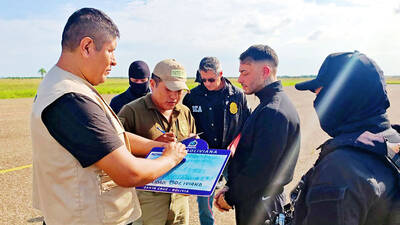
KINGPIN: Marset allegedly laundered the proceeds of his drug enterprise by purchasing and sponsoring professional soccer teams and even put himself in the starting lineups Notorious Latin American narco trafficker Sebastian Marset, who eluded police for years, was handed over to US authorities after his arrest on Friday in Bolivia. Marset, a Uruguayan national who was on the US most-wanted list, was passed to agents of the US Drug Enforcement Administration at Santa Cruz airport in Bolivia, then put on a US airplane, Bolivian state television showed. “The arrest and deportation were carried out pursuant to a court order issued by the US justice system,” Bolivian Minister of Government Marco Antonio Oviedo told reporters. The alleged kingpin was arrested in an upscale neighborhood of Santa
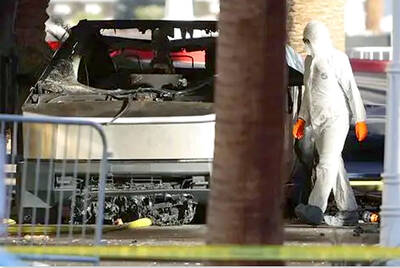
ACTIONABLE ADVICE: The majority of chatbots tested provided guidance on weapons, tactics and target selections, with Perplexity and Meta AI deemed to be the least safe From school shootings to synagogue bombings, leading artificial intelligence (AI) chatbots helped researchers plot violent attacks, according to a study published on Wednesday that highlighted the technology’s potential for real-world harm. Researchers from the nonprofit watchdog Center for Countering Digital Hate and CNN posed as 13-year-old boys in the US and Ireland to test 10 chatbots, including ChatGPT, Google Gemini, Perplexity, Deepseek and Meta AI. Eight of the chatbots assisted the make-believe attackers in more than half the responses, providing advice on “locations to target” and “weapons to use” in an attack, the study said. The chatbots had become a “powerful accelerant for
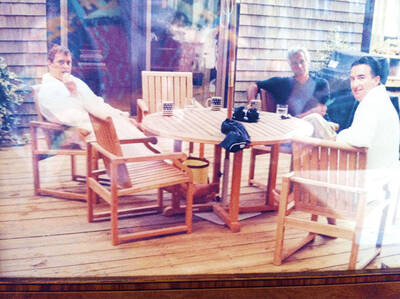
SCANDAL: Other images discovered earlier show Andrew bent over a female and lying across the laps of a number of women, while Mandelson is pictured in his underpants A photograph of former British prince Andrew and veteran politician Peter Mandelson sitting in bathrobes alongside late sex offender Jeffrey Epstein was unearthed on Friday in previously published documents. The image is believed to be the first known photograph of the two men with Epstein. They are currently engulfed in scandal in the UK over their ties to their mutual friend. The undated photograph, first reported by ITV News, shows King Charles III’s disgraced brother and former British ambassador to the US sitting barefoot outside on a wooden deck. They appear to have mugs with a US flag on them
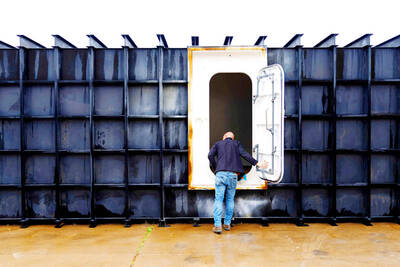
Since the war in the Middle East began nearly two weeks ago, the telephone at Ron Hubbard’s bomb shelter company in Texas has not stopped ringing. Foreign and US clients are rushing to buy his bunkers, seeking refuge in case of air raids, nuclear fallout or apocalypse. With the US and Israel pounding Iran, and Tehran retaliating with strikes across the region, Hubbard has seen demand for his product soar, mostly from Gulf nation customers in Bahrain, Qatar, Kuwait and the United Arab Emirates. “You can imagine how many people are thinking: ‘I wish I had a bomb shelter,’” Hubbard, 63, said in


 RSS
RSS