


UN Secretary-General Ban Ki-moon received a report confirming a deadlock in negotiations between Kosovo's ethnic Albanian leaders and Serbia over the future status of Kosovo, but Russia called for further talks, saying "a solution is possible."
US Secretary of State Condoleezza Rice disagreed, however, saying the time for negotiations was over. She said failure to move ahead on Kosovo's status was ignoring the reality in the Serb province where the ethnic-Albanian majority has pledged to declare independence with or without an international agreement.
The report sets the stage for a difficult period ahead, both at the UN and in Europe over Kosovo's future. It will pit the US and most European nations that back the ethnic Albanian quest for independence against Serbia and its close ally Russia.
The US, the EU and Russia reported to the secretary-general on Friday that negotiations "served a useful purpose" and led to "the most sustained and intense high-level direct dialogue since hostilities ended in Kosovo in 1999."
"Perhaps most important, Belgrade and Pristina reaffirmed the centrality of their European perspective to their future relations, with both sides restating their desire to seek a future under the common roof of the European Union," the negotiators said.
But they said the talks failed because "neither party was willing to cede its position on the fundamental question of sovereignty," a copy obtained by the Associated Press showed.
The negotiators said they could not bridge the gap between Kosovo's Albanian leadership, which refused to budge on its demand for independence, and the Serbian government, which offered a high degree of autonomy to Kosovo but insisted that the province remain part of Serbia.
The widely expected declaration of failure came after more than two years of negotiations between Serbia and Kosovo, where ethnic Albanians comprise 90 percent of the 7 million population.
Russia's U.N. Ambassador Vitaly Churkin rejected the word "failure" to describe the 120 days of negotiations, calling the talks "a very worthwhile exercise ... that produced some serious results" and the first "substantive dialogue" in years.
"We believe that this outcome is quite encouraging," Churkin said.
While the Kosovo Albanians' refusal to show flexibility was regrettable, "we believe that certainly the talks revealed that a solution is possible," he said.
The UN Security Council is scheduled to discuss the Kosovo report on Dec. 19.
Rice on Friday made clear that the US would not support more negotiations.
"I think that process is at an end," she told reporters in Brussels, where she attended meetings with other NATO foreign ministers and Russia's foreign minister.
"We have to move on to the next step," Rice told a news conference. "It is not going to produce stability in the Balkans to ignore the reality of the situation."

Crowds in Bangladesh are flocking to snap photographs with an unlikely social media star — an albino buffalo with flowing blond hair nicknamed “Donald Trump” that is due to be sacrificed within days. Owner Zia Uddin Mridha, 38, said his brother named the 700kg bull over its flowing helmet of hair resembling the signature look of the US president. “My younger brother picked this name because of the buffalo’s extraordinary hair,” he said at his farm in Narayanganj, just outside the capital, Dhaka. Mridha said that a constant stream of curious visitors — social media fans, onlookers and children — have come throughout

It began as a satirical online project. Now millions of young people in India are flocking to it as an outlet for their frustration. A parody political party called the Cockroach Janta Party, with the insect as its symbol, has exploded across India’s social media by turning absurdist humor into protest. Memes and short videos mocking corruption, joblessness and political dysfunction have flooded social media sites, where millions of users are embracing the cockroach — known for its ability to survive harsh conditions — as a tongue-in-cheek symbol of endurance. The online movement’s rise has been unusually rapid. The Cockroach Janta Party (CJP)

BIGGER ROLE: Beijing has said it maintains an impartial stance on the war in Ukraine, but by training Russian troops, China is far more involved than previously known China’s armed forces secretly trained about 200 Russian military personnel in China late last year, and some have since returned to fight in Ukraine, according to three European intelligence agencies and documents seen by Reuters. While China and Russia have held a number of joint military exercises since Moscow’s full-scale invasion of Ukraine in 2022, Beijing has repeatedly said that it is neutral in the conflict and presents itself as a peace mediator. The covert training sessions, which predominantly focused on the use of drones, were outlined in a dual-language Russian-Chinese agreement signed by senior Russian and Chinese officers in Beijing on
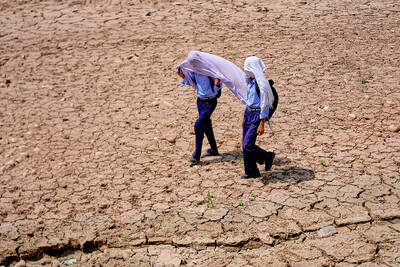
HOTTER: While Indians are accustomed to summer heat, climate change has caused northwestern India to warm faster than other parts of the country, an academic said Roads and markets have emptied during afternoons and some farmers have switched to nighttime work to avoid scorching temperatures as a heat wave grips large parts of India. The India Meteorological Department forecast maximum temperatures for yesterday of about 45°C in the capital, New Delhi, where authorities have opened temporary “cooling zones” to help people cope. The weather department warned that conditions would likely persist across several northern regions in the coming days, with temperatures staying well above seasonal averages. Authorities urged people to stay indoors during the hottest hours and take precautions against heat-related illnesses. India declares a heat wave whenever maximum temperatures


 RSS
RSS