


Former Soviet president Mikhail Gorbachev said on Tuesday a pillar of the arms control system could fall if Washington and Moscow replace the landmark START nuclear arms reduction treaty with a less formal pact.
The START treaty, signed in 1991, set ceilings on the size of the Russian and US nuclear arsenals and became a symbol of the end of the Cold War. Washington has indicated it will not extend it in 2009 but wants to replace it with a pact that eliminates strict verification requirements and weapons curbs.
"I don't see a negotiating process actually happening," Gorbachev, who signed the START treaty with then-president George Bush, told a Harvard University forum entitled "Overcoming Nuclear Danger."
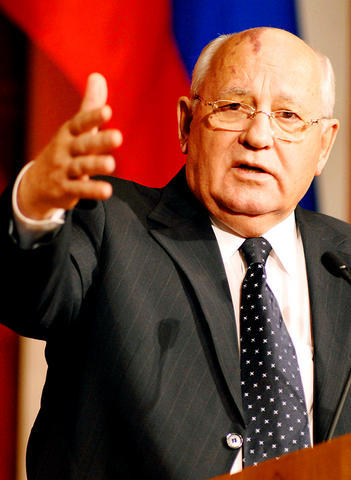
PHOTO: AP
The conference at the John F. Kennedy School of Government assembled dozens of experts from the US, Russia and other nations for discussions on minimizing the risks of nuclear terrorism and nuclear war.
Diplomatic analysts have said a US position on START reflects US President George W. Bush's practice of repudiating arms control as a means of curbing nuclear weapons while relying more on measures like export controls, interdiction and sanctions.
Russia has said the treaty should be replaced with a formal, binding pact, and not an informal arrangement.
Gorbachev said verifying and inspecting each country's nuclear arsenals was crucial.
"It is totally wrong to declare that this system is obsolete and unnecessary after the end of the Cold War," he said. "It is totally wrong."
Gorbachev also said another milestone arms control pact, the Intermediate-Range Nuclear Forces Treaty (INF) which he signed with former US president Ronald Reagan in 1987, must be preserved.
In an interview, he said he disagrees with Russian President Vladimir Putin and others who have called the treaty outdated and suggested that Moscow should consider pulling out of it.
The treaty banned the entire class of medium-range missiles.
"All of these treaties constitute a system, a structure, that maintained a certain stability ... but this is something that should continue to work," Gorbachev said. "It's not some kind of scrap and it's not some kind of old goods to be sold."
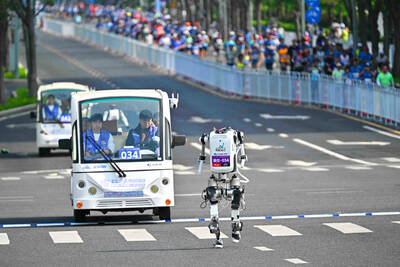
A humanoid robot that won a half-marathon race for robots in Beijing on Sunday ran faster than the human world record in a show of China’s technological leaps. The winner from Honor, a Chinese smartphone maker, completed the 21km race in 50 minutes and 26 seconds, said a WeChat post by the Beijing Economic-Technological Development Area, also known as Beijing E-Town, where the race began. That was faster than the human world record holder, Ugandan Jacob Kiplimo, who finished the same distance in about 57 minutes in March at the Lisbon road race. The performance by the robot marked a significant step forward
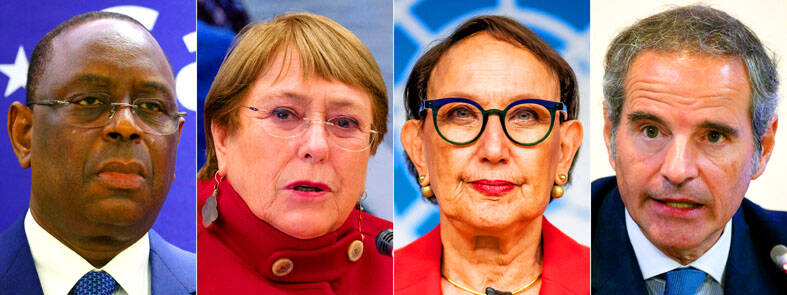
Four contenders are squaring up to succeed Antonio Guterres as secretary-general of the UN, which faces unprecedented global instability, wars and its own crushing budget crisis. Chile’s Michelle Bachelet, Argentina’s Rafael Grossi, Costa Rica’s Rebeca Grynspan and Senegal’s Macky Sall are each to face grillings by 193 member states and non-governmental organizations for three hours today and tomorrow. It is only the second time the UN has held a public question-and-answer, a format created in 2016 to boost transparency. Ultimately the five permanent members of the UN’s top body, the Security Council, hold the power, wielding vetoes over who leads the
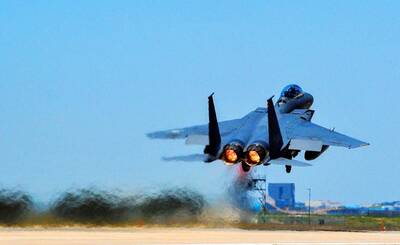
South Korea’s air force yesterday apologized for a 2021 midair collision involving two fighter jets, a day after auditors said the pilots were taking selfies and filming during the flight and held them responsible for the accident. “We sincerely apologize to the public for the concern caused by the accident that occurred in 2021,” an air force spokesman told a news conference, adding that one of the pilots involved had been suspended from flying duties, received severe disciplinary action and has since left the military. The apology followed a report released on Wednesday by the South Korean Board of Audit and Inspection,
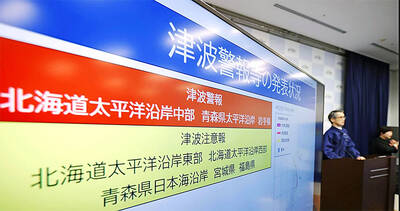
An earthquake registering a preliminary magnitude of 7.7 off northern Japan on Monday prompted a short-lived tsunami alert and the advisory of a higher risk of a possible mega-quake for coastal areas there. The Cabinet Office and the Japan Meteorological Agency said there was a 1% chance for a mega-quake, compared to a 0.1% chance during normal times, in the next week or so following the powerful quake near the Chishima and Japan trenches. Officials said the advisory was not a quake prediction but urged residents in 182 towns along the northeastern coasts to raise their preparedness while continuing their daily lives. Prime


 RSS
RSS