


A notorious Mexican drug lord issued an apology for his crimes on Monday as his life prison sentence for running the murderous Tijuana cartel was confirmed, justice officials said.
Francisco Javier Arellano-Felix, 37, was sentenced to life without the possibility of parole after pleading guilty to running a criminal enterprise and conspiracy to launder money at a hearing in San Diego.
Arellano-Felix's sentence had been announced in September after officials confirmed he would admit his guilt in a plea deal with prosecutors.
In a letter read to the court by his lawyer, Arellano-Felix begged for forgiveness from loved ones and victims alike.
"I would like to ask forgiveness from all of those people, on both sides of the border, who I have affected by my wrongful decisions and criminal conduct," the letter read.
"I am very remorseful, and personally accept responsibility for my actions," the letter continued. "If I had the power to change and undo the things that I have done, I would."
Arellano-Felix, nicknamed "El Tigrillo" ("Little Tiger"), was arrested by the US Coast Guard in August last year while fishing in international waters off Mexico's coast.
US authorities alleged he was the head of the Tijuana drug cartel, which has been blamed for the murder and torture of police officers, informants and rivals and is one of the main smugglers of cocaine into the US.
According to Mexican authorities, Arellano-Felix was also involved in the 1993 assassination of Roman Catholic cardinal Juan Jesus Posadas Ocampo at Guadalajara airport.
The Tijuana cartel distributes illegal drugs, much of it cocaine from Colombia, to California. Authorities say the group has diversified to include amphetamines and marijuana.
A US indictment for 11 top members of the group unveiled in July 2003 charged them with racketeering, conspiracy to import and distribute cocaine and marijuana, and with money laundering.
The 2003 indictment said the Tijuana operation received multi-tonne shipments of cocaine by sea and air from other traffickers, including Colombia's rebel Revolutionary Armed Forces of Colombia, and then arranged to smuggle the drugs into the US.
Arellano-Felix pleaded guilty in September after justice officials indicated they would not seek the death penalty.
The drug kingpin also agreed to forfeit US$50 million he made from his drugs empire as well as a 13m yacht called the Dock Holiday, as part of the plea agreement.
A co-defendant, Manuel Arturo Villareal-Heredia, 31 -- a senior lieutenant within the cartel -- also pleaded guilty to racketeering and conspiracy to invest and reinvest illicit drug profits.
Villareal-Heredia agreed to forfeit US$5 million. He faces up to 30 years in prison when he is sentenced on Jan. 7.
Arellano-Felix was jailed weeks after his elder brother, Francisco Rafael, received a six-year prison term for selling drugs in San Diego.

China’s military news agency yesterday warned that Japanese militarism is infiltrating society through series such as Pokemon and Detective Conan, after recent controversies involving events at sensitive sites. In recent days, anime conventions throughout China have reportedly banned participants from dressing as characters from Pokemon or Detective Conan and prohibited sales of related products. China Military Online yesterday posted an article titled “Their schemes — beware the infiltration of Japanese militarism in culture and sports.” The article referenced recent controversies around the popular anime series Pokemon, Detective Conan and My Hero Academia, saying that “the evil influence of Japanese militarism lives on in

DIPLOMATIC THAW: The Canadian prime minister’s China visit and improved Beijing-Ottawa ties raised lawyer Zhang Dongshuo’s hopes for a positive outcome in the retrial China has overturned the death sentence of Canadian Robert Schellenberg, a Canadian official said on Friday, in a possible sign of a diplomatic thaw as Canadian Prime Minister Mark Carney seeks to boost trade ties with Beijing. Schellenberg’s lawyer, Zhang Dongshuo (張東碩), yesterday confirmed China’s Supreme People’s Court struck down the sentence. Schellenberg was detained on drug charges in 2014 before China-Canada ties nosedived following the 2018 arrest in Vancouver of Huawei chief financial officer Meng Wanzhou (孟晚舟). That arrest infuriated Beijing, which detained two Canadians — Michael Spavor and Michael Kovrig — on espionage charges that Ottawa condemned as retaliatory. In January

A sign hanging from a rusty ice-green shipping container installed by Thai forces on what they say is the border with Cambodia reads: “Cambodian citizens are strictly prohibited from entering this area.” On opposite sides of the makeshift barricade, fronted by coils of barbed wire, Cambodians lamented their lost homes and livelihoods as Thailand’s military showed off its gains. Thai forces took control of several patches of disputed land along the border during fighting last year, which could amount to several square kilometers in total. Cambodian Kim Ren said her house in Chouk Chey used to stand on what is now the Thai
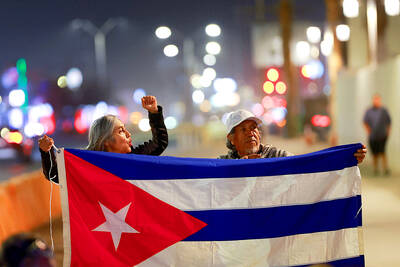
NEW RULES: There would be fewer school days, four-day workweeks, and a reduction in transportation services as the country battles a crisis exacerbated by US pressure The Cuban government on Friday announced emergency measures to address a crippling energy crisis worsened by US sanctions, including the adoption of a four-day work week for state-owned companies and fuel sale restrictions. Cuban Deputy Prime Minister Oscar Perez-Oliva Fraga blamed Washington for the crisis, telling Cuban television the government would “implement a series of decisions, first and foremost to guarantee the vitality of our country and essential services, without giving up on development.” “Fuel will be used to protect essential services for the population and indispensable economic activities,” he said. Among the new measures are the reduction of the working week in


 RSS
RSS