


US Secretary of Defense Robert Gates left for Beijing on Saturday to air US misgivings about the direction China is taking with a military buildup that this year featured an alarming anti-satellite test.
Gates is also scheduled to visit South Korea and Japan during the week-long trip. He will meet Chinese President Hu Jintao (
The US side is hoping the Chinese will agree to establish a telephone hotline linking the Pentagon and Chinese defense ministry as a mark of improving security ties, a senior defense official said.
But on his first trip to China as defense secretary, Gates also has basic questions for Chinese leaders about where they are taking the world's most populous country, as well as specific concerns such as the Jan. 11 anti-satellite test, the official said.
"We're still looking for the kind of response from the Chinese that really helps us understand why they did it," the official said of the anti-satellite test.
China kept silent for nearly two weeks after the test, finally confirming reports that it had used a ballistic missile to destroy one of its own weather satellites in low Earth orbit.
Gates said last month that the test had exposed vulnerabilities of US space systems to attack.
US experts have said China may be developing the capability with an eye to "blinding" the US military in the early days of a conflict over Taiwan.
In August, a senior US military official said China may be capable of disrupting US military communications satellites in a conflict within three years.
"What was the purpose of it? Was it just to do a test for the fun of it? That doesn't make a lot of sense," said the US official, who briefed reporters on condition of anonymity.
"There are definitely larger strategic issues involved here. Understanding those is still is something that in our view needs some serious discussion from the Chinese that we haven't seen yet," he said.
China's cyber warfare capabilities are another broad area of concern, the official said.
The Financial Times, citing unnamed current and former US officials, said a cyber attack in June that temporarily shut down a computer system serving the office of the US defense secretary was traced to the People's Liberation Army.
The US defense official said Iran also could come up in Gates' talks. China, a permanent member of the UN Security Council, has opposed further sanctions against Iran.
"We think China can do more on Iran," the official said.
Washington also has problems with Chinese conventional arms sales to Iran, which have found their way into countries like Iraq and Afghanistan.
"It's clear evidence that the Chinese can't trust Iran to behave responsibly with any weapons that they sell," the official said.
Gates also is expected to raise questions about the accelerating pace and scope of China's military modernization program, a persistent irritant in US-Chinese relations for several years.
The Defense Intelligence Agency estimates Chinese military spending this year to be US$125 billion, well beyond China's US$45 billion official defense budget.
"It's what is the role they plan to play in the world, how do they plan to play it, and especially what does their military buildup mean for us and the rest of the region. Those are the subjects we are going to be talking about," the US defense official said.
From Beijing, Gates travels to South Korea and Japan for talks that the official described as exercises in alliance building.
Security relations with South Korea have improved amid a realignment of US forces on the peninsula, he said.
In Japan, Gates will seek support for a resumption of a Japanese naval refueling operation in support of coalition "war on terror" operations in the Indian Ocean.

China’s military news agency yesterday warned that Japanese militarism is infiltrating society through series such as Pokemon and Detective Conan, after recent controversies involving events at sensitive sites. In recent days, anime conventions throughout China have reportedly banned participants from dressing as characters from Pokemon or Detective Conan and prohibited sales of related products. China Military Online yesterday posted an article titled “Their schemes — beware the infiltration of Japanese militarism in culture and sports.” The article referenced recent controversies around the popular anime series Pokemon, Detective Conan and My Hero Academia, saying that “the evil influence of Japanese militarism lives on in
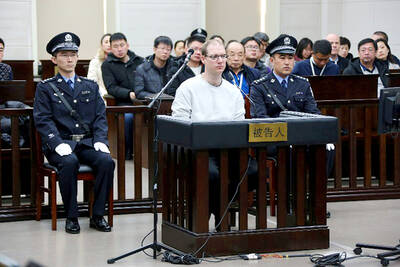
DIPLOMATIC THAW: The Canadian prime minister’s China visit and improved Beijing-Ottawa ties raised lawyer Zhang Dongshuo’s hopes for a positive outcome in the retrial China has overturned the death sentence of Canadian Robert Schellenberg, a Canadian official said on Friday, in a possible sign of a diplomatic thaw as Canadian Prime Minister Mark Carney seeks to boost trade ties with Beijing. Schellenberg’s lawyer, Zhang Dongshuo (張東碩), yesterday confirmed China’s Supreme People’s Court struck down the sentence. Schellenberg was detained on drug charges in 2014 before China-Canada ties nosedived following the 2018 arrest in Vancouver of Huawei chief financial officer Meng Wanzhou (孟晚舟). That arrest infuriated Beijing, which detained two Canadians — Michael Spavor and Michael Kovrig — on espionage charges that Ottawa condemned as retaliatory. In January

A sign hanging from a rusty ice-green shipping container installed by Thai forces on what they say is the border with Cambodia reads: “Cambodian citizens are strictly prohibited from entering this area.” On opposite sides of the makeshift barricade, fronted by coils of barbed wire, Cambodians lamented their lost homes and livelihoods as Thailand’s military showed off its gains. Thai forces took control of several patches of disputed land along the border during fighting last year, which could amount to several square kilometers in total. Cambodian Kim Ren said her house in Chouk Chey used to stand on what is now the Thai

NEW RULES: There would be fewer school days, four-day workweeks, and a reduction in transportation services as the country battles a crisis exacerbated by US pressure The Cuban government on Friday announced emergency measures to address a crippling energy crisis worsened by US sanctions, including the adoption of a four-day work week for state-owned companies and fuel sale restrictions. Cuban Deputy Prime Minister Oscar Perez-Oliva Fraga blamed Washington for the crisis, telling Cuban television the government would “implement a series of decisions, first and foremost to guarantee the vitality of our country and essential services, without giving up on development.” “Fuel will be used to protect essential services for the population and indispensable economic activities,” he said. Among the new measures are the reduction of the working week in


 RSS
RSS