


The mystery surrounding the construction of what might have been a nuclear reactor in Syria deepened on Friday, when a company released a satellite photo showing that the main building was well under way in September 2003 -- four years before Israeli jets bombed it.
The long genesis was likely to raise questions about whether the administration of US President George W. Bush overlooked a nascent atomic threat in Syria while planning and executing a war in Iraq, which was later found to have no active nuclear program.
A senior US intelligence official said on Friday that US analysts had looked carefully at the site from its early days, but were unsure whether it posed a nuclear threat.
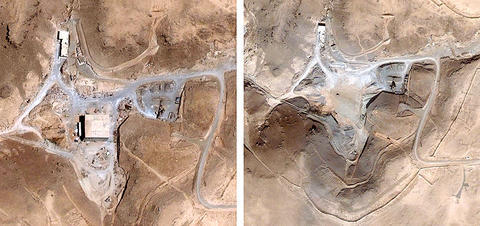
PHOTO: AP
In the time before the Iraq War, Bush and his senior advisers sounded many alarms about Baghdad's reconstituting its nuclear program. But they have never publicly discussed what many analysts say appears to have been a long-running nuclear effort next door.
On Friday, independent analysts, examining the latest satellite image, suggested that work on the site might have begun around 2001 and the senior intelligence official agreed with that analysis. That early date is potentially significant in terms of North Korea's suspected aid to Syria, suggesting that North Korea could have begun its assistance in the late 1990s.
A dispute has broken out between conservatives and US Secretary of State Condoleezza Rice over the administration's pursuit of diplomacy with North Korea in the face of intelligence that North Korea might have helped Syria design a nuclear reactor.
The new image could give ammunition to those in the administration, including Rice, who call for diplomacy. If North Korea started its Syrian aid long ago, the officials could argue that the assistance was historical, not current, and that diplomacy should move ahead.
The progress of the site in late 2003 also raises new questions about a disagreement at the time between intelligence analysts and John Bolton, then the US State Department's top arms control official.
In the summer of 2003, Bolton's testimony on Capitol Hill was delayed after a dispute erupted in part over whether Syria was actively pursuing a nuclear weapon. Some intelligence officials said Bolton overstated the Syrian threat.
"There was disagreement about what Syria was interested in and how much we should be monitoring it," Bolton said in an interview on Friday. "There was activity in Syria that I felt was evidence that they were trying to develop a nuclear program."
Bolton declined to say whether he had knowledge at the time about the site that the Israelis struck in September.
Spokesmen for the CIA and the National Security Council declined to comment.
The new image of the desolate Syrian site was released on Friday by GeoEye, in Dulles, Virginia.
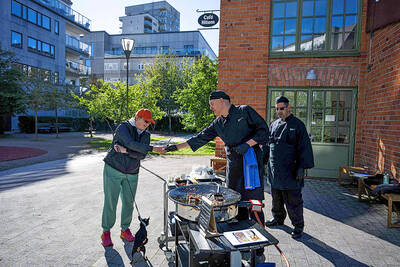
READINESS: According to a survey of 2,000 people, 86 percent of Swedes believe the country is worth defending in the event of a military attack Swedes are stocking up on food items in case of war, as more conflict in Europe no longer feels like a distant possibility, and authorities encourage measures to boost readiness. At a civil preparedness fair in southwest Stockholm, 71-year-old Sirkka Petrykowska said that she is taking the prospect of hostilities seriously and preparing as much as she can. “I have bought a camping stove. I have taken a course on preservation in an old-fashioned way, where you can preserve vegetables, meat and fruit that lasts for 30 years without a refrigerator,” Petrykowska said. “I’ve set aside blankets for warmth, I
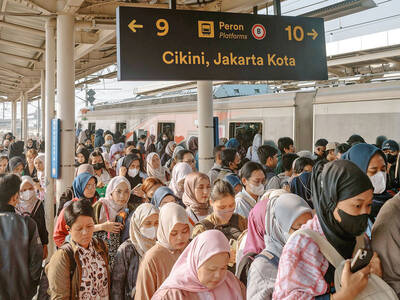
FRUSTRATIONS: One in seven youths in China and Indonesia are unemployed, and many in the region are stuck in low-productivity jobs, the World Bank said Young people across Asia are struggling to find good jobs, with many stuck in low-productivity work that the World Bank said could strain social stability as frustrations fuel a global wave of youth-led protests. The bank highlighted a persistent gap between younger and more experienced workers across several Asian economies in a regional economic update released yesterday, noting that one in seven young people in China and Indonesia are unemployed. The share of people now vulnerable to falling into poverty is now larger than the middle class in most countries, it said. “The employment rate is generally high, but the young struggle to

ENERGY SHIFT: A report by Ember suggests it is possible for the world to wean off polluting sources of power, such as coal and gas, even as demand for electricity surges Worldwide solar and wind power generation has outpaced electricity demand this year, and for the first time on record, renewable energies combined generated more power than coal, a new analysis said. Global solar generation grew by a record 31 percent in the first half of the year, while wind generation grew 7.7 percent, according to the report by the energy think tank Ember, which was released after midnight yesterday. Solar and wind generation combined grew by more than 400 terawatt hours, which was more than the increase in overall global demand during the same period, it said. The findings suggest it is

‘ARMED CONFLICT’: At least 21 people have died in such US attacks, while experts say the summary killings are illegal even if they target confirmed narcotics traffickers US forces on Friday carried out a strike on an alleged drug-smuggling boat off the coast of Venezuela, killing four people, US Secretary of Defense Pete Hegseth said. The latest strike, which Hegseth announced in a post on X, brings the number of such US attacks to at least four, leaving at least 21 people dead. An accompanying video shared by Hegseth showed a boat speeding across the waves before being engulfed in smoke and flames. “Four male narco-terrorists aboard the vessel were killed,” the Pentagon chief wrote. He said the strike “was conducted in international waters just off the


 RSS
RSS