


Two dummy hand grenades that had been fashioned into crude bombs exploded outside the Mexican consulate in Manhattan at about 3:40am on Friday, authorities said. The attack bore a striking similarity to a blast two years ago outside an office building housing the British consulate.
Ramon Xilotl, the Mexican consul general, said three windows were shattered, but no one was in the building at the time, and no one was injured.
Law enforcement officials were investigating whether the attacks on the two consulates were the work of the same person, but stopped short of definitively linking them.
Nevertheless, they said the improvised explosive devices used in both cases were virtually identical. Both contained explosive powder. Both attacks occurred before dawn when there were few people on the street. And in both cases the devices were thrown against building facades, the first on March 5, 2005, at 845 Third Avenue between 51st and 52nd Streets, and Friday's outside 27 East 39th Street near Madison Avenue, in Murray Hill.
In the 2005 explosion, surveillance videotape, along with other evidence, indicated that someone riding a bicycle had hurled a device at the building. The arc of the device -- with its lit fuse -- can be seen on the videotape.
In Friday's attack, a witness reported seeing a man in his 20s on a bicycle pedaling quickly away and turning south onto Park Avenue, the police said. The bicyclist was wearing a hooded gray jacket and his face was partly covered, but the police could not say for certain that he threw the grenades.
"There was a person seen on a bicycle today," Police Commissioner Raymond Kelly said at a news conference at police headquarters. "Two years ago, there were videos showing an individual on a bicycle."
The 2005 case is still considered an open investigation, Kelly said.
The explosions on Friday were also captured on surveillance videotape. The grenades were hurled over a wall topped by a fence; the first one, which fell in front of a picture window, exploded after the second one, which landed just west of a door.
Kelly described the two improvised explosives as training, or dummy, grenades -- perhaps purchased from a novelty shop -- that had been hollowed out and stuffed with gunpowder, possibly black powder, and equipped with pyrotechnic fuses. One had a smooth surface, modeled after the "lemon" type used in the Vietnam War, and the other was scored like the rough "pineapple" type used during World War II.
At a second news briefing, Kelly displayed grenades similar to those used in Friday's attack and said they could be purchased over the Internet. The devices used in 2005 were filled with a type of black powder and had M-80-type fuses.
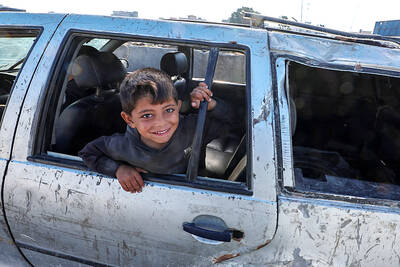
Gaza is rapidly running out of its limited fuel supply and stocks of food staples might become tight, officials said, after Israel blocked the entry of fuel and goods into the war-shattered territory, citing fighting with Iran. The Israeli military closed all Gaza border crossings on Saturday after announcing airstrikes on Iran carried out jointly with the US. Israeli authorities late on Monday night said that they would reopen the Kerem Shalom crossing from Israel to Gaza yesterday, for “gradual entry of humanitarian aid” into the strip, without saying how much. Israeli authorities previously said the crossings could not be operated safely during
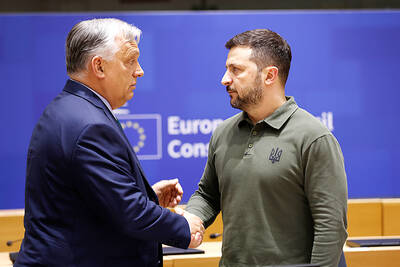
Hungarian authorities temporarily detained seven Ukrainian citizens and seized two armored cars carrying tens of millions of euros in cash across Hungary on suspicion of money laundering, officials said on Friday. The Ukrainians were released on Friday, following their detention on Thursday, but Hungarian officials held onto the cash, prompting Ukraine to accuse Hungary’s Russia-friendly government of illegally seizing the money. “We will not tolerate this state banditism,” Ukrainian Minister of Foreign Affairs Andrii Sybiha said. The seven detained Ukrainians were employees of the Ukrainian state-owned Oschadbank, who were traveling in the two armored cars that were carrying the money between Austria and

Kosovar President Vjosa Osmani on Friday after dissolving the Kosovar parliament said a snap election should be held as soon as possible to avoid another prolonged political crisis in the Balkan country at a time of global turmoil. Osmani said it is important for Kosovo to wrap up the upcoming election process and form functional institutions for political stability as the war rages in the Middle East. “Precisely because the geopolitical situation is that complex, it is important to finish this electoral process which is coming up,” she said. “It is very hard now to imagine what will happen next.” Kosovo, which declared

MORE BANS: Australia last year required sites to remove accounts held by under-16s, with a few countries pushing for similar action at an EU level and India considering its own ban Indonesia on Friday said it would ban social media access for children under 16, citing threats from online pornography, cyberbullying, online fraud and Internet addiction. “Accounts belonging to children under 16 on high-risk platforms will start to be deactivated, beginning with YouTube, TikTok, Facebook, Instagram, Threads, X, Bigo Live and Roblox,” Indonesian Minister of Communications and Digital Meutya Hafid said. “The government is stepping in so that parents no longer have to fight alone against the giants of the algorithm. Implementation will begin on March 28, 2026,” she said. The social media ban would be introduced in stages “until all platforms fulfill their


 RSS
RSS