


NY Times News Service, BEIJING
China will spend more than US$14 billion to clean up a famed lake inundated by so much pollution this year that it became a symbol of the country's lax environmental regulation against polluting industries.
Officials in Jiangsu Province, in eastern China, posted a notice on Friday on a government Web site announcing plans to spend 108.5 billion yuan (US$14.4 billion) for a cleanup of Lake Tai, the country's third-largest freshwater lake. The campaign would focus initially on eradicating the toxic algal bloom that choked the lake this spring and left more than 2 million people without drinking water.
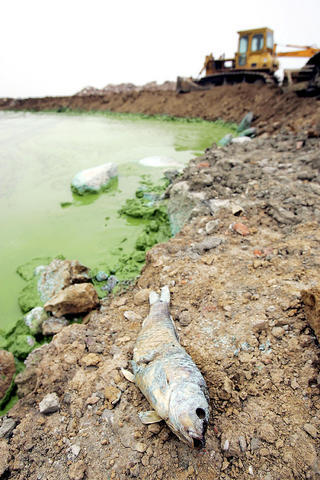
PHOTO: AP
"Jiangsu Province plans to effectively control the eutrophication of Lake Tai in five years, and greatly improve the water quality of the lake," the notice declared.
Lake Tai, known as China's ancient "land of rice and fish," is a legendary setting, once famous for its bounty of white shrimp, whitebait and whitefish. But over time, an industrial buildup transformed the region. More than 2,800 chemical factories arose around the lake, and industrial dumping became a severe problem and, eventually, a crisis.
This spring, urban sewage and chemical dumping caused an explosion of bright green pond scum that coated much of the giant lake with a fetid algal coating. Panic quickly followed in Wuxi, a nearby city that depended on the lake to supply drinking water for its 2.3 million residents. Officials were forced to shut off the drinking water supply for several days.
Local officials initially dismissed the algal bloom as a natural phenomenon, but Chinese news media broadcast images of factories dumping directly into the lake. The scandal deepened until Premier Wen Jiabao (溫家寶) convened a meeting of the State Council to discuss the problem.
"The pollution of Lake Tai has sounded the alarm for us," Wen said, according to state news media. "The problem has never been tackled at its root."
Several local officials have been fired or demoted, and state news media have reported that regulators have already closed as many as 1,000 factories in the area.
But the new crackdown has not helped Wu Lihong (吳立紅), a local environmentalist who has spent more than a decade trying to force official action. Wu, a feisty peasant, had repeatedly protested against the chemical factories and the local officials who protected them.
Wu was arrested shortly before the algae crisis and was later convicted in August on questionable charges. He is now serving three years in prison, even as his direst warnings about the lake have come to pass.
Details about the new cleanup campaign are somewhat sketchy, though state news media reports have hinted that more factories might be closed or forced to suspend operations. In general terms, the campaign includes stricter emissions standards for industry and tighter water treatment regulations.
Ultimately, though, the success or failure of the program will depend on the sustained commitment of local officials and regulators. In other major cleanup campaigns, including one of the Huai River, corruption and the pressure for economic development have undermined environmental protection efforts.

READINESS: According to a survey of 2,000 people, 86 percent of Swedes believe the country is worth defending in the event of a military attack Swedes are stocking up on food items in case of war, as more conflict in Europe no longer feels like a distant possibility, and authorities encourage measures to boost readiness. At a civil preparedness fair in southwest Stockholm, 71-year-old Sirkka Petrykowska said that she is taking the prospect of hostilities seriously and preparing as much as she can. “I have bought a camping stove. I have taken a course on preservation in an old-fashioned way, where you can preserve vegetables, meat and fruit that lasts for 30 years without a refrigerator,” Petrykowska said. “I’ve set aside blankets for warmth, I

FRUSTRATIONS: One in seven youths in China and Indonesia are unemployed, and many in the region are stuck in low-productivity jobs, the World Bank said Young people across Asia are struggling to find good jobs, with many stuck in low-productivity work that the World Bank said could strain social stability as frustrations fuel a global wave of youth-led protests. The bank highlighted a persistent gap between younger and more experienced workers across several Asian economies in a regional economic update released yesterday, noting that one in seven young people in China and Indonesia are unemployed. The share of people now vulnerable to falling into poverty is now larger than the middle class in most countries, it said. “The employment rate is generally high, but the young struggle to

ENERGY SHIFT: A report by Ember suggests it is possible for the world to wean off polluting sources of power, such as coal and gas, even as demand for electricity surges Worldwide solar and wind power generation has outpaced electricity demand this year, and for the first time on record, renewable energies combined generated more power than coal, a new analysis said. Global solar generation grew by a record 31 percent in the first half of the year, while wind generation grew 7.7 percent, according to the report by the energy think tank Ember, which was released after midnight yesterday. Solar and wind generation combined grew by more than 400 terawatt hours, which was more than the increase in overall global demand during the same period, it said. The findings suggest it is

‘ARMED CONFLICT’: At least 21 people have died in such US attacks, while experts say the summary killings are illegal even if they target confirmed narcotics traffickers US forces on Friday carried out a strike on an alleged drug-smuggling boat off the coast of Venezuela, killing four people, US Secretary of Defense Pete Hegseth said. The latest strike, which Hegseth announced in a post on X, brings the number of such US attacks to at least four, leaving at least 21 people dead. An accompanying video shared by Hegseth showed a boat speeding across the waves before being engulfed in smoke and flames. “Four male narco-terrorists aboard the vessel were killed,” the Pentagon chief wrote. He said the strike “was conducted in international waters just off the


 RSS
RSS