


The government is increasingly using secret evidence allowed under new anti-terrorism laws to prevent certain critics from entering the US, a group of civil rights and academic organizations said.
The group, led by the American Civil Liberties Union (ACLU), went to court on Tuesday in Boston seeking to force the State Department and the Department of Homeland Security to grant an entry visa to a South African Muslim academic who they said was barred from the US because of his criticism of US foreign policy.
"It sends the message that we are afraid of engaging difficult ideas," said an ACLU lawyer, Melissa Goodman.
Goodman said that it was possible that some people barred were a threat but the fact that the reasons for their exclusion were kept secret made such cases difficult to evaluate.
Leftists traditionally bear the brunt of such exclusions, the various organizations suing said, but there has been a significant increase in such cases involving Muslims since the terrorist attacks of Sept. 11, 2001.
Under the McCarran-Walter Act of 1952, which was written in part to limit the entry of communists or their sympathizers, the US has had a history of barring prominent intellectuals. Those denied entry visas over the years under McCarran-Walter have included the writers Gabriel Garcia Marquez and Graham Greene as well as political figures like Pierre Trudeau, long before he became prime minister of Canada.
"It sometimes does seem that what the government has done is taken the communist-era playbook and replaced every instance of the word communist with terrorist," said Jameel Jaffer, an ACLU lawyer who said those excluded rarely appeared to be national security threats.
Critics also say the exclusions are making Americans increasingly isolated from international opinion. They say that at a time when the US is seen by many foreigners as arrogant, it is important to admit foreigners and to let them express their opinions, if not necessarily endorse them.
"We see it as violation of our First Amendment rights as Americans to engage in international ideas and with international figures face to face," said Larry Siems, director of Freedom to Write at the PEN American Center, an international organization of writers. "To impose new barriers at the border is an act of international antagonism."
Supporters of exclusion say the ACLU and other organizations are ignoring the welter of opinions that reach Americans and some argue that exclusions made under the USA Patriot Act are weaker than the 1950s legislation.
"What the ACLU and those extreme liberal groups are trying to do is focus a magnifying glass on a small part of the picture rather than focus on the entire picture," said James Edwards Jr, an immigration expert and adjunct fellow at the Hudson Institute, a Washington public policy group.
"There are certainly some diverse opinions from foreigners that are voiced regularly in this country," Edwards said, pointing, for instance, to the speech on Monday by Iranian President Mahmoud Ahmadinejad at Columbia University.

‘SHORTSIGHTED’: Using aid as leverage is punitive, would not be regarded well among Pacific Island nations and would further open the door for China, an academic said New Zealand has suspended millions of dollars in budget funding to the Cook Islands, it said yesterday, as the relationship between the two constitutionally linked countries continues to deteriorate amid the island group’s deepening ties with China. A spokesperson for New Zealand Minister of Foreign Affairs Winston Peters said in a statement that New Zealand early this month decided to suspend payment of NZ$18.2 million (US$11 million) in core sector support funding for this year and next year as it “relies on a high trust bilateral relationship.” New Zealand and Australia have become increasingly cautious about China’s growing presence in the Pacific

The team behind the long-awaited Vera Rubin Observatory in Chile yesterday published their first images, revealing breathtaking views of star-forming regions as well as distant galaxies. More than two decades in the making, the giant US-funded telescope sits perched at the summit of Cerro Pachon in central Chile, where dark skies and dry air provide ideal conditions for observing the cosmos. One of the debut images is a composite of 678 exposures taken over just seven hours, capturing the Trifid Nebula and the Lagoon Nebula — both several thousand light-years from Earth — glowing in vivid pinks against orange-red backdrops. The new image
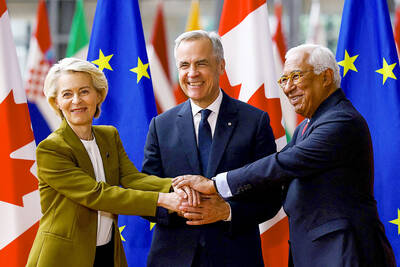
Canada and the EU on Monday signed a defense and security pact as the transatlantic partners seek to better confront Russia, with worries over Washington’s reliability under US President Donald Trump. The deal was announced after a summit in Brussels between Canadian Prime Minister Mark Carney and European Commission President Ursula von der Leyen and European Council President Antonio Costa. “While NATO remains the cornerstone of our collective defense, this partnership will allow us to strengthen our preparedness ... to invest more and to invest smarter,” Costa told a news conference. “It opens new opportunities for companies on both sides of the
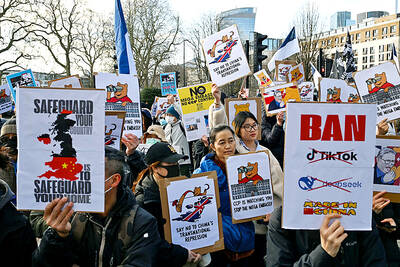
ESPIONAGE: The British government’s decision on the proposed embassy hinges on the security of underground data cables, a former diplomat has said A US intervention over China’s proposed new embassy in London has thrown a potential resolution “up in the air,” campaigners have said, amid concerns over the site’s proximity to a sensitive hub of critical communication cables. The furor over a new “super-embassy” on the edge of London’s financial district was reignited last week when the White House said it was “deeply concerned” over potential Chinese access to “the sensitive communications of one of our closest allies.” The Dutch parliament has also raised concerns about Beijing’s ideal location of Royal Mint Court, on the edge of the City of London, which has so


 RSS
RSS