


This could have been the election that ripped Morocco's secular ruling class asunder, bestowing unprecedented power on Islamists in a country where Muslim women in T-shirts sip wine alongside veiled sisters sipping tea.
Instead, voters stuck to the status quo in last week's election, favoring a conservative-leaning secular party close to King Mohamed VI, who exercises ultimate authority over Morocco's 33 million people.
Fear of the unknown appeared to trump the anti-corruption, anti-establishment message of the Islam-rooted Justice and Development Party.
Despite some new faces in parliament and government, analysts say no shifts are likely in the country's overall direction, its close ties to the US, or its commitment to privatization and boosting tourism.
Defying predictions, the Istiqlal party of the ruling coalition won 52 of the 325 seats in the lower house of parliament in Friday's vote, preliminary results announced on Saturday night showed.
The Justice and Development Party, or PJD, whose growing strength in recent years had worried its secular rivals, had 47 seats.
That was five more than the party won in the last elections, in 2002 -- but well short of the 80 it had hoped for. Even rival parties had expected the PJD to come out on top.
"We were modest," Istiqlal leader Abbas el Fassi said.
While the PJD predicted victory, he said, "we didn't say anything, because we are confident and patient to see what the Moroccan people have to say."
Yazmina Sibari, a 26-year-old mother who wore a headscarf as she strolled in Rabat, voted for the incumbent in her district, from the ruling coalition party RNI.
"I don't know all the candidates, so I voted for the candidate I knew," she said.
fed up
Mohamed Laroussi, who works for an advertising firm in Casablanca, said he didn't vote.
"People are fed up with politics," he said. "It's not a question of being afraid of extremism, because the PJD is not really extremist, but in the end they were afraid of major change."
The low turnout -- just 37 percent, the lowest in the country's young democratic history -- was an embarrassment to the government.
Interior Minister Chakib Benmoussa said it reflected the country's "political maturity." But international election observers expressed concern about disillusionment with the political system.
Ies Van der Laan of the international observer mission also noted "widespread allegations of corruption," including vote-buying.
While such incidents were limited and the observer mission called the vote overall transparent, Van der Laan said: "Even just the perception of corruption undermines faith in the democratic system."
tolerant
Morocco's cities are widely tolerant of Western customs. But the nation has seen a rise in religious conservatism that has boosted the PJD's support, especially among the poor but also among middle class families worried about youth joblessness.
"Political Islam is still a growing force, even if voters were not as enthusiastic about the PJD as they had wanted," said Mohamed Darif, a professor at Mohammedia University and an expert on Islamic groups and extremism.
The PJD presents itself as a bulwark against extremism. It has distanced itself from some members' calls to introduce Shariah and require the veil, especially after extremists staged the 2004 Madrid bombings and suicide attacks in Casablanca in 2003 and this year.

DOUBLE-MURDER CASE: The officer told the dispatcher he would check the locations of the callers, but instead headed to a pizzeria, remaining there for about an hour A New Jersey officer has been charged with misconduct after prosecutors said he did not quickly respond to and properly investigate reports of a shooting that turned out to be a double murder, instead allegedly stopping at an ATM and pizzeria. Franklin Township Police Sergeant Kevin Bollaro was the on-duty officer on the evening of Aug. 1, when police received 911 calls reporting gunshots and screaming in Pittstown, about 96km from Manhattan in central New Jersey, Hunterdon County Prosecutor Renee Robeson’s office said. However, rather than responding immediately, prosecutors said GPS data and surveillance video showed Bollaro drove about 3km

Tens of thousands of people on Saturday took to the streets of Spain’s eastern city of Valencia to mark the first anniversary of floods that killed 229 people and to denounce the handling of the disaster. Demonstrators, many carrying photos of the victims, called on regional government head Carlos Mazon to resign over what they said was the slow response to one of Europe’s deadliest natural disasters in decades. “People are still really angry,” said Rosa Cerros, a 42-year-old government worker who took part with her husband and two young daughters. “Why weren’t people evacuated? Its incomprehensible,” she said. Mazon’s
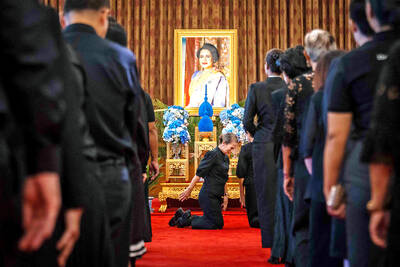
‘MOTHER’ OF THAILAND: In her glamorous heyday in the 1960s, former Thai queen Sirikit mingled with US presidents and superstars such as Elvis Presley The year-long funeral ceremony of former Thai queen Sirikit started yesterday, with grieving royalists set to salute the procession bringing her body to lie in state at Bangkok’s Grand Palace. Members of the royal family are venerated in Thailand, treated by many as semi-divine figures, and lavished with glowing media coverage and gold-adorned portraits hanging in public spaces and private homes nationwide. Sirikit, the mother of Thai King Vajiralongkorn and widow of the nation’s longest-reigning monarch, died late on Friday at the age of 93. Black-and-white tributes to the royal matriarch are being beamed onto towering digital advertizing billboards, on

SECRETIVE SECT: Tetsuya Yamagami was said to have held a grudge against the Unification Church for bankrupting his family after his mother donated about ¥100m The gunman accused of killing former Japanese prime minister Shinzo Abe yesterday pleaded guilty, three years after the assassination in broad daylight shocked the world. The slaying forced a reckoning in a nation with little experience of gun violence, and ignited scrutiny of alleged ties between prominent conservative lawmakers and a secretive sect, the Unification Church. “Everything is true,” Tetsuya Yamagami said at a court in the western city of Nara, admitting to murdering the nation’s longest-serving leader in July 2022. The 45-year-old was led into the room by four security officials. When the judge asked him to state his name, Yamagami, who


 RSS
RSS