


Japanese Prime Minister Shinzo Abe yesterday voiced admiration for two controversial Indians who stood up to colonial ruler Britain during World War II and sided with Tokyo.
Abe visited the eastern city of Kolkata to meet relatives of nationalist Subhash Chandra Bose, who advocated violent resistance and backed imperial Japan, and Radhabinod Pal, the sole judge who dissented at the Allied tribunal that condemned to death wartime Japanese leaders.
"Many Japanese have been moved deeply by such persons of strong will and action of the independence of India like Subhash Chandra Bose," Abe said. "Even to this day, many Japanese revere Radhabinod Pal."
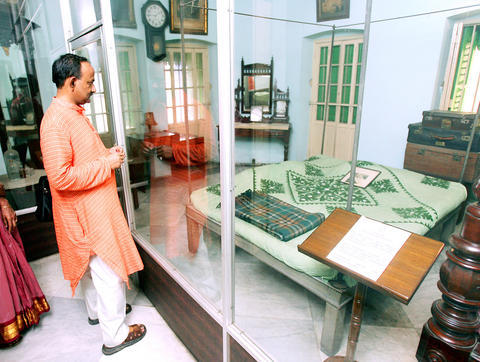
PHOTO: AFP
Abe, wrapping up a three-day official visit to India, has dismissed suggestions back home that meeting Pal's son would anger other Asian nations resentful over Japan's wartime actions.
In a dissenting opinion, Pal questioned the legitimacy of the tribunal, sealing a friendship between Pal and Abe's grandfather Nobusuke Kishi, who was charged but never tried as a war criminal.
Prashanto Pal, 81, told reporters he was "very, very happy to see" Abe.
"I feel proud of the fact that my father is still remembered for his contribution that was only correct and just. How can you blame only one side for war crimes and not the others?" he said.
Abe was speaking to reporters at the inauguration of the Indo-Japan Cultural Association in Kolkata and went on for talks with West Bengal state's Marxist chief minister Buddhadeb Bhattacharjee.
He was then to tour a museum dedicated to Bose, who broke with India's non-violence leader Mahatma Gandhi and won Japanese support for a military venture against British forces.
After World War II broke out, Bose escaped his British watchers, sought help from Nazi Germany and later went to Tokyo, where he organized an army.
"We're very excited, this is truly a historic moment," Krishna Bose, the nationalist's niece by marriage, said of Abe's visit.
The 76-year-old heads a trust that has preserved a three-storey residence in Kolkata as a museum to Bose.
"This is the first such visit and this makes it very special for us," she said. "It is a recognition of the role Bengal has played in building modern India-Japan relations."
Her brother-in-law Subrata, Bose's nephew, said the family was "deeply grateful" to Abe for this "unparalleled gesture."
The museum's walls are lined with black-and-white photos of Bose's parents, of him as a young boy, his May 1942 meeting with Adolf Hitler in Berlin and a picture of his German wife, Emilie Schenkl, holding their baby girl.
Other pictures capture his 90-day journey from Germany to Japan aboard a submarine between February and May 1943.
Another is allegedly the last known picture of Bose, in which he is seen stepping off a plane in Saigon on Aug. 17, 1945, a day before his widely disputed death in an aircrash in Taipei.
The exhibits include coats, caps and footwear as well as furniture and scores of books owned by Bose until he fled Kolkata in 1941.
"If Japan remembers Bose's support, we Indians have to remember that it was Japan which helped Bose assemble the Indian National Army" to fight British colonial rule, Krishna said. "Our future relations can be and will be enhanced when we remember the past that we share."
Abe's stop in Kolkata came at the end of a high-profile visit during which India and Japan vowed to seal an economic partnership deal by December.

SPEAKING OUT: After Siranudh Scott’s allegations surfaced, celebrities and public figures took to social media to share their own experiences of sexual misconduct and abuse A high-profile alleged sexual abuse case within a wealthy Thai beer brewing family has prompted a wave of painful accounts from survivors of unconnected abuse in the conservative nation. Siranudh Scott, a member of the billionaire Thai family that founded the ubiquitous Singha beer brand, posted an emotional video this month accusing his elder brother Sunit of repeatedly abusing him when he was a teenager. Sunit, who is in his 30s, later denied the allegations in a video posted online, but Singha parent Boonrawd dismissed him from his executive role with the company on Tuesday last week. “I felt I needed to speak

SEEKING ORDER: Rodrigo Paz said that ‘anyone who wants to destroy the nation will have to deal with this president and the full force of the constitution’ Bolivian President Rodrigo Paz on Wednesday said that the nation was at a “breaking point” after nearly a month of protests that have caused shortages of food, fuel and medicine. Paz, who took office six months ago amid the worst economic crisis there in four decades, is battling a groundswell of fury over his policies. The political capital, La Paz, has been besieged by low-income workers and members of the indigenous majority calling for his resignation. “The country needs order and is reaching breaking point,” the 58-year-old said at a public event in La Paz, renewing his appeal for dialogue. On Tuesday, the Bolivian
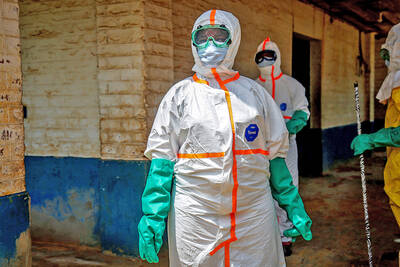
COMMUNITY CONFLICT: Concerns about disease spread from corpses has run up against friends and families’ desire to bury their dead as infection spreads in the area Angry residents of a town at the epicenter of the Ebola outbreak in the Democratic Republic of the Congo (DR Congo) attacked and burned a tent that was part of a health center where people are being treated for the virus, the staff there said Saturday. It was the second such attack in the region in a week. No one was hurt in the attack, according to reports but as patients ran out to escape the fire, 18 people with suspected Ebola infections fled the facility and are unaccounted for, a hospital director said. Angry residents arrived at the clinic in the

Forecasters in Europe yesterday warned of exceptional heat as record temperatures driven by a “heat dome” push temperatures well above seasonal norms across the continent. The surge follows a record-breaking Monday, with France logging its hottest day in the month of May on record, its weather agency said, and the UK also posting unprecedented highs. A so-called “heat dome” of warm air from northern Africa trapped under a high-pressure system over western Europe is behind the high temperatures not usually seen until high summer. Restrictions on outdoor work were imposed in parts of Italy, beaches in southwest France filled earlier than usual and


 RSS
RSS