


French Foreign Minister Bernard Kouchner arrived in Lebanon on Friday on a delicate mission to follow through with a French initiative to end a standoff between the country's political parties.
He said his two-day visit was aimed at encouraging dialogue in order to end an eight-month power struggle between the Western-backed prime minister and the Hezbollah-led opposition.
"There is little time left for this dialogue to take place," Kouchner said before meeting with Prime Minister Fouad Siniora. "My trip here is but one stage [in the negotiations] and there will be others."
The foreign minister will pick up where he left off during talks in France earlier this month between the two sides, and try to get them to follow through.
Following the talks with Siniora, he said "we underlined the need to create confidence among Lebanon's communities."
"We affirmed that the solution was in the hands of the Lebanese, and that I have not got a magical plan to bring an end to the crisis," he said.
Kouchner said that while he is in Lebanon he hopes to meet with all those figures who traveled to France two weeks ago for an initial round of talks.
He added that talks could continue following Aug. 5 Lebanese by-elections to replace two deputies from Siniora's coalition who were assassinated.
However experts and political observers said there is little likelihood of a breakthrough, given that each side is refusing to budge.
"I think he might be able to get them to sit down and talk to each other, but I don't see them agreeing on a national unity government before the presidential elections and I don't see them agreeing on a president," said Paul Salem, head of the Carnegie Middle East Center, a Beirut-based think tank.
"So I don't think his mission at this time will succeed," he said.
Hezbollah, the Shiite group backed by Syria and Iran, is pushing for the opposition to be better represented in government in order to give it veto power.
The majority insists this can only happen if Hezbollah agrees to stop blocking parliamentary sessions in order to ensure the quorum needed for the presidential elections to replace pro-Syrian President Emile Lahoud by a Nov. 25 deadline.
Telecommunications Minister Marwan Hamadeh said this week's unsuccessful visit to Beirut by French envoy Jean-Claude Cousseran to pave the way for Kouchner had tempered Paris' expectations.
"I think France has reduced its ambition as far as resolving the crisis and Kouchner's visit marks but a step in the negotiations rather than a final one," Hamadeh, a prominent member of the ruling majority, said.
Kouchner was to head to Egypt today to brief members of the Arab League on his talks in Beirut.
The resignation in November of six pro-Syrian ministers, five of them Shiite, sparked the current political crisis, the country's worst since the end of the 1975-1990 civil war.
Salem said he believed the major stumbling block to France's diplomatic efforts was the US on the one hand and Syria on the other.
"The US does not want to accommodate Hezbollah, Syria or Iran in Lebanon," he said. "And Syria does not want to accommodate the ruling majority or the United States in Lebanon."
Salem said he believed all players would wait until the last moment before reaching a compromise that would allow the presidential elections to take place.
That would avoid a dangerous power vacuum or even the creation of two rival governments that would plunge the country into further chaos, he said.
"If there is going to be a deal it's going to be at the last minute," Salem said. "Because like a poker game, you don't show your cards early. You show them at the very end -- and we're not there yet."
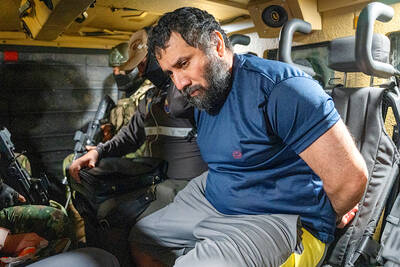
Drug lord Jose Adolfo Macias Villamar, alias “Fito,” was Ecuador’s most-wanted fugitive before his arrest on Wednesday, more than a year after he escaped prison from where he commanded the country’s leading criminal gang. The former taxi driver turned crime boss became the prime target of law enforcement early last year after escaping from a prison in the southwestern port of Guayaquil. Ecuadoran President Daniel Noboa’s government released “wanted” posters with images of his face and offered US$1 million for information leading to his capture. In a country plagued by crime, members of Fito’s gang, Los Choneros, have responded with violence, using car

The team behind the long-awaited Vera Rubin Observatory in Chile yesterday published their first images, revealing breathtaking views of star-forming regions as well as distant galaxies. More than two decades in the making, the giant US-funded telescope sits perched at the summit of Cerro Pachon in central Chile, where dark skies and dry air provide ideal conditions for observing the cosmos. One of the debut images is a composite of 678 exposures taken over just seven hours, capturing the Trifid Nebula and the Lagoon Nebula — both several thousand light-years from Earth — glowing in vivid pinks against orange-red backdrops. The new image
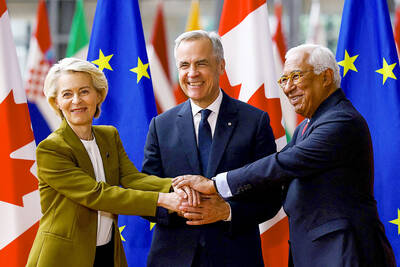
Canada and the EU on Monday signed a defense and security pact as the transatlantic partners seek to better confront Russia, with worries over Washington’s reliability under US President Donald Trump. The deal was announced after a summit in Brussels between Canadian Prime Minister Mark Carney and European Commission President Ursula von der Leyen and European Council President Antonio Costa. “While NATO remains the cornerstone of our collective defense, this partnership will allow us to strengthen our preparedness ... to invest more and to invest smarter,” Costa told a news conference. “It opens new opportunities for companies on both sides of the

OVERHAUL: The move would likely mark the end to Voice of America, which was founded in 1942 to counter Nazi propaganda and operated in nearly 50 languages The parent agency of Voice of America (VOA) on Friday said it had issued termination notices to more than 639 more staff, completing an 85 percent decrease in personnel since March and effectively spelling the end of a broadcasting network founded to counter Nazi propaganda. US Agency for Global Media (USAGM) senior advisor Kari Lake said the staff reduction meant 1,400 positions had been eliminated as part of US President Donald Trump’s agenda to cut staffing at the agency to a statutory minimum. “Reduction in Force Termination Notices were sent to 639 employees at USAGM and Voice of America, part of a


 RSS
RSS