


A judge yesterday sentenced four al-Qaeda-inspired plotters to life in prison for attempting to bomb London's transit system on July 21, 2005, two weeks after suicide bombers killed 52 commuters.
Judge Adrian Fulford said the men must spend at least 40 years in jail before becoming eligible for parole.
A jury on Monday found Muktar Said Ibrahim, 29; Yassin Omar, 26; Ramzi Mohammed, 25; and Hussain Osman, 28, guilty of conspiracy to murder in a plot to detonate explosives in knapsacks on three subway trains and a bus.
The bombs failed to explode and no one was injured.
The judge said that that if the bombs had gone off, "at least 50 people would have died, hundreds of people would have been wounded, thousands would have had their lives permanently damaged, disfigured or otherwise, whether they were Christian, Muslim, Jewish, Hindu, Sikh, Buddhist, agnostic or atheist."
He said that the July 7 and July 21 plots "were both part of an al-Qaeda-inspired and controlled sequence of attacks."
Two other suspects, Manfo Kwaku Asiedu, 34, and Adel Yahya, 24, will be retried after the jury failed to reach a verdict.
Prosecutors said the July 21 attacks were a deliberate mirror image of the July 7 transit bombings, though the planning started long before.
Police suspect, but could not prove, that there were links between the two groups of bombers.
Fulford said the events of July 7 meant the July 21 plotters knew how deadly their bombs were likely to be.
"The family and friends of the dead and the injured, the hundreds, indeed thousands, captured underground in terrifying circumstances, the smoke, the screams of the wounded and the dying -- this each defendant knew," the judge said.
"They planned this, they prepared for it. They had spent many hours making viable bombs. After 7/7, each defendant knew exactly what the result would be," he said.
All six defendants denied the charges, saying the devices were duds and their actions a protest against the Iraq war. But police and prosecutors said scientific tests proved the bombs were all viable. They do not know why they did not work.
"Exactly two weeks after the terrorist attacks on 7/7 these men targeted the same transport system and tried to cause the same level of death and destruction," said Sue Hemming, head of counter-terrorism at the Crown Prosecution Service.
"While the implementation of their plan was incompetent, their aim was clear. They wanted to kill and maim on a massive scale," she said.
The four convicted men attempted to detonate explosives-laden backpacks on three subway trains and a bus, as in the July 7, 2005, attacks. The devices -- made from a volatile mix of hydrogen peroxide and flour packed into tubs and surrounded by bolts and screws -- did not explode.
Unlike three of the four July 7 bombers, who were British-born, those in the July 21 plot had come to Britain as youths from countries in the Horn of Africa. Some had become British citizens, while others had refugee status.
Police believe the planning for the attack started after Ibrahim returned to Britain from a trip to Pakistan in March 2005. He was in that country at the same time as two of the July 7 bombers -- Shezhad Tanweer and Mohammed Sidique Khan -- but officials do not know if they ever met.
In both cases, the main ingredient in the bombs was the same -- hydrogen peroxide, an easily available chemical commonly used in hair dying and coloring.
Police believe the transit system was not the group's original target, but was chosen following the successful attacks two weeks earlier.
The failed attack sparked a huge police manhunt for the would-be suicide bombers. The prosecution's case rested largely on testimony and transportation system video footage.
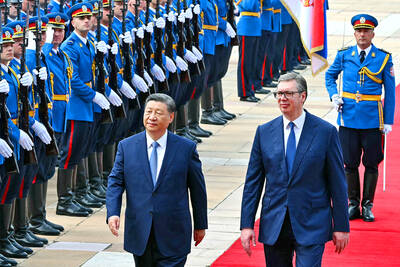
MONEY MATTERS: Xi was to highlight projects such as a new high-speed railway between Belgrade and Budapest, as Serbia is entirely open to Chinese trade and investment Serbian President Aleksandar Vucic yesterday said that “Taiwan is China” as he made a speech welcoming Chinese President Xi Jinping (習近平) to Belgrade, state broadcaster Radio Television of Serbia (RTS) said. “We have a clear and simple position regarding Chinese territorial integrity,” he told a crowd outside the government offices while Xi applauded him. “Yes, Taiwan is China.” Xi landed in Belgrade on Tuesday night on the second leg of his European tour, and was greeted by Vucic and most government ministers. Xi had just completed a two-day trip to France, where he held talks with French President Emmanuel Macron as the

With the midday sun blazing, an experimental orange and white F-16 fighter jet launched with a familiar roar that is a hallmark of US airpower, but the aerial combat that followed was unlike any other: This F-16 was controlled by artificial intelligence (AI), not a human pilot, and riding in the front seat was US Secretary of the Air Force Frank Kendall. AI marks one of the biggest advances in military aviation since the introduction of stealth in the early 1990s, and the US Air Force has aggressively leaned in. Even though the technology is not fully developed, the service is planning
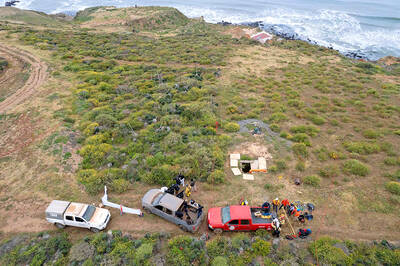
INTERNATIONAL PROBE: Australian and US authorities were helping coordinate the investigation of the case, which follows the 2015 murder of Australian surfers in Mexico Three bodies were found in Mexico’s Baja California state, the FBI said on Friday, days after two Australians and an American went missing during a surfing trip in an area hit by cartel violence. Authorities used a pulley system to hoist what appeared to be lifeless bodies covered in mud from a shaft on a cliff high above the Pacific. “We confirm there were three individuals found deceased in Santo Tomas, Baja California,” a statement from the FBI’s office in San Diego, California, said without providing the identities of the victims. Australian brothers Jake and Callum Robinson and their American friend Jack Carter
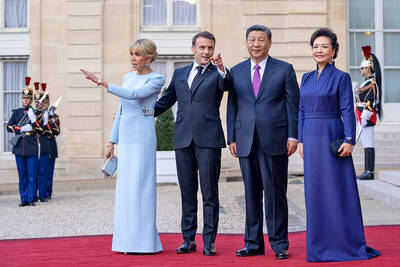
CUSTOMS DUTIES: France’s cognac industry was closely watching the talks, fearing that an anti-dumping investigation opened by China is retaliation for trade tensions French President Emmanuel Macron yesterday hosted Chinese President Xi Jinping (習近平) at one of his beloved childhood haunts in the Pyrenees, seeking to press a message to Beijing not to support Russia’s war against Ukraine and to accept fairer trade. The first day of Xi’s state visit to France, his first to Europe since 2019, saw respectful, but sometimes robust exchanges between the two men during a succession of talks on Monday. Macron, joined initially by EU Commission President Ursula von der Leyen, urged Xi not to allow the export of any technology that could be used by Russia in its invasion


 RSS
RSS