


Efforts to slash opium production in Asia are having mixed results, with cultivation up massively in Afghanistan but almost wiped out in the Golden Triangle region, a UN report said.
The report, released in Vienna on Monday by the UN Office on Drugs and Crime (UNODC), said efforts to eradicate the world's drug problems are paying off as cultivation, production and abuse appear to have stabilized on a global level.
The 2007 World Drug Report pointed to the Golden Triangle, once one of the largest sources for heroin, as an example of success, saying the Southeast Asian region is now "almost opium free" as a result of crackdowns on poppy farming.
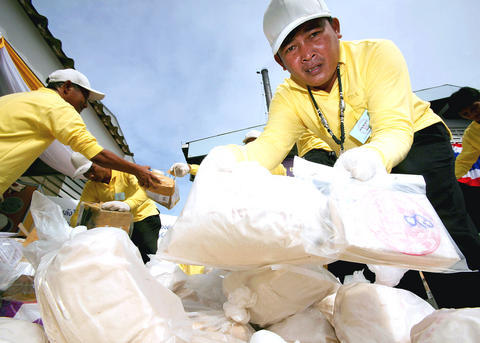
PHOTO: AFP
But opium production worldwide reached a record 6,610 tonnes last year, up 43 percent from 2005, because of a spike in supply from Afghanistan, the report warned.
"The production and consumption of cannabis, cocaine, amphetamines and ecstasy have stabilized at the global level -- with one exception," the report said.
"The exception is the continuing expansion of opium production in Afghanistan," it said.
Production in Afghanistan, responsible for 92 percent of the world's opium, increased by almost 50 percent last year despite internationally backed efforts to eradicate its poppy fields.
"For no other drug is production so concentrated in a single area," the report said. "This expansion continues to pose a threat to the security of the country and to the global containment of opiates abuse."
Illicit cultivation in Helmand Province matched that of entire countries, UNODC chief Antonio Maria Costa said in the report.
Income from the industry in Afghanistan tops US$3 billion annually, officials said, and helps finance the Taliban-led insurgency plaguing the country.
"Effective surgery on Helmand's drug and insurgency cancer will rid the world of the most dangerous source of its most dangerous narcotic and go a long way to bringing security to the region," Costa said.
‘GROSS NEGLIGENCE?’ Despite a spleen typically being significantly smaller than a liver, the surgeon said he believed Bryan’s spleen was ‘double the size of what is normal’ A Florida surgeon who is facing criminal charges after allegedly removing a patient’s liver instead of his spleen has said he is “forever traumatized” by that person’s death. In a deposition from November last year that was recently obtained by NBC, 44-year-old Thomas Shaknovsky described the death of 70-year-old William Bryan as an “incredibly unfortunate event that I regret deeply.” Bryan died after the botched surgery; and last month, a grand jury in Tallahassee indicted Shaknovsky on a charge of manslaughter. “I’m forever traumatized by it and hurt by it,” Shaknovsky added, also saying that wrong-site surgeries can happen “during

Former Chinese ministers of national defense Wei Fenghe(魏鳳和) and Li Shangfu (李尚福) were both sentenced to death with a two-year reprieve over graft charges, state news agency Xinhua reported on Thursday, underscoring the severity of the purge in the military. The armed forces have been one of the main targets of a broad corruption crackdown ordered by Chinese President Xi Jinping (習近平) after coming to power in 2012. The purges reached the elite Rocket Force, which oversees nuclear weapons as well as conventional missiles, in 2023. Earlier this year they escalated further, resulting in the removal of the top general in

New Zealand is open to expanding its frigate fleet beyond its current two vessels, with New Zealand Minister of Defence Chris Penk saying “no options are off the table” as the government weighs buying new warships from Japan or the UK. The government yesterday said it is looking to replace its two aging Anzac-class frigates, which were both commissioned almost 30 years ago. The UK’s Type 31 and Japan’s Mogami-class warships are the options under consideration. Speaking in an interview, Penk said there is potential to increase the number of frigates the nation purchases. “We need a certain amount of capability as a

The Philippine Coast Guard yesterday said it deployed aircraft to issue radio warnings to a Chinese research ship in a disputed area of the South China Sea “swarming” with vessels from Beijing’s so-called maritime militia. The research vessel Xiang Yang Hong 33 (向陽紅33), which is capable of supporting submersible craft, was operating near a reef in the contested Spratly Islands (Nansha Islands, 南沙群島), which Taiwan also claims, the Philippine Coast Guard said. The Chinese ship was deploying a service boat toward the Spratly’s Iroquois Reef on Wednesday when it was spotted by a coast guard plane, “confirming ongoing unauthorized [marine scientific research]


 RSS
RSS