


When a racy brunette in a bikini gyrates in a steamy video, declaring a crush on US Democratic hopeful Senator Barack Obama, it's clear that the hoopla surrounding this election is going to be like nothing that came before.
In her own musical moment, formerly frosty Senator Hillary Clinton has been spotted on her own Web site swaying to music in a trance-like state and Senator John McCain in an unguarded moment sang, "bomb, bomb, bomb, bomb, bomb Iran."
These campaign snapshots, starring on computers everywhere, are partly the product of the YouTube video sharing craze which has opened a new dimension in political campaigns.
The latest sensation this past week handed Clinton's chief Democratic rival, Obama, unwanted top billing in a raunchy Web video by a scantily clad woman dubbed "Obama Girl."
"I got a crush on Obama ... I can't wait until 2008 ... I love it when you get hot on Hillary in debate," lip-synchs model Amber Lee Ettinger, grabbing her 15 minutes of YouTube fame in a video not linked to the campaign.
The mock music video features Ettinger dancing next to a picture of the toned 45-year-old candidate strolling out of the surf in Hawaii and has migrated from the Web to cable television.
Maybe all publicity is good publicity, but Lee Rainie, who studies the intersection of campaigns and the Web for the Pew Internet and American Life Project says viral videos raise worrying questions for candidates.
"You love that people are engaged with your campaign ... but it is pretty hard to have control of your message," Rainie said, adding that anyone with a modem and a video camera could seize an unwanted role in the race.
The line between an advertisement sanctioned by a candidate and one that just materialized and seizes the public imagination is also becoming blurred.
As candidates trade fire on Iraq, abortion and health care, sometimes traditional, offline, campaign hijinks are also rattling the dignity of the White House dreamers.
In one incident, former New York mayor Rudolph Giuliani was left red-faced after a 140-page blueprint of how to win the Republican nomination showed up in the New York Daily News late last year.
Operatives on other campaigns mocked the security lapse, from a former New York mayor and Sept. 11 hero, who is basing much of his campaign on ... security.
Top Democrats have not been spared embarrassment either.
Clips of Democratic front-runner Clinton's woefully off key rendition of the US national anthem at an Iowa campaign rally this year, picked up on an errant microphone, flashed around the world.
But the slick Clinton campaign, which rarely misses a trick, used the embarrassment to claim an avalanche of free publicity, launching a competition to chose a campaign song.
"I won't sing it in public ... unless I win!" Clinton said on one Web site video, then swayed to music in another, in a canny attempt to chip away at what critics say is the former first lady's starchy image.
McCain sung his off-the-cuff Iran-themed version of the Beach Boys hit Barbara Ann at a campaign event -- and soon lived to regret it.
His indiscretion, a sign that in the Internet age a candidate is never safe, was soon the subject of a political ad by liberal group MoveOn.org, which ended with the slogan "We can't afford another reckless president."
In one of the most surreal campaign ads ever, ex-senator Mike Gravel, the longest of long-shots on the Democratic side, stares blankly at a camera for over a minute, then walks off and throws a rock into a lake -- leaving puzzled viewers to draw their own conclusions.
In another bizarre moment, Dennis Kucinich, another Democratic also-ran swirled around a stage at a health care forum with his arms outstretched shouting "no strings, no strings" to show he was not a puppet of special interests.
The crowded Republican and Democratic presidential debates have also offered up their own share of odd moments.
Three candidates raised their hands and said they didn't believe in evolution in one Republican debate -- unthinkable in a developed Western nation other than the US where conservative Christians wield considerable influence within the party
In another light moment, Giuliani threw up his hands in mock fear of divine retribution at a lightning strike as he discussed abortion in a New Hampshire debate between Republican presidential hopefuls.
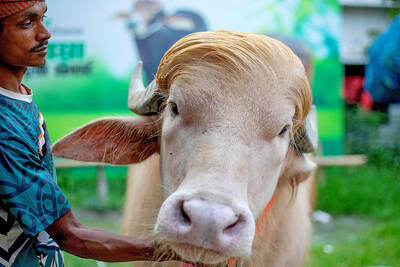
Crowds in Bangladesh are flocking to snap photographs with an unlikely social media star — an albino buffalo with flowing blond hair nicknamed “Donald Trump” that is due to be sacrificed within days. Owner Zia Uddin Mridha, 38, said his brother named the 700kg bull over its flowing helmet of hair resembling the signature look of the US president. “My younger brother picked this name because of the buffalo’s extraordinary hair,” he said at his farm in Narayanganj, just outside the capital, Dhaka. Mridha said that a constant stream of curious visitors — social media fans, onlookers and children — have come throughout

It began as a satirical online project. Now millions of young people in India are flocking to it as an outlet for their frustration. A parody political party called the Cockroach Janta Party, with the insect as its symbol, has exploded across India’s social media by turning absurdist humor into protest. Memes and short videos mocking corruption, joblessness and political dysfunction have flooded social media sites, where millions of users are embracing the cockroach — known for its ability to survive harsh conditions — as a tongue-in-cheek symbol of endurance. The online movement’s rise has been unusually rapid. The Cockroach Janta Party (CJP)
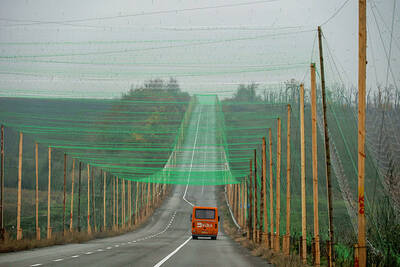
BIGGER ROLE: Beijing has said it maintains an impartial stance on the war in Ukraine, but by training Russian troops, China is far more involved than previously known China’s armed forces secretly trained about 200 Russian military personnel in China late last year, and some have since returned to fight in Ukraine, according to three European intelligence agencies and documents seen by Reuters. While China and Russia have held a number of joint military exercises since Moscow’s full-scale invasion of Ukraine in 2022, Beijing has repeatedly said that it is neutral in the conflict and presents itself as a peace mediator. The covert training sessions, which predominantly focused on the use of drones, were outlined in a dual-language Russian-Chinese agreement signed by senior Russian and Chinese officers in Beijing on
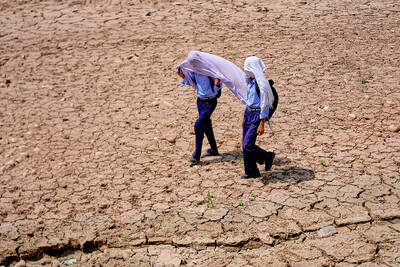
HOTTER: While Indians are accustomed to summer heat, climate change has caused northwestern India to warm faster than other parts of the country, an academic said Roads and markets have emptied during afternoons and some farmers have switched to nighttime work to avoid scorching temperatures as a heat wave grips large parts of India. The India Meteorological Department forecast maximum temperatures for yesterday of about 45°C in the capital, New Delhi, where authorities have opened temporary “cooling zones” to help people cope. The weather department warned that conditions would likely persist across several northern regions in the coming days, with temperatures staying well above seasonal averages. Authorities urged people to stay indoors during the hottest hours and take precautions against heat-related illnesses. India declares a heat wave whenever maximum temperatures


 RSS
RSS