


Malaysia's top police official yesterday warned of a "real and possible" threat of terrorism in the Malacca Straits, one of the world's most vital trade-related waterways.
Inspector-General of the Royal Malaysian Police Musa Hassan said maritime security concerns included piracy and extortion of fishermen in the straits.
But touching on a topic rarely discussed by Malaysian officials, Musa said terrorist attacks on the crucial trade route would cripple economies globally, and he called for continued vigilance.
"Another threat which is real and possible that is lurking in the strait is maritime terrorism," Musa told a conference of maritime industry experts discussing security threats.
MARITIME TERRORISM
Forms of maritime terrorism of "particular concern" included attacks on ships, the hijacking of ships carrying dangerous materials and the use of vessels to attack ports or land facilities, Musa said.
"If terrorists were to command a ship transporting LPG [liquefied petroleum gas] for a suicide mission in the strait, such an act would devastate Southeast Asia's economic environment and severely disrupt trade," he said in his keynote address.
More than 30 percent of world trade passes through the Malacca Straits, and the volume of traffic has increased dramatically, up 42 percent from 44,000 ships in 1999 to 62,600 ships in 2005.
OIL
Half of the world's oil shipments also travel through the waterway, where piracy attacks have prompted concerns among East Asian nations who rely on fuel shipments.
"A significant impediment to the flow of oil would be a direct threat to the national security of countries that are highly dependent, particularly Japan and South Korea," Musa said.
"It would mean re-routing the vessels, which would lead to skyrocketing freight and insurance rates and ... a devastating global economic impact," he said.
Maintaining and securing the waterway has always been regarded as the responsibility of the littoral states who border the sea lane -- Singapore, Malaysia and Indonesia.
STANDBY
Separately, Pottengal Mukundan, the London-based director of the International Maritime Bureau, which organized the conference, said that governments needed to stay on standby for any terror attacks.
"There is always the possibility of a terror attack. We need to be prepared for it," Mukundan said.
He also said the war against pirates was not over in the straits despite a fall in attacks in recent years after Indonesia boosted maritime patrols.
"There is no room for complacency. The moment the pirates sense law enforcement will not respond promptly, the attacks will resume," he told the conference.


Through the noise of rushing papers and whirring belts at a print factory in Kyoto, two creators watch their photo essay come to life in broadsheet form — part of an effort to win new audiences in the age of artificial intelligence (AI). Despite the decline of the publishing industry, self-publication and handmade “zine” magazines are growing in popularity in Japan, reflecting the nation’s enduring love of paper in the digital era. While speaking to Agence France-Presse at the plant, his hands black with ink, one of the creators, Kazuma Obara, said: “I think [paper] is a medium that engages all five
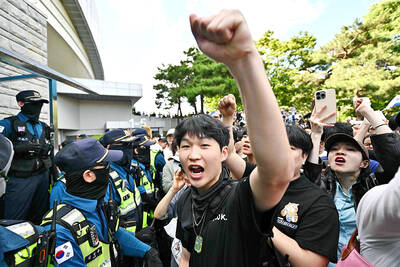
‘ABSURD MISTAKE’: The election commission said that there had been a failure to anticipate turnout after 14 polling stations ran short of ballot papers South Korean riot police yesterday cleared protesters from a Seoul polling station after a 35-hour blockade sparked by a shortage of ballot papers during local elections earlier this week. Wednesday’s election was the first nationwide vote since South Korean President Lee Jae-myung took office following the ouster of Yoon Suk-yeol over his short-lived martial law declaration. Lee’s ruling Democratic Party swept most races, but failed to flip the crucial Seoul mayoral seat. The South Korean National Election Commission apologized, blaming a failure to anticipate turnout after 14 polling stations in Seoul ran short of ballot papers. Some polling stations stayed open until 10pm to

France experienced its hottest spring on record, the French weather service said on Tuesday, after an exceptional early heat wave that also broke highs for the season in England and Wales. Meteo-France said the average nationwide temperature over March to May was 13.8°C — about 1.7°C above the norm, and surpassing records set in 2011 and 2020. “The warmest spring since records began in 1900,” it said in a bulletin. All three months were warmer than average, but the onset of an “unprecedented heatwave” late last month pushed the mercury to highs typically seen at the height of the summer. “Our country had never

A Sherpa guide was found crawling to base camp on Mount Everest a week after he went missing and was reunited with his family, who had given up hope he would return. Dawa Sherpa was last seen on Friday last week descending the mountain, but he did not reach base camp even though his client did. The pair were among the last climbers on the mountain as the climbing season came to an end and the route was dismantled. Dawa was located by a cleaning crew on Thursday morning as he was crawling down the snowy slopes around the Khumbu Icefall, just above


 RSS
RSS