


A presidential commission created to investigate human rights violations amid Sri Lanka's worsening civil conflict has been ineffective and plagued with conflicts of interest, a government-appointed international panel said.
The panel, created last year to monitor an official commission probing human rights violations, issued its first statement late on Sunday night. It accused the commission of moving slowly, failing to protect witnesses and operating without transparency.
"The commission has so far made hardly any noticeable progress in investigations and inquiries since its inception," the statement said.
The commission's methods "are not adequate and do not satisfy international norms and standards," it said, referring to inadequate witness protection programs and lagging investigation times.
As violence between Tamil Tiger separatists and government forces has increased over the past 19 months on this war-torn island, abductions and killings have escalated.
Sri Lankan President Mahinda Rajapakse created the commission last November to investigate 16 specific cases of human rights violations, including last year's killings of 17 employees of the international aid group Action Against Hunger.
His government then appointed an 11-member international panel called the International Independent Group of Eminent Persons to monitor their investigation, though under tight reins. The panel is only permitted to "observe" the workings of the commission.
The international group faulted the commission of inquiry, saying it had dawdled since its inception last November and that its independence had been compromised by interference from the attorney general's office, which acts as the legal counsel to the commission.
As the government's top law enforcement authority, the group said, the attorney general's office faces a conflict of interest in investigating crimes in which government officials, including security forces, are suspected.
"We consider these to be serious conflicts of interest, which lack transparency and compromise national and international standards of independence and impartiality," the statement said.
The international panel went further to say that the commission of inquiry ought not to be seen as "a substitute for robust, effective measures including national and international human rights monitoring."
The attorney general's office issued a sharp retort to that last observation, calling it "inappropriate" and urging the group to stick to making "observations and recommendations in terms of its mandate."
The commission of inquiry, for its part, disputed that its reliance on the attorney general undermined its independence.
It said it expected the government would soon enact a witness protection law, enabling witnesses to come forward without fear.
The commission added that it was committed to its task and was at the stage of interviewing witnesses. Its members are confident "the mandate of the commission can be implemented in the best interests of justice," a statement said.
In an interview last month, commission chairman Nissanka Kumara Udalagam, said the commission had not heard from a single witness in the killings of the aid workers, its first case.
"There are witnesses, but they are frightened to come forward," he said.

SPEAKING OUT: After Siranudh Scott’s allegations surfaced, celebrities and public figures took to social media to share their own experiences of sexual misconduct and abuse A high-profile alleged sexual abuse case within a wealthy Thai beer brewing family has prompted a wave of painful accounts from survivors of unconnected abuse in the conservative nation. Siranudh Scott, a member of the billionaire Thai family that founded the ubiquitous Singha beer brand, posted an emotional video this month accusing his elder brother Sunit of repeatedly abusing him when he was a teenager. Sunit, who is in his 30s, later denied the allegations in a video posted online, but Singha parent Boonrawd dismissed him from his executive role with the company on Tuesday last week. “I felt I needed to speak

A Hong Kong astronaut is to join a Chinese space mission for the first time as part of a three-person crew launching today, as Beijing edges closer to its goal of landing people on the moon. The Tiangong space station — crewed by teams of three astronauts that are typically rotated every six months — is the crown jewel of China’s space program, boosted by billions in state investment in a bid to catch up with the US and Russia. The Shenzhou-23 mission is to blast off at 11:08pm from the Jiuquan Satellite Launch Center in northwestern China, carrying three astronauts to
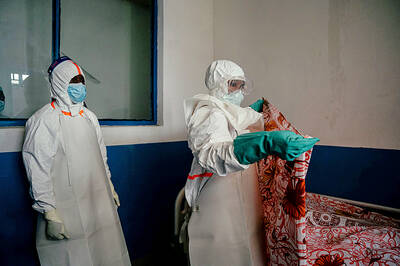
UPGRADED ALERT: The risk inside DR Congo is now considered ‘very high,’ while neighboring countries face a ‘high’ threat as the outbreak continues, the WHO said Ebola is spreading faster than responders can track it in eastern Congo, where health workers managed to follow up with barely one in five identified contacts in a single day. Authorities in the Democratic Republic of the Congo (DR Congo) reported 83 confirmed infections, 746 suspected cases and 1,603 identified contacts as of Thursday, but health workers were able to follow up on only 342 contacts that day — about 21 percent of the total under monitoring — data released by the DR Congo Ministry of Public Health on Friday showed. The figures suggest the response is falling behind the outbreak itself,
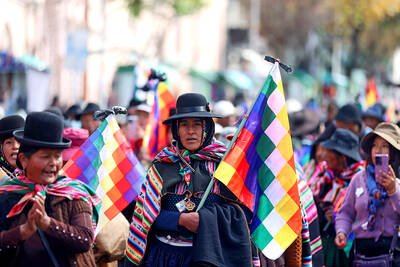
SEEKING ORDER: Rodrigo Paz said that ‘anyone who wants to destroy the nation will have to deal with this president and the full force of the constitution’ Bolivian President Rodrigo Paz on Wednesday said that the nation was at a “breaking point” after nearly a month of protests that have caused shortages of food, fuel and medicine. Paz, who took office six months ago amid the worst economic crisis there in four decades, is battling a groundswell of fury over his policies. The political capital, La Paz, has been besieged by low-income workers and members of the indigenous majority calling for his resignation. “The country needs order and is reaching breaking point,” the 58-year-old said at a public event in La Paz, renewing his appeal for dialogue. On Tuesday, the Bolivian


 RSS
RSS