


Enraged mobs from one of India's myriad lower castes blocked roads with fiery barricades, stoned police and battled rival castes across a wide swath of northern India for a week to make a single, simple point: They want to be even lower.
With 25 people dead, the unrest spread to the fringes of the capital before the Gujjars — a class of farmers and shepherds — called off their protests.
They did so only after officials agreed to consider their demand to be officially shunted to the lowest rung of India's complex hereditary caste system, so they can get government jobs and university spots reserved for such groups.
"I am a farmer and I am poor," said Rajesh Gurjjar, 26, his thin T-shirt soaked with sweat a few minutes after police chased him off a main thoroughfare in the New Delhi suburb of Gurgaon on Monday.
"I want a government job. It pays more. The office is cool in summer. The fields are too hot," he said.
In other words, the fastest way up India's modern economic ladder is a quick step down its age-old social ladder.
Caste-related violence is nothing new, but in the Gujjars' bloody race to the bottom many see a paradox of caste in modern India: Its political importance keeps growing, even as the rise of an increasingly urbanized and educated middle class has weakened the system's grip socially, making it more acceptable for a group to try to fight its way down instead of pushing its way up.
"This isn't a case of a group agitating for the primacy or superiority of their caste. It has nothing to do with a claim of caste loyalty according to the Hindu world view or religious scriptures," said Parvan Varma, the author of Being Indian, a book about Indian society.
"This is the use of caste as political negotiating currency.
It's about a finite cake and a caste community attempting to get a piece," he said.
Caste politics were clear late Monday, when Gujjar leaders called off their protests after officials agreed to look into their demands.
The move immediately drew threats from leaders of a powerful rival group, the Meena, who are already classified among the lowest castes and clearly do not want more competition for jobs and school spots set aside under quotas. During the unrest, fighting between Meenas and Gujjars left at least four dead.
The caste system's origins and inner workings are subjects of a seemingly never-ending debate. But this much is certain: It divides people into four broad groups with the priestly Brahmin caste at the top. There are hundreds of sub-castes within each group, most drawn along occupational lines, although one's caste does not always dictate one's economic status.
While the caste system is part of Hinduism, there are also caste-like divisions among India's Muslims, who make up 13 percent of the country's 1.1 billion people, and Christians, who make up 2.4 percent.
Discrimination under the system was outlawed soon after independence from Britain in 1947, but its influence remains powerful and the government has sought to redress discrimination against those on the lower rungs by setting up quotas for government jobs and university spots.
But instead of weakening caste affiliations, the result has been a fracturing of politics along caste lines, with each of the lower groups vying for its share of the quotas.
Further complicating matters is that caste has never been as rigid a system as imagined in the West. Sociologists say there is, over generations, movement within its subgroups, and determining who gets access to the quotas has long been a red-hot, contentious issue.
There have been repeated protests in the past year over a government plan to reserve more than a quarter of the spots at India's top professional schools for the 3,743 castes and sub-castes, Gujjars among them, classified in the second-to-lowest category, the "Other Backward Classes."
India's Supreme Court temporarily suspended the plan in a March ruling that presaged the Gujjar protests.
"Nowhere in the world do castes queue up to be branded as backward," it said. "Nowhere in the world is there a competition to become backward."
Less controversial have been the decades-old quotas for those on the lowest rung of the caste system, the so-called Scheduled Castes and Tribes. It include the dalits, once called "untouchables." It's this group the Gujjars want to join.
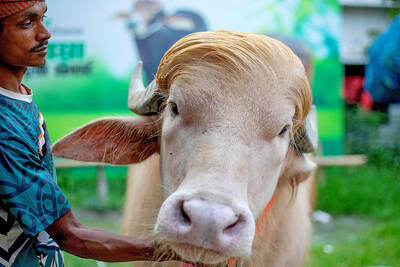
Crowds in Bangladesh are flocking to snap photographs with an unlikely social media star — an albino buffalo with flowing blond hair nicknamed “Donald Trump” that is due to be sacrificed within days. Owner Zia Uddin Mridha, 38, said his brother named the 700kg bull over its flowing helmet of hair resembling the signature look of the US president. “My younger brother picked this name because of the buffalo’s extraordinary hair,” he said at his farm in Narayanganj, just outside the capital, Dhaka. Mridha said that a constant stream of curious visitors — social media fans, onlookers and children — have come throughout

It began as a satirical online project. Now millions of young people in India are flocking to it as an outlet for their frustration. A parody political party called the Cockroach Janta Party, with the insect as its symbol, has exploded across India’s social media by turning absurdist humor into protest. Memes and short videos mocking corruption, joblessness and political dysfunction have flooded social media sites, where millions of users are embracing the cockroach — known for its ability to survive harsh conditions — as a tongue-in-cheek symbol of endurance. The online movement’s rise has been unusually rapid. The Cockroach Janta Party (CJP)
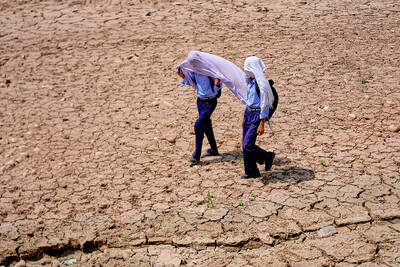
HOTTER: While Indians are accustomed to summer heat, climate change has caused northwestern India to warm faster than other parts of the country, an academic said Roads and markets have emptied during afternoons and some farmers have switched to nighttime work to avoid scorching temperatures as a heat wave grips large parts of India. The India Meteorological Department forecast maximum temperatures for yesterday of about 45°C in the capital, New Delhi, where authorities have opened temporary “cooling zones” to help people cope. The weather department warned that conditions would likely persist across several northern regions in the coming days, with temperatures staying well above seasonal averages. Authorities urged people to stay indoors during the hottest hours and take precautions against heat-related illnesses. India declares a heat wave whenever maximum temperatures

SPEAKING OUT: After Siranudh Scott’s allegations surfaced, celebrities and public figures took to social media to share their own experiences of sexual misconduct and abuse A high-profile alleged sexual abuse case within a wealthy Thai beer brewing family has prompted a wave of painful accounts from survivors of unconnected abuse in the conservative nation. Siranudh Scott, a member of the billionaire Thai family that founded the ubiquitous Singha beer brand, posted an emotional video this month accusing his elder brother Sunit of repeatedly abusing him when he was a teenager. Sunit, who is in his 30s, later denied the allegations in a video posted online, but Singha parent Boonrawd dismissed him from his executive role with the company on Tuesday last week. “I felt I needed to speak


 RSS
RSS