


Jamil el-Banna has been locked up by the US for nearly five years without being charged -- arrested in Africa, allegedly tortured at a CIA "black site" in Afghanistan, then held at Guantanamo Bay -- all because of faulty British intelligence, his defenders charge.
Now his lawyers have a new worry. The British government told them on Friday that el-Banna had been cleared for transfer to his native Jordan, where he says he was tortured before becoming a political refugee in Britain in 1997.
His lawyers decried the move, charging that sending him back amounted to the US outsourcing torture.
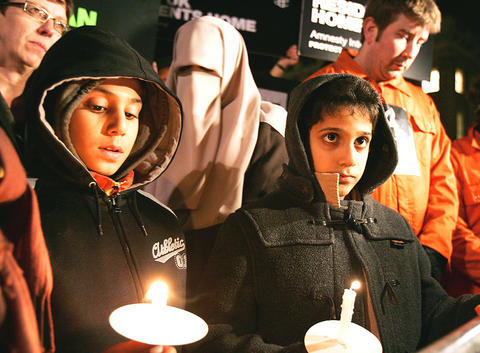
PHOTO: AP
"We are going to block his rendition to Jordan," attorney Clive Stafford Smith said. "To be sure, he would be out of [Guantanamo], but it would be from the frying pan into the fire."
Intelligence documents released by Britain to defense attorneys and a transcript of a Guantanamo hearing trace el-Banna's story.
His troubles started after a British MI5 intelligence officer visited his home near London one overcast morning in October 2002 and tried to get him to become a paid informant.
El-Banna, who is of Palestinian origin, was comfortable in Britain, repairing cars for sale at auction and performing faith healings while raising his family. But after the Sept. 11 attacks on the US, British spies were interested in him because of his associations with radical Muslims.
Abu Qatada, a Muslim cleric described by a Spanish judge as Osama bin Laden's "spiritual ambassador in Europe," had been el-Banna's neighbor in Pakistan, where el-Banna worked in the early 1990s for a Saudi charity helping Afghan refugees.
In Jordan, el-Banna belonged to a radical Palestinian support group linked to Iran and Syria -- which is what got him in trouble with Jordanian authorities.
El-Banna also had spoken with Imad Barakat Yarkas, an alleged al-Qaeda cell leader later jailed in Spain, and he was among hundreds of Muslims who regularly attended sermons in Abu Qatada's London-area mosque.
But the MI5 officer wrote that el-Banna "did not give any hint of willingness to cooperate with us."
His lawyers confirmed he didn't want to become an informant.
"He had nothing to do with Islamic extremism, and he did not want his life to be one of an informant," Stafford Smith said. "He was quite happy living the way he was living; he did not want their money, and he had four [now five] young kids to look after, who did not need to be exposed to that kind of jeopardy."
Unbeknownst to el-Banna, his friend Bisher al-Rawi, an Iraqi living in Britain, was helping MI5 keep tabs on London's Muslim community.
At the time, Abu Qatada was in hiding to avoid arrest under Britain's anti-terrorism laws, and al-Rawi relayed messages between MI5 and the cleric. El-Banna, meanwhile, sometimes drove Abu Qatada's wife and children to the imam's hideout as a favor to al-Rawi, el-Banna's lawyers said.
Al-Rawi also recruited el-Banna on the trip that ended with their arrest in Africa. El-Banna, then on welfare while working under the table, planned to manage a Gambian peanut oil plant, and the MI5 officer assured him he could travel.
El-Banna and al-Rawi were detained at Gatwick Airport the next day, however. According to an MI5 memo written that day -- Nov. 1, 2002 -- "some form of homemade electronic device" found in al-Rawi's bag could have been used in a car bomb.
British authorities released the men three days later and let them go to Africa after deciding the device was simply "a commercially available battery charger that had been modified by al-Rawi in order to make it more powerful."
But their fate was sealed when MI5 sent the Nov. 1 memo to US intelligence and alerted Gambian security, which arrested the two friends and handed them over to the CIA.
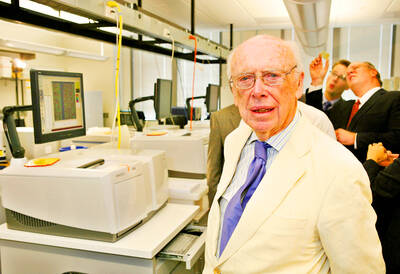
James Watson — the Nobel laureate co-credited with the pivotal discovery of DNA’s double-helix structure, but whose career was later tainted by his repeated racist remarks — has died, his former lab said on Friday. He was 97. The eminent biologist died on Thursday in hospice care on Long Island in New York, announced the Cold Spring Harbor Laboratory, where he was based for much of his career. Watson became among the 20th century’s most storied scientists for his 1953 breakthrough discovery of the double helix with researcher partner Francis Crick. Along with Crick and Maurice Wilkins, he shared the
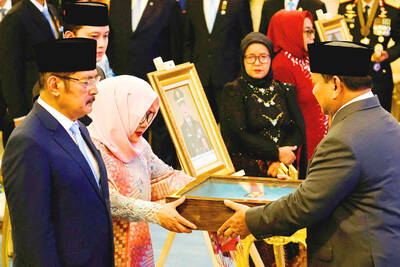
OUTRAGE: The former strongman was accused of corruption and responsibility for the killings of hundreds of thousands of political opponents during his time in office Indonesia yesterday awarded the title of national hero to late president Suharto, provoking outrage from rights groups who said the move was an attempt to whitewash decades of human rights abuses and corruption that took place during his 32 years in power. Suharto was a US ally during the Cold War who presided over decades of authoritarian rule, during which up to 1 million political opponents were killed, until he was toppled by protests in 1998. He was one of 10 people recognized by Indonesian President Prabowo Subianto in a televised ceremony held at the presidential palace in Jakarta to mark National
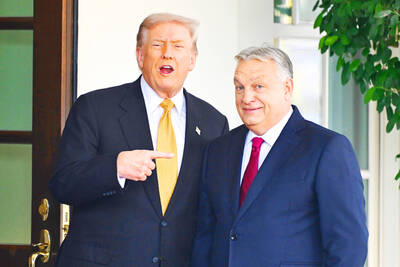
US President Donald Trump handed Hungarian Prime Minister Viktor Orban a one-year exemption from sanctions for buying Russian oil and gas after the close right-wing allies held a chummy White House meeting on Friday. Trump slapped sanctions on Moscow’s two largest oil companies last month after losing patience with Russian President Vladimir Putin over his refusal to end the nearly four-year-old invasion of Ukraine. However, while Trump has pushed other European countries to stop buying oil that he says funds Moscow’s war machine, Orban used his first trip to the White House since Trump’s return to power to push for
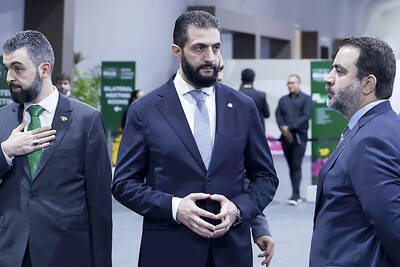
LANDMARK: After first meeting Trump in Riyadh in May, al-Sharaa’s visit to the White House today would be the first by a Syrian leader since the country’s independence Syrian President Ahmed al-Sharaa arrived in the US on Saturday for a landmark official visit, his country’s state news agency SANA reported, a day after Washington removed him from a terrorism blacklist. Sharaa, whose rebel forces ousted long-time former Syrian president Bashar al-Assad late last year, is due to meet US President Donald Trump at the White House today. It is the first such visit by a Syrian president since the country’s independence in 1946, according to analysts. The interim leader met Trump for the first time in Riyadh during the US president’s regional tour in May. US envoy to Syria Tom Barrack earlier


 RSS
RSS