


Hundreds of police in riot gear deployed yesterday throughout the mostly deserted streets of Hyderabad, hoping to prevent anger over a mosque bombing from sparking more of the religious violence that has plagued the southern Indian city.
Most shops closed for a daylong strike to protest Friday's attack at the 17th-century Mecca Masjid mosque that left 10 people dead and 35 wounded and the ensuing clashes with police that left four others dead.
Authorities across India were told to be alert for any signs of Hindu-Muslim fighting, and top officials called for calm.
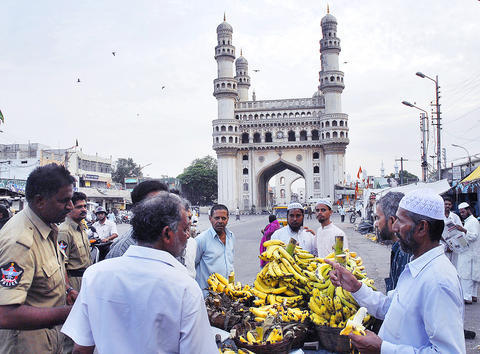
PHOTO: AP
Black protest flags were planted across the city and families of most of those killed prepared for funerals. Thirteen of the 14 bodies at the mortuary of the state-run Osmania Hospital had been claimed by yesterday morning.
Y.S. Rajasekhara Reddy, the chief minister of Andhra Pradesh state, where Hyderabad is located, called the bombing an act of "intentional sabotage on the peace and tranquility in the country."
Prime Minister Manmohan Singh also condemned the attack, the second on a mosque this year and urged Indians to remain peaceful.
There was no immediate claim of responsibility for the attack and officials refused to publicly say who they suspect.
Indian media reported yesterday that intelligence agencies were looking at a possible link to Islamic militant groups based in Pakistan.
None of the accounts offered any reasons why investigators would suspect Muslim groups in an attack on a mosque, but the militants are routinely blamed for attacks in India, even when Muslims are targeted.
Such accusations stoke resentment among Muslims, who account for about 130 million of India's 1.1 billion, about 80 percent of whom are Hindu.
"I don't have any doubts that this is an act of Hindu terrorists," said Saleem Uddin, a 35-year-old businessman who lives near the Mecca Masjid.
Speaking soon after Friday's attack, Uddin talked of the bombing of another mosque in the western Indian city of Malegaon last year that killed 31 people and complained bitterly that authorities have blamed Muslim extremists for that attack but provided only limited evidence.
A series of blasts have hit India in the past year, including the July bombings of seven Mumbai commuter trains that killed more than 200 people.
After the blast on Friday, worshippers at the mosque, angered by what they said was a lack of police protection, began hurling stones at police and chanting: "God is great!" Police dispersed them with baton charges and tear gas.
Groups of Muslims later clashed with security forces in at least three others parts of Hyderabad and police used live ammunition and tear gas to quell the riots, killing four people, city police chief Balwinder Singh said.
Hyderabad, a city of 7 million people, about 40 percent of whom are Muslim, has long been plagued by communal tensions -- and occasional spasms of inter-religious bloodletting.
Five people were killed and 27 wounded in Hindu-Muslim clashes in 2003.
The fighting began when Muslims marked the anniversary of the destruction of the 16th century Babri Mosque by Hindu extremists in northern India in 1992.
Relations between Hindus and Muslims have been largely peaceful since the bloody partition of the subcontinent into India and Muslim Pakistan at independence from Britain in 1947.
But mistrust runs deep and there have been sporadic bouts of violence.
The worst in recent years came in 2002, in the western Gujarat state.
More than 1,000 people, most of them Muslim, were killed by Hindu mobs after a train fire killed 60 Hindus returning from a religious pilgrimage. Muslims were blamed for the train fire.
India's federal Home Minister Shivraj Patil was to hold a press conference later yesterday, although no details on the subject of his briefing were immediately available.

Hungarian authorities temporarily detained seven Ukrainian citizens and seized two armored cars carrying tens of millions of euros in cash across Hungary on suspicion of money laundering, officials said on Friday. The Ukrainians were released on Friday, following their detention on Thursday, but Hungarian officials held onto the cash, prompting Ukraine to accuse Hungary’s Russia-friendly government of illegally seizing the money. “We will not tolerate this state banditism,” Ukrainian Minister of Foreign Affairs Andrii Sybiha said. The seven detained Ukrainians were employees of the Ukrainian state-owned Oschadbank, who were traveling in the two armored cars that were carrying the money between Austria and

Kosovar President Vjosa Osmani on Friday after dissolving the Kosovar parliament said a snap election should be held as soon as possible to avoid another prolonged political crisis in the Balkan country at a time of global turmoil. Osmani said it is important for Kosovo to wrap up the upcoming election process and form functional institutions for political stability as the war rages in the Middle East. “Precisely because the geopolitical situation is that complex, it is important to finish this electoral process which is coming up,” she said. “It is very hard now to imagine what will happen next.” Kosovo, which declared

MORE BANS: Australia last year required sites to remove accounts held by under-16s, with a few countries pushing for similar action at an EU level and India considering its own ban Indonesia on Friday said it would ban social media access for children under 16, citing threats from online pornography, cyberbullying, online fraud and Internet addiction. “Accounts belonging to children under 16 on high-risk platforms will start to be deactivated, beginning with YouTube, TikTok, Facebook, Instagram, Threads, X, Bigo Live and Roblox,” Indonesian Minister of Communications and Digital Meutya Hafid said. “The government is stepping in so that parents no longer have to fight alone against the giants of the algorithm. Implementation will begin on March 28, 2026,” she said. The social media ban would be introduced in stages “until all platforms fulfill their
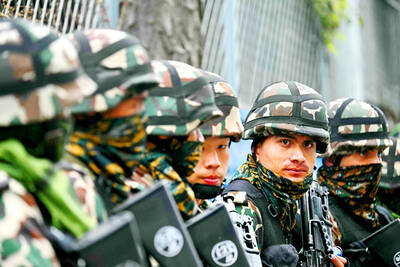
Counting was under way in Nepal yesterday, after a high-stakes parliamentary election to reshape the country’s leadership following protests last year that toppled the government. Key figures vying for power include former Nepalese prime minister K. P. Sharma Oli, rapper-turned-mayor Balendra Shah, who is bidding for the youth vote, and newly elected Nepali Congress party leader Gagan Thapa. In Kathmandu’s tea shops and city squares, people were glued to their phones, checking results as early trends flashed up — suggesting Shah’s centrist Rastriya Swatantra Party (RSP) was ahead. Nepalese Election Commission spokesman Prakash Nyupane said the counting was ongoing “in a peaceful manner”


 RSS
RSS