


North Korea is willing in principle to start regular cross-border rail services with South Korea, Seoul's unification minister said yesterday amid criticism that a one-off link-up will lead nowhere.
The two nations on Thursday carried out landmark test runs on two lines across their heavily fortified border for the first time since the Korean War of 1950 to 1953.
The journeys prompted celebratory scenes in the South and were hailed as a milestone for reunification. But they cannot be repeated until the North's powerful military extends its one-off guarantee of safe passage across the world's last Cold War frontier.
"The North has shared the view with us that the test runs should lead to the opening of cross-border rail service," Unification Minister Lee Jae-joung said on a local radio program.
Lee, quoted by Yonhap news agency, did not say when and how the two sides made the agreement. He said they will discuss the formal opening of the connected railways during ministerial talks from May 29 to May 31 in Seoul.
Analysts say the military is reluctant to open up railways as it depends on them for transporting war materials.
The lines, especially the one that could link the two countries' capitals, pass sensitive areas once used as invasion routes.
"The North's military is concerned that the opening of railways may lead to the loosening of defense as railways are like lifelines for them," Professor Yang Moo-jin of the University of North Korean Studies said.
"It [the security guarantee] will be resolved step by step, not by a single stroke," the unification minister said, adding that it would be raised when top-level military talks resume in July.
Lee Churl, head of the state Korea Railroad Corporation, said on Thursday he planned to meet his North Korean and Russian counterparts in Pyongyang as early as next month to discuss linking an inter-Korean railway to the Trans-Siberian Railway.
Even with security guarantees, such a project would need massive investment in the North's crumbling rail network.
Before the test runs on short stretches of track, South Korea spent 545.4 billion won (US$586 million) on repairing railways and facilities on both sides of the border, the Korea Times estimated.
This week it agreed to provide the North with US$80 billion worth of light industrial goods and 400,000 tonnes of rice aid worth US$170 million.
"This, and North Korea's reluctance to go any further, forces one to rethink before dreaming of fully re-linked inter-Korean railways, much less its connection to Trans-Siberian Railway," the Times said in an editorial.
The conservative opposition Grand National Party urged the government to slow down on inter-Korean economic cooperation, to avoid jeopardizing international efforts to scrap North Korea's nuclear weapons.
"Given that no tangible progress has been made since the February 13 [disarmament] agreement, the railway test runs could work against the international community's coordinated peace efforts," the party said.
The JoongAng daily said the test runs came seven years after an initial agreement, at the first and only inter-Korean summit in 2000.
It said their significance may be tainted "if the government tries to puff up its symbolic meaning or to use it for its own political purposes."

‘SHORTSIGHTED’: Using aid as leverage is punitive, would not be regarded well among Pacific Island nations and would further open the door for China, an academic said New Zealand has suspended millions of dollars in budget funding to the Cook Islands, it said yesterday, as the relationship between the two constitutionally linked countries continues to deteriorate amid the island group’s deepening ties with China. A spokesperson for New Zealand Minister of Foreign Affairs Winston Peters said in a statement that New Zealand early this month decided to suspend payment of NZ$18.2 million (US$11 million) in core sector support funding for this year and next year as it “relies on a high trust bilateral relationship.” New Zealand and Australia have become increasingly cautious about China’s growing presence in the Pacific
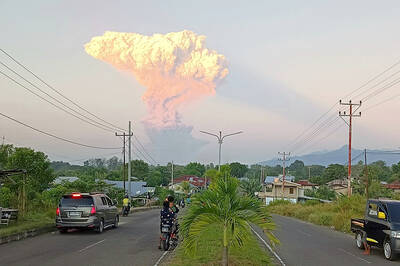
Indonesia’s Mount Lewotobi Laki-Laki yesterday erupted again with giant ash and smoke plumes after forcing evacuations of villages and flight cancelations, including to and from the resort island of Bali. Several eruptions sent ash up to 5km into the sky on Tuesday evening to yesterday afternoon. An eruption on Tuesday afternoon sent thick, gray clouds 10km into the sky that expanded into a mushroom-shaped ash cloud visible as much as 150km kilometers away. The eruption alert was raised on Tuesday to the highest level and the danger zone where people are recommended to leave was expanded to 8km from the crater. Officers also

The team behind the long-awaited Vera Rubin Observatory in Chile yesterday published their first images, revealing breathtaking views of star-forming regions as well as distant galaxies. More than two decades in the making, the giant US-funded telescope sits perched at the summit of Cerro Pachon in central Chile, where dark skies and dry air provide ideal conditions for observing the cosmos. One of the debut images is a composite of 678 exposures taken over just seven hours, capturing the Trifid Nebula and the Lagoon Nebula — both several thousand light-years from Earth — glowing in vivid pinks against orange-red backdrops. The new image

ESPIONAGE: The British government’s decision on the proposed embassy hinges on the security of underground data cables, a former diplomat has said A US intervention over China’s proposed new embassy in London has thrown a potential resolution “up in the air,” campaigners have said, amid concerns over the site’s proximity to a sensitive hub of critical communication cables. The furor over a new “super-embassy” on the edge of London’s financial district was reignited last week when the White House said it was “deeply concerned” over potential Chinese access to “the sensitive communications of one of our closest allies.” The Dutch parliament has also raised concerns about Beijing’s ideal location of Royal Mint Court, on the edge of the City of London, which has so


 RSS
RSS