


A French aid worker released by the Taliban after five weeks in captivity in Afghanistan returned to France yesterday and made a plea for his captors to free three Afghans seized with him.
Eric Damfreville arrived at the Villacoublay military airport, west of Paris, where he was met by Foreign Minister Philippe Douste-Blazy.
"I feel a great joy to be here this morning," said Damfreville, who worked for the humanitarian aid group Terre d'Enfance. "But my joy will be even greater once Azrat, Rasul, Hashim, three Afghans, are also freed."
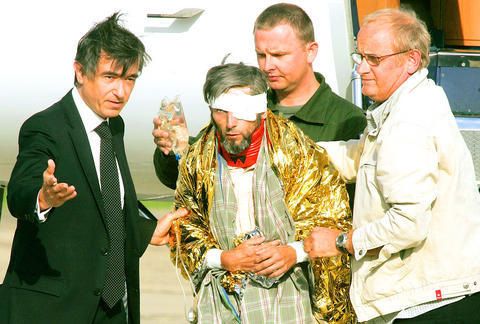
Damfreville, who had one eye covered by a bandage, looked thin and frail as he stepped off a French military plane.
The head of Terre d'Enfance, Antoine Vuillaume, said Damfreville had spent most of his captivity bound and gagged and described his health as "quite deteriorated."
Damfreville, however, said he was treated well by his captors and that his weakened health was a result of the length of his detention and the sparse conditions of the area where he was held.
"I was treated well ... there was no bad treatment from our captors, who did everything so that the conditions of detention were good," he told reporters in brief remarks.
He was taken by ambulance to a military hospital in the Paris region.
"His release is a relief for all of us," Douste-Blazy said.
The aid worker was released on Friday after 38 days in captivity. He had been abducted along with a female colleague and the three Afghans in the country's southwestern Nimroz province on April 3.
The Taliban released the woman, Celine Cordelier, on April 28. There was no word on the fate of the three Afghans.
After taking the group captive, the Taliban demanded the withdrawal of all remaining French troops from Afghanistan. France pulled 200 French special forces out of Afghanistan late last year and still has about 1,000 troops stationed in the country.
The French aid workers were kidnapped two weeks after Afghan authorities released five Taliban prisoners in exchange for an Italian newspaper reporter who was abducted along with his two Afghan colleagues in southern Helmand province on March 5. The two Afghans were killed.
French President Jacques Chirac said in a statement he was "delighted" to learn of Damfreville's liberation and called for the release of the three Afghans.
Terre d'Enfance said his release was a "great joy" for members of the aid group. It also called for the three Afghans to be freed.
"We will only be completely relieved once Rasul, Azrat and Hashim have been released and returned to their families," the aid group said in a statement. "We ask that the mobilization of French and Afghan authorities -- which led to these first releases -- be continued until there's a happy outcome for everyone."
Meanwhile, new airstrikes in a volatile southern Afghan region have killed up to 10 Taliban fighters close to where villagers say about 40 civilians died during a battle earlier this week.
Taliban fighters ambushed a patrol of US-led coalition and Afghan forces near Sangin in Helmand province Thursday evening, and gunfire and airstrikes killed 10 militants, said Eizatullah Khan, the Sangin district chief.
A coalition spokesman, Sargent 1st Class Dean Welch, put the toll at six Taliban killed. He had no further details. Two villagers from Sangin said they knew of no civilian casualties caused by the fight.
Airstrikes called in by US Special Forces fighting some 200 Taliban militants north of Sangin on Tuesday killed 21 civilians, government officials said, while villagers said nearly 40 civilians were killed.
The US-led coalition confirmed that the battle caused civilian casualties, killing at least one child, and that a joint Afghan-U.S. team would investigate.
General Dan McNeill, the top NATO commander in Afghanistan, told NPR News' "Morning Edition" that "it does appear there were civilian casualties" but that it wasn't clear what caused them. He said it was likely the Taliban militants had been firing on coalition forces from civilian homes.

‘CROSSING THE LINE’: China’s embassy in Seoul criticized US Forces Korea Commander General Xavier Brunson, asking if his ‘hostile’ remarks were authorized by Washington South Korea and the US are in talks over recent public remarks by the commander of US Forces Korea, Seoul’s presidential office said yesterday, after the comments drew sharp criticism from China. In a recent podcast interview, US Forces Korea Commander General Xavier Brunson described South Korea as “the dagger in the heart of Asia” from China’s east coast, prompting the Chinese embassy in Seoul to say that he had “truly crossed the line.” The interview came amid growing speculation that Washington might seek to expand the role of US Forces Korea in countering the growing regional influence of China, a key

Through the noise of rushing papers and whirring belts at a print factory in Kyoto, two creators watch their photo essay come to life in broadsheet form — part of an effort to win new audiences in the age of artificial intelligence (AI). Despite the decline of the publishing industry, self-publication and handmade “zine” magazines are growing in popularity in Japan, reflecting the nation’s enduring love of paper in the digital era. While speaking to Agence France-Presse at the plant, his hands black with ink, one of the creators, Kazuma Obara, said: “I think [paper] is a medium that engages all five

Australian researchers have trained lab-grown brain cells on a silicon computer chip to play the 1990s shooter game Doom and said they are just scratching the surface of what the neurons could be capable of doing. It is the science-fiction work of biotech boffins at Cortical Labs, who researched and developed the technology that harnesses the workings of the brain’s networking system. Each so-called “biological computer” contains about 200,000 living human brain cells, grown from stem cells that were harvested from blood donations. Having mastered the simple computer game Pong, where a paddle is moved up and down to send a ball

France experienced its hottest spring on record, the French weather service said on Tuesday, after an exceptional early heat wave that also broke highs for the season in England and Wales. Meteo-France said the average nationwide temperature over March to May was 13.8°C — about 1.7°C above the norm, and surpassing records set in 2011 and 2020. “The warmest spring since records began in 1900,” it said in a bulletin. All three months were warmer than average, but the onset of an “unprecedented heatwave” late last month pushed the mercury to highs typically seen at the height of the summer. “Our country had never


 RSS
RSS