


Saudi Arabia said it is still negotiating with Iraq over writing off billions of dollars owed it by the war-torn country, and major creditors Kuwait and Russia failed to offer immediate debt relief -- a key goal of an ambitious blueprint launched to stabilize Iraq.
The absence of major commitments to reduce Iraq's burdensome debt was a disappointment on Thursday at a major regional conference in the Egyptian resort aimed at showing support for Iraq -- and a sign that some, particularly Sunni Arab, nations are still keeping their distance from Iraq's Shiite-led government.
Still, the Iraqi government, the UN and many of the more than 60 nations and organizations gathered here hailed the launch of the blueprint as a milestone.
The International Compact with Iraq sets ambitious benchmarks to achieve a stable, united, democratic Iraq within five years. It defines international help for Iraq -- including debt relief -- but also sets tough commitments on the Baghdad government, particularly carrying out reforms aimed at giving Iraq's Sunni Arabs a greater role in the political process.
It was an initiative of Iraq's first elected government, launched soon after Iraqi Prime Minister Nouri al-Maliki took office last June and strongly backed by the UN.
The US has stressed the Iraqi role in organizing the conference, but US diplomats and Secretary of State Condoleezza Rice's advisers have crisscrossed the globe and worked hard to increase support, particularly among Arab nations.
After delegates backed the compact on Thursday by acclamation with a round of applause, a smiling Rice approached UN Secretary-General Ban Ki-moon, saying: "You did a great job. This is a wonderful day for all of us."
But the debt issue loomed large over the meeting's unfinished business.
The Paris Club of affluent lender nations has already written off US$100 billion of Iraq's debt -- most from former Iraqi leader Saddam Hussein's war against Iran in the 1990s.
But the government still owes a huge amount. Iraq's finance minister put the total remaining at roughly US$50 billion, but the numbers vary and in some cases are still not resolved -- with some estimates as high as US$62 billion.
Al-Maliki opened the conference urging ``all our friends ... to forgive our debts and allow us to launch our reconstruction and development.''
But the foreign minister of Saudi Arabia -- a major lender -- made no immediate public pledge. Saud al-Faisal said only that his country was in talks with Iraq "to have an appropriate solution to debts in line with rules of the Paris Club," which calls for forgiving at least 80 percent of Iraq's debts.
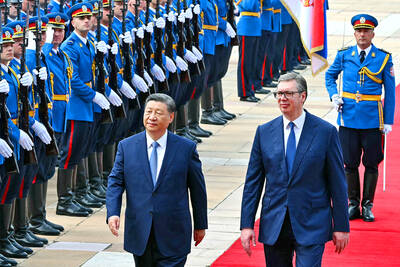
MONEY MATTERS: Xi was to highlight projects such as a new high-speed railway between Belgrade and Budapest, as Serbia is entirely open to Chinese trade and investment Serbian President Aleksandar Vucic yesterday said that “Taiwan is China” as he made a speech welcoming Chinese President Xi Jinping (習近平) to Belgrade, state broadcaster Radio Television of Serbia (RTS) said. “We have a clear and simple position regarding Chinese territorial integrity,” he told a crowd outside the government offices while Xi applauded him. “Yes, Taiwan is China.” Xi landed in Belgrade on Tuesday night on the second leg of his European tour, and was greeted by Vucic and most government ministers. Xi had just completed a two-day trip to France, where he held talks with French President Emmanuel Macron as the

With the midday sun blazing, an experimental orange and white F-16 fighter jet launched with a familiar roar that is a hallmark of US airpower, but the aerial combat that followed was unlike any other: This F-16 was controlled by artificial intelligence (AI), not a human pilot, and riding in the front seat was US Secretary of the Air Force Frank Kendall. AI marks one of the biggest advances in military aviation since the introduction of stealth in the early 1990s, and the US Air Force has aggressively leaned in. Even though the technology is not fully developed, the service is planning
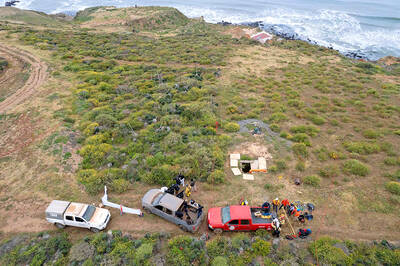
INTERNATIONAL PROBE: Australian and US authorities were helping coordinate the investigation of the case, which follows the 2015 murder of Australian surfers in Mexico Three bodies were found in Mexico’s Baja California state, the FBI said on Friday, days after two Australians and an American went missing during a surfing trip in an area hit by cartel violence. Authorities used a pulley system to hoist what appeared to be lifeless bodies covered in mud from a shaft on a cliff high above the Pacific. “We confirm there were three individuals found deceased in Santo Tomas, Baja California,” a statement from the FBI’s office in San Diego, California, said without providing the identities of the victims. Australian brothers Jake and Callum Robinson and their American friend Jack Carter
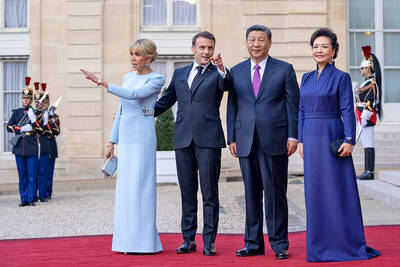
CUSTOMS DUTIES: France’s cognac industry was closely watching the talks, fearing that an anti-dumping investigation opened by China is retaliation for trade tensions French President Emmanuel Macron yesterday hosted Chinese President Xi Jinping (習近平) at one of his beloved childhood haunts in the Pyrenees, seeking to press a message to Beijing not to support Russia’s war against Ukraine and to accept fairer trade. The first day of Xi’s state visit to France, his first to Europe since 2019, saw respectful, but sometimes robust exchanges between the two men during a succession of talks on Monday. Macron, joined initially by EU Commission President Ursula von der Leyen, urged Xi not to allow the export of any technology that could be used by Russia in its invasion


 RSS
RSS