


Malaysia's No. 2 leader is fighting efforts by opposition politician Anwar Ibrahim to tie him to a high-profile murder, as the rivals square off in a bitter electoral campaign.
Anwar, himself a former deputy prime minister, has repeatedly claimed in recent days that Najib Razak is corrupt, and has tried to link Najib to the murder of a Mongolian woman.
Najib denied any wrongdoing in a speech late on Saturday, insisting that Altantuya Shaariibuu's murder case "has nothing to do with me" and accusing the opposition of being "bankrupt of ideas," the New Straits Times newspaper reported yesterday.
Anwar told supporters late Friday in the semi-rural constituency of Ijok, 50km northwest of Kuala Lumpur, that he possessed "knowledge of many things about Najib," and threatened to "reveal more when the general elections arrive."
Video footage of Anwar's speech was posted on several opposition Web sites.
The conflict comes while both men are leading rival factions in fierce campaigning to win a state legislative seat in Ijok in an April 28 by-election, which has drawn widespread attention amid speculation that the government will call general elections by early next year.
Anwar accused Najib, who is also defense minister, of "deceiving the public" about government defense contracts, and suggested that Najib might also be connected to last October murder of Shaariibuu, a 28-year-old Mongolian who had an eight-month-affair with top political analyst Abdul Razak Baginda, who has close ties to Najib.
"Who ordered the murder?" Anwar said. "We want to ask Najib, did you know about it? Did you know Altantuya?"
Najib has rejected the taunts by Anwar, who held the No. 2 position under former prime minister Mahathir Mohamad for five years until Mahathir fired him in 1998 over allegations of graft and homosexuality.
Abdul Razak has been charged with abetting the murder of Shaariibuu, who was believed to have been shot and her body blown up with military-grade explosives. Two policemen are charged with carrying out the murder, and their joint trial is scheduled to begin June 4. If convicted, all three face the death penalty.
In the past week, Najib has said that he too knows of skeletons in Anwar's closet.
"If I want to talk, I can," Najib said on Wednesday. "However I do not want to embarrass him because we know he has a wife and children."
After Anwar was fired by Mahathir, he was tried and convicted of abuse of power and sodomy, and sentenced to 15 years in prison. He was freed in 2004 after Malaysia's top court overturned the sodomy conviction.
Anwar has said the charges were fabricated to keep him from challenging Mahathir, who retired in 2003 and handed power to Prime Minister Abdullah Ahmad Badawi.
The by-election in Ijok, which pits Abdullah's National Front ruling coalition against Anwar's opposition People's Justice Party, is considered a warm-up for both sides to gauge their preparedness for general elections, as well as a test of Anwar's popularity after nearly a decade in political limbo.
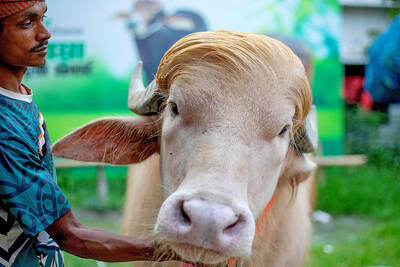
Crowds in Bangladesh are flocking to snap photographs with an unlikely social media star — an albino buffalo with flowing blond hair nicknamed “Donald Trump” that is due to be sacrificed within days. Owner Zia Uddin Mridha, 38, said his brother named the 700kg bull over its flowing helmet of hair resembling the signature look of the US president. “My younger brother picked this name because of the buffalo’s extraordinary hair,” he said at his farm in Narayanganj, just outside the capital, Dhaka. Mridha said that a constant stream of curious visitors — social media fans, onlookers and children — have come throughout

It began as a satirical online project. Now millions of young people in India are flocking to it as an outlet for their frustration. A parody political party called the Cockroach Janta Party, with the insect as its symbol, has exploded across India’s social media by turning absurdist humor into protest. Memes and short videos mocking corruption, joblessness and political dysfunction have flooded social media sites, where millions of users are embracing the cockroach — known for its ability to survive harsh conditions — as a tongue-in-cheek symbol of endurance. The online movement’s rise has been unusually rapid. The Cockroach Janta Party (CJP)

BIGGER ROLE: Beijing has said it maintains an impartial stance on the war in Ukraine, but by training Russian troops, China is far more involved than previously known China’s armed forces secretly trained about 200 Russian military personnel in China late last year, and some have since returned to fight in Ukraine, according to three European intelligence agencies and documents seen by Reuters. While China and Russia have held a number of joint military exercises since Moscow’s full-scale invasion of Ukraine in 2022, Beijing has repeatedly said that it is neutral in the conflict and presents itself as a peace mediator. The covert training sessions, which predominantly focused on the use of drones, were outlined in a dual-language Russian-Chinese agreement signed by senior Russian and Chinese officers in Beijing on
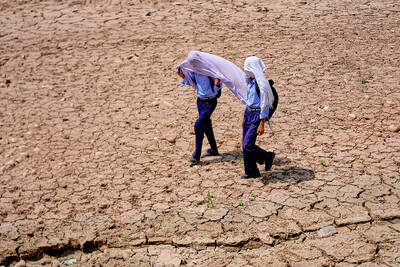
HOTTER: While Indians are accustomed to summer heat, climate change has caused northwestern India to warm faster than other parts of the country, an academic said Roads and markets have emptied during afternoons and some farmers have switched to nighttime work to avoid scorching temperatures as a heat wave grips large parts of India. The India Meteorological Department forecast maximum temperatures for yesterday of about 45°C in the capital, New Delhi, where authorities have opened temporary “cooling zones” to help people cope. The weather department warned that conditions would likely persist across several northern regions in the coming days, with temperatures staying well above seasonal averages. Authorities urged people to stay indoors during the hottest hours and take precautions against heat-related illnesses. India declares a heat wave whenever maximum temperatures


 RSS
RSS