


The ancient teachings of Confucius, centering on peace and social harmony, are finding a new resonance amid the chaos and rapid development of modern China.
Once suppressed by Maoist China, the Confucian revival is being welcomed by the communist government as a calming influence amid growing public dissatisfaction over a host of issues.
"The teachings of Confucius are the first thing we begin teaching the children," said Feng Zhe, director of the Confucian School, which opened six months ago. "Each child should recite the Confucian texts 1,000 times until their spirit is imprinted completely. This is a graduation requirement."
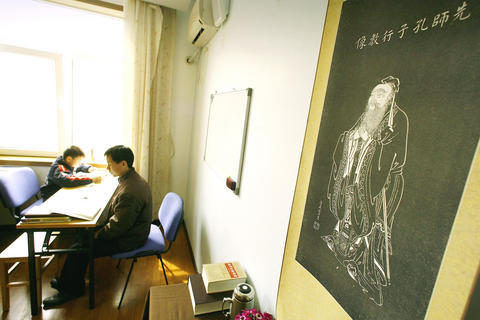
PHOTO: AFP
China's education ministry gave permission for the school to open in a villa in the Beijing suburbs, and Feng sees it as the tip of a future iceberg.
So far 46 students below the age of 14 have enrolled in the school which is based on learning through recitation.
"The concept of scientific development and the idea of a harmonious society advocated by the government today comes from ancient Chinese culture," Feng said with a smile from behind his round scholarly glasses. "We hope that our students will become China's cultural ambassadors in the world."
Feng predicts that there will be more than 10,000 similar schools throughout China within the next 10 years as the nation wakes up to its heritage.
The school hopes to combine the best of traditional China with the great classics of the world and is aiming to train "human beings who know their own culture as well as the advanced culture of the West," said Tao Ye, another school official.
In 1973, revolutionary leader Mao Zedong (
Thirty years later, the Chinese Communist Party is embracing Confucius in official slogans.
In the "eight vices and eight virtues" of President Hu Jintao (
Far from discouraging this return to Confucianism the government is promoting it amid growing public dissatisfaction with rampant corruption and unbridled development, evident in more than 87,000 public protests recorded in 2005.
For young students, learning the 2,500-year-old teachings of Confucius, advocating subservience to authority through filial piety, is key to becoming a better person.
"If we study at a regular school and learn Chinese and math, that is useful but not as useful as this," said Liu Zhenran, a 10-year-old. "Here we learn to be a good person thanks to Confucius. This is more useful for us in the future."
Although the school is mainly geared for a privileged class capable of paying an annual tuition of 30,000 yuan (US$3,900), Confucian studies have also reemerged in society thanks to television and books.
One of China's bestsellers in the past months is Confucius, As I See Him, the paperback version of a televised lecture series by Yu Dan (
Confucius, she says, would disapprove of disorderly behavior the government is trying to stamp out.


The leader of a South Korean church was arrested on Wednesday on suspicion of election influence as authorities widened an investigation into allegations that he illegally recruited thousands of followers into the People Power Party. The Shincheonji Church has denied the accusations against Lee Man-hee, 95, a self-proclaimed messenger of Jesus who founded the congregation in the 1980s. The church says it has about 200,000 members. Since January, a special team of prosecutors and police has been investigating alleged ties between religious groups such as Shincheonji and the Unification Church, and politicians. The inquiry is part of broader investigations under South Korea’s government into

Japanese airlines canceled more than 100 flights yesterday, as two tropical storms barrelled toward the archipelago, with authorities advising evacuations in some areas because of possible flooding and landslides. Severe tropical storm Mekkhala was downgraded from a typhoon, but still carried gusts of up to 144kph, forecasters said, with heavy rain already pounding parts of southern and western Japan. The weather system was expected to skirt the islands of Kyushu and Shikoku over the weekend and potentially converge with tropical storm Higos, which was also swirling further out in the Pacific. That could result in the atmospheric phenomenon known as the

Electric prods rested against the wall near rusty cages containing dog skulls in an abandoned canine slaughterhouse in a South Korean town. The deserted site in Pyeongtaek, south of Seoul, offered a glimpse into an industry rapidly disappearing as South Korea’s landmark dog meat ban enters into force next year. It also raises a question: What happened to the hundreds of thousands of dogs once bred for human consumption? Historically regarded as a summer stamina booster — particularly among older and rural people — dog meat has steadily fallen out of favor as younger South Koreans embrace dogs as pets and public attitudes

EXTREME HEAT WARNING: Across Europe, farms have suffered and hospitals have struggled to cope amid the heat wave, while dozens of people have died in France Germany and Italy yesterday endured sweltering conditions as a heatwave linked to dozens of deaths in Western Europe spread eastward after temperatures broke records above 40°C. The UK, France, Switzerland and Germany have experienced record heat this month, and the weather system could test more records as it rolls across Germany toward Poland. Scientists said the heatwave would have been virtually impossible without man-made climate change, which has made this week’s temperatures 100 times more likely than they would have been even two decades ago. On Friday, a new German record of 41.3°C was reached near the city of Saarbruecken close to the


 RSS
RSS