


Israel, Jordan and the Palestinians have agreed to create a 500km long "valley of peace" common economic zone, Israeli Deputy Prime Minister Shimon Peres said on Thursday.
"I do believe that the time has come, that while the politics should be done in a couple -- between the Palestinians and us -- the economy in our region should be done by a troika, the Jordanians, the Palestinians and us," Peres said at the World Economic Forum.
"The three countries have agreed to take the whole length of the frontier between Jordan, Israel and the Palestinians [West Bank], 500 kilometers long, and convert it into an ongoing economic zone," he added.
Peres, who was speaking during a public debate with Palestinian President Mahmoud Abbas and Israeli Foreign Minister Tzipi Livni, did not give details on what parts of the frontier between Israel and Palestinian territory might be involved.
Dubbing the zone a "valley of peace," Peres underlined that a huge market could develop in the Arab world over the next decade and appealed for investment.
"It can lower the tone and the flames of Muslim resistance and do it very quickly," Peres said.
The economic zone would include cooperation on water, agriculture, joint airports and tourism, he said.
Israel, Jordan and the Palestinian Authority -- which all divert waters from the Jordan River for irrigation purposes -- last month launched a two-year feasibility study to try and save the rapidly vanishing Dead Sea.
Israeli Deputy Defense Minister Ephraim Sneh said in Davos that a zone would take up the entire valley from the Red Sea near Aqaba to the Sea of Galilee.
Peres has been pushing the project "for a long time," Sneh said, saying it would bring together a "convergence of interests" between the three countries.
"It's not a matter of weeks but it will happen I believe," Peres added.
"The creation of an integrated economy of Israel, Palestine and Jordan, this is the core of the future Middle East," Sneh said.
Peres called on investors to seize "an awaiting opportunity," saying that economic interests represented at meetings like Davos could not afford to wait for the political side to move.

Crowds in Bangladesh are flocking to snap photographs with an unlikely social media star — an albino buffalo with flowing blond hair nicknamed “Donald Trump” that is due to be sacrificed within days. Owner Zia Uddin Mridha, 38, said his brother named the 700kg bull over its flowing helmet of hair resembling the signature look of the US president. “My younger brother picked this name because of the buffalo’s extraordinary hair,” he said at his farm in Narayanganj, just outside the capital, Dhaka. Mridha said that a constant stream of curious visitors — social media fans, onlookers and children — have come throughout

The Bolivian government on Friday struck a deal with protesting miners, but was still grappling with blockades and demonstrations by other workers across La Paz. Other groups are still blocking access roads into the city, which is also the seat of the government. Police on Thursday prevented the miners from entering the main square by using tear gas, while the demonstrators hurled stones and explosives with slingshots. Protests against the policies of Bolivian President Rodrigo Paz have convulsed the Andean nation since early this month, and roadblocks were choking routes into La Paz throughout Friday, the national road authority said. Miners demanded that Paz
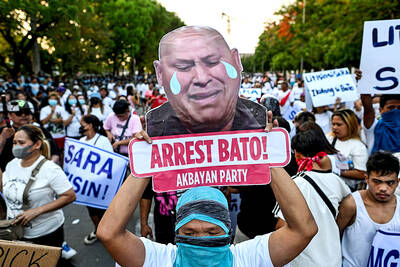
The Philippines said it has asked the country’s Supreme Court to allow it to arrest former Philippine president Rodrigo Duterte’s chief drug war enforcer to stand trial in an international tribunal. The International Criminal Court (ICC) last week unsealed an arrest warrant against Philippine Senator Ronald dela Rosa, accusing him along with Duterte and other “coperpetrators” of the “crime against humanity of murder.” Dela Rosa briefly sought refuge in the Philippine Senate last week while asking the Philippine Supreme Court to stop an ongoing attempt by government agents to arrest him. “By his own conduct, he has placed himself outside the protection of

The researchers in Ireland looked at their computer screen, marveling at a medieval book tracked down in a Roman library. They flipped through its digitized pages and found their sought-after treasure: the oldest surviving English poem. “We were extremely surprised. We were speechless. We couldn’t believe our eyes when we first saw that,” said Elisabetta Magnanti, a visiting research fellow at Trinity College Dublin’s school of English. The poem was also within the main body of Latin text, she said, calling it “extraordinary.” Composed in Old English by a Northumbrian agricultural worker in the 7th century, Caedmon’s Hymn appears within some copies of


 RSS
RSS