


The Department of Homeland Security (DHS) admitted it violated the Privacy Act two years ago by obtaining more commercial data about US airline passengers than it had announced it would.
Seventeen months ago, the government accountability office (GAO), Congress' auditing arm, reached the same conclusion -- the department's transportation security administration (TSA) "did not fully disclose to the public its use of personal information in its fall 2004 privacy notices as required by the Privacy Act."
Even so, in a report on Friday on the testing of TSA's Secure Flight domestic air passenger screening program, the DHS privacy office acknowledged TSA did not comply with the law.
Instead, the privacy office said: "TSA announced one testing program, but conducted an entirely different one."
In a 40-word, separate sentence, the report noted that federal programs that collect personal data that can identify Americans "are required to be announced in Privacy Act system notices and privacy impact assessments."
TSA spokesman Christopher White noted the GAO's earlier conclusions and said: "TSA has already implemented or is in the process of implementing each of the DHS privacy office recommendations."
Friday's report reinforced concerns on Capitol Hill.
"This further documents the cavalier way the Bush administration treats Americans' privacy," said Senator Patrick Leahy, the democrat who is set to become Senate Judiciary Committee chairman next month.
"With this database program, first they ignored the Privacy Act, and now, two years later, they still have a hard time admitting it," he said.
The privacy office said TSA announced in fall 2004 it would acquire passenger name records of people who flew domestically in June 2004. Airline passenger name records include the flyer's name, address, itinerary, form of payment, history of one-way travel, contact phone number, seating location and even requests for special meals.
The public notices said TSA would try to match the passenger names with names on watch lists of terrorists and criminals.
But they also said the passenger records would be compared with unspecified commercial data about Americans in an effort to see if the passenger data was accurate. It assured the public that TSA would not receive commercial data used by contractors to conduct that part of the tests.
But the contractor, EagleForce, used data obtained from commercial data collection companies Acxiom, Insight America and Qsent to fill in missing information in the passenger records and then sent the enhanced records back to TSA on CDs for comparison with watch lists.
Eventually, the three companies supplied EagleForce with 191 million records, though many were duplicates.
This was "contrary to the express statements in the fall privacy notices about the Secure Flight program," the privacy office concluded.
"EagleForce's access to the commercial data amounted to access of the data by TSA," it said.

It began as a satirical online project. Now millions of young people in India are flocking to it as an outlet for their frustration. A parody political party called the Cockroach Janta Party, with the insect as its symbol, has exploded across India’s social media by turning absurdist humor into protest. Memes and short videos mocking corruption, joblessness and political dysfunction have flooded social media sites, where millions of users are embracing the cockroach — known for its ability to survive harsh conditions — as a tongue-in-cheek symbol of endurance. The online movement’s rise has been unusually rapid. The Cockroach Janta Party (CJP)

SPEAKING OUT: After Siranudh Scott’s allegations surfaced, celebrities and public figures took to social media to share their own experiences of sexual misconduct and abuse A high-profile alleged sexual abuse case within a wealthy Thai beer brewing family has prompted a wave of painful accounts from survivors of unconnected abuse in the conservative nation. Siranudh Scott, a member of the billionaire Thai family that founded the ubiquitous Singha beer brand, posted an emotional video this month accusing his elder brother Sunit of repeatedly abusing him when he was a teenager. Sunit, who is in his 30s, later denied the allegations in a video posted online, but Singha parent Boonrawd dismissed him from his executive role with the company on Tuesday last week. “I felt I needed to speak

A Hong Kong astronaut is to join a Chinese space mission for the first time as part of a three-person crew launching today, as Beijing edges closer to its goal of landing people on the moon. The Tiangong space station — crewed by teams of three astronauts that are typically rotated every six months — is the crown jewel of China’s space program, boosted by billions in state investment in a bid to catch up with the US and Russia. The Shenzhou-23 mission is to blast off at 11:08pm from the Jiuquan Satellite Launch Center in northwestern China, carrying three astronauts to
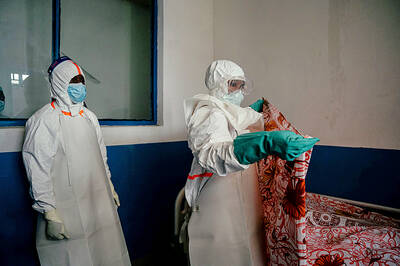
UPGRADED ALERT: The risk inside DR Congo is now considered ‘very high,’ while neighboring countries face a ‘high’ threat as the outbreak continues, the WHO said Ebola is spreading faster than responders can track it in eastern Congo, where health workers managed to follow up with barely one in five identified contacts in a single day. Authorities in the Democratic Republic of the Congo (DR Congo) reported 83 confirmed infections, 746 suspected cases and 1,603 identified contacts as of Thursday, but health workers were able to follow up on only 342 contacts that day — about 21 percent of the total under monitoring — data released by the DR Congo Ministry of Public Health on Friday showed. The figures suggest the response is falling behind the outbreak itself,


 RSS
RSS