


A veiled woman and two other suicide bombers exploded cars outside the base of Somalia's weak government on Thursday, killing themselves and five others hours after Ethiopia took another step toward war with its Islamic rivals in the country.
Besides the bombers, the others killed were three accomplices and two policemen, officials said. The suicide bombing was only the second in the country's history.
Officials of Somalia's Ethiopian-backed government blamed the attacks on foreign al-Qaeda fighters. Somalia's president has claimed Islamic extremists have drawn up a hit list of top officials in his weak administration.
In addition to the dead on Thursday, four people were injured in the attack at a checkpoint outside Baidoa, the only town the government controls.
Three cars arrived at a government checkpoint "and as the police tried to check them, they exploded," Somali Deputy Defense Minister Salad Ali Jelle said. He later said that two policemen were also killed, bringing the death toll to eight.
"We have captured three who were with them who have tried to flee," the minister said. "The dead include non-Somalis, they are al-Qaeda supporters."
No one claimed responsibility. The Islamic group denied it was behind the bombing.
In Ethiopia earlier on Thursday, the country's parliament authorized military action if attacked by the Islamic movement, which has declared holy war on Ethiopia over its troop incursions.
Ethiopian Prime Minister Meles Zenawi told lawmakers the country had already suffered attacks on Ethiopian soil by insurgent groups working closely with bitter rival Eritrea and Islamic forces in Somalia. The resolution authorized "any lawful or constitutional measures necessary to counter and stand up to any attacks or incursions on or into Ethiopia."
Tensions are high in Somalia, where the Islamic movement and the transitional government are vying for control. Analysts fear a war could engulf the entire region.

Crowds in Bangladesh are flocking to snap photographs with an unlikely social media star — an albino buffalo with flowing blond hair nicknamed “Donald Trump” that is due to be sacrificed within days. Owner Zia Uddin Mridha, 38, said his brother named the 700kg bull over its flowing helmet of hair resembling the signature look of the US president. “My younger brother picked this name because of the buffalo’s extraordinary hair,” he said at his farm in Narayanganj, just outside the capital, Dhaka. Mridha said that a constant stream of curious visitors — social media fans, onlookers and children — have come throughout

It began as a satirical online project. Now millions of young people in India are flocking to it as an outlet for their frustration. A parody political party called the Cockroach Janta Party, with the insect as its symbol, has exploded across India’s social media by turning absurdist humor into protest. Memes and short videos mocking corruption, joblessness and political dysfunction have flooded social media sites, where millions of users are embracing the cockroach — known for its ability to survive harsh conditions — as a tongue-in-cheek symbol of endurance. The online movement’s rise has been unusually rapid. The Cockroach Janta Party (CJP)
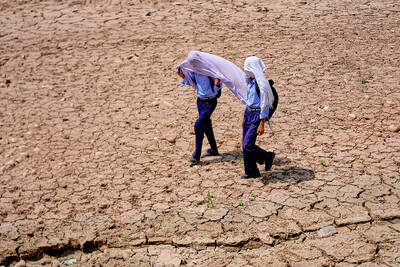
HOTTER: While Indians are accustomed to summer heat, climate change has caused northwestern India to warm faster than other parts of the country, an academic said Roads and markets have emptied during afternoons and some farmers have switched to nighttime work to avoid scorching temperatures as a heat wave grips large parts of India. The India Meteorological Department forecast maximum temperatures for yesterday of about 45°C in the capital, New Delhi, where authorities have opened temporary “cooling zones” to help people cope. The weather department warned that conditions would likely persist across several northern regions in the coming days, with temperatures staying well above seasonal averages. Authorities urged people to stay indoors during the hottest hours and take precautions against heat-related illnesses. India declares a heat wave whenever maximum temperatures

A Hong Kong astronaut is to join a Chinese space mission for the first time as part of a three-person crew launching today, as Beijing edges closer to its goal of landing people on the moon. The Tiangong space station — crewed by teams of three astronauts that are typically rotated every six months — is the crown jewel of China’s space program, boosted by billions in state investment in a bid to catch up with the US and Russia. The Shenzhou-23 mission is to blast off at 11:08pm from the Jiuquan Satellite Launch Center in northwestern China, carrying three astronauts to


 RSS
RSS