


Restored to power, congressional Democrats pledged on Wednesday to press for a new course in Iraq and move promptly to raise the minimum wage.
"We will not disappoint" the American people, Representative Nancy Pelosi said.
At a news conference in the Capitol, Pelosi, who will become the speaker, or leader of the House of Representatives pledged that Democrats will make the next Congress "the most honest, ethical and open" one in history.
Pelosi and Senate Democratic Leader Harry Reid of Nevada both said they would work with President George W. Bush in a bipartisan manner, and they made the same commitment with respect to congressional Republicans.
"If Democrats go in and seek retribution, we lose," agreed Democratic senator-elect Sherrod Brown who defeated two-term Republican Senator Mike DeWine in Ohio.
Pelosi and Reid made their comments before the full extent of the Democrats' triumph was clear.
Several House races remained too close to call, and the size of the new Democratic majority seemed likely to grow by a few seats. And within hours, Democrats gained control of the Senate when Virginia Senator George Allen lost his seat to Democratic challenger Jim Webb.
While Democrats stressed their desire for bipartisanship, they also made clear they intend to use their power.
Several Democrats suggested during the day that Bush meet with leaders to conduct a high-level review of the war in Iraq, a conflict that is unpopular with the public and that polls said had contributed to the Republicans' defeats.
Democratic Representative John Dingell, in line to take back the chairmanship of one powerful committee, told reporters he wants the Federal Communications Commission to postpone its vote on AT&T's proposed acquisition of BellSouth Corp.
"I think it would be in their interest, I think it would be in the interest of the committee and I think it would be in the interest of the public," he said.
Representative Charles Rangel, a Democrat in line to head the tax-writing Ways and Means Committee, declined to discuss possible tax increases or changes in Medicare in an interview with reporters.
He said his top priority was to close the tax gap -- referring to money that taxpayers owe the government but do not pay.
"My only fear is that Republicans might call this an increase in taxes," he said.
The minimum wage increase is one of a handful of measures Pelosi had promised to bring to the floor of the House in the first 100 hours it is in session under Democratic control next January.
Republican congressional leaders have maneuvered successfully to block passage of a minimum wage increase in recent years, but voters in six states approved ballot measures on Tuesday mandating raises.
"When Washington doesn't act, then America does," said Senator Edward Kennedy, who will be chairman of the committee with jurisdiction over the issue.
The federal minimum wage is US$5.15 an hour. Legislation backed by Democrats in the House and Senate would increase it to US$7.25 in three steps, although Pelosi has not yet said precisely what bill she intends to bring to a vote.
Pelosi, following up on a campaign promise, said Democrats would seek passage of several bills in the first days of the new session.
In addition to the minimum wage hike, Democrats will push to implement the recommendations of the commission that investigated the Sept. 11 terrorist attacks, and a reduction in the interest rate on student loans. Other items include legislation to promote energy independence, allow expanded stem cell research with federal funds and a call for lower drug prices under the Medicare prescription drug program.
If Democrats were dividing up the spoils of victory, Republicans were sorting out their own future. Representative Dennis Hastert said he would not run for party leader when the new Congress convenes under Democratic control.
That leaves Representative John Boehner, the majority leader, and Representative Mike Pence, a prominent conservative, as rivals for the post.
Representative Joe Barton is another potential contender.

SPEAKING OUT: After Siranudh Scott’s allegations surfaced, celebrities and public figures took to social media to share their own experiences of sexual misconduct and abuse A high-profile alleged sexual abuse case within a wealthy Thai beer brewing family has prompted a wave of painful accounts from survivors of unconnected abuse in the conservative nation. Siranudh Scott, a member of the billionaire Thai family that founded the ubiquitous Singha beer brand, posted an emotional video this month accusing his elder brother Sunit of repeatedly abusing him when he was a teenager. Sunit, who is in his 30s, later denied the allegations in a video posted online, but Singha parent Boonrawd dismissed him from his executive role with the company on Tuesday last week. “I felt I needed to speak

SEEKING ORDER: Rodrigo Paz said that ‘anyone who wants to destroy the nation will have to deal with this president and the full force of the constitution’ Bolivian President Rodrigo Paz on Wednesday said that the nation was at a “breaking point” after nearly a month of protests that have caused shortages of food, fuel and medicine. Paz, who took office six months ago amid the worst economic crisis there in four decades, is battling a groundswell of fury over his policies. The political capital, La Paz, has been besieged by low-income workers and members of the indigenous majority calling for his resignation. “The country needs order and is reaching breaking point,” the 58-year-old said at a public event in La Paz, renewing his appeal for dialogue. On Tuesday, the Bolivian
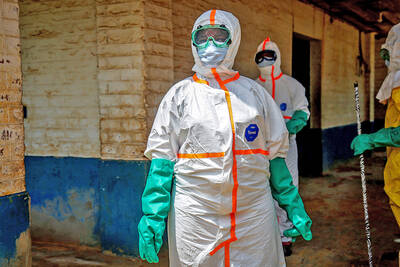
COMMUNITY CONFLICT: Concerns about disease spread from corpses has run up against friends and families’ desire to bury their dead as infection spreads in the area Angry residents of a town at the epicenter of the Ebola outbreak in the Democratic Republic of the Congo (DR Congo) attacked and burned a tent that was part of a health center where people are being treated for the virus, the staff there said Saturday. It was the second such attack in the region in a week. No one was hurt in the attack, according to reports but as patients ran out to escape the fire, 18 people with suspected Ebola infections fled the facility and are unaccounted for, a hospital director said. Angry residents arrived at the clinic in the

Forecasters in Europe yesterday warned of exceptional heat as record temperatures driven by a “heat dome” push temperatures well above seasonal norms across the continent. The surge follows a record-breaking Monday, with France logging its hottest day in the month of May on record, its weather agency said, and the UK also posting unprecedented highs. A so-called “heat dome” of warm air from northern Africa trapped under a high-pressure system over western Europe is behind the high temperatures not usually seen until high summer. Restrictions on outdoor work were imposed in parts of Italy, beaches in southwest France filled earlier than usual and


 RSS
RSS